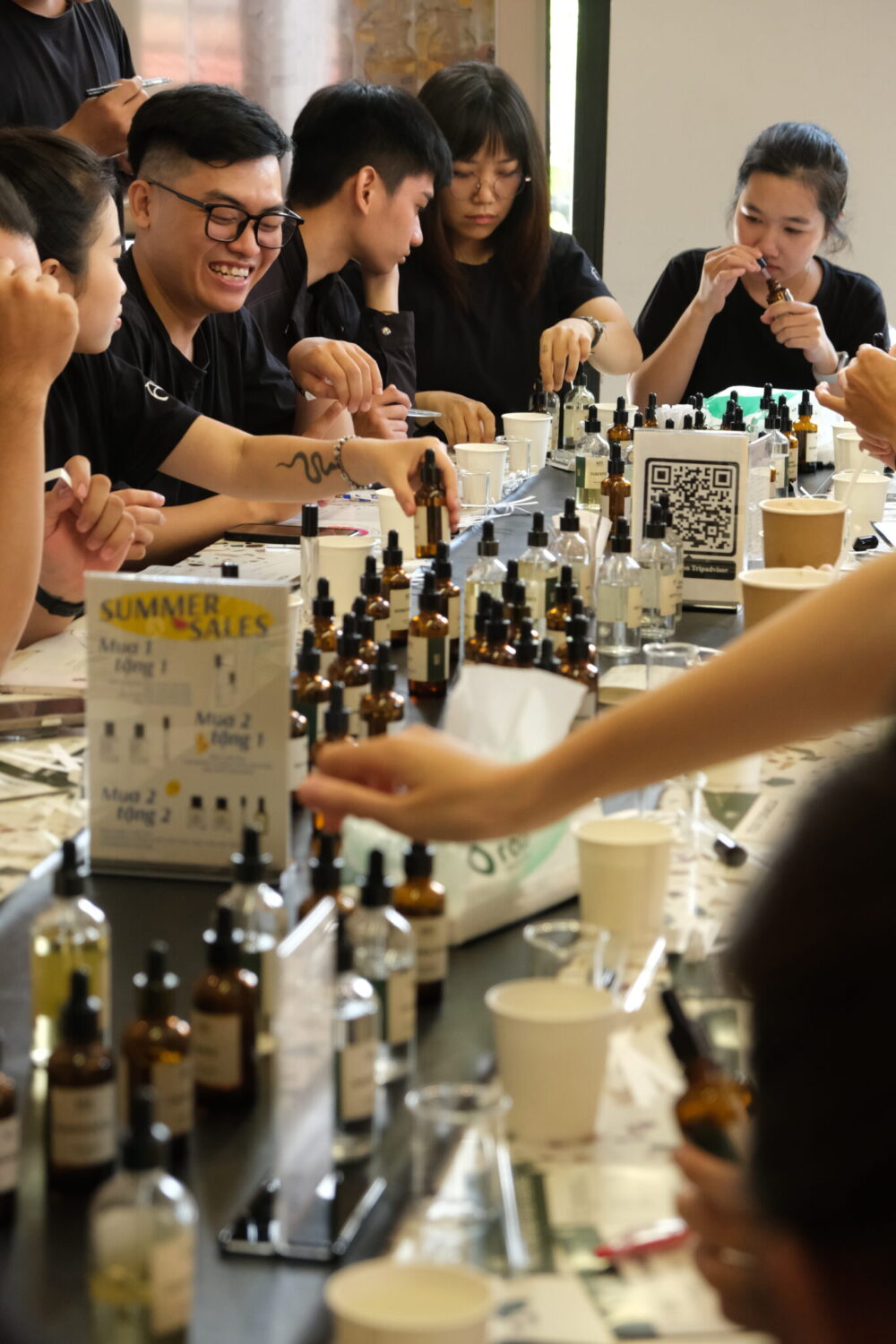
A perfume making workshop is a hands-on experience where you create your own custom fragrance from scratch — guided by a trained workshop instructor who teaches you how professional perfumers work. At NOTE – The Scent Lab in Ho Chi Minh City and Hanoi, Vietnam, the workshop takes 120 minutes, requires no experience, and you leave with a bottled perfume that’s uniquely yours.
If you’ve never heard of a perfume workshop before, you’re not alone. Five years ago, they barely existed outside Paris and Grasse. Today, they’re one of the fastest-growing categories of experiential travel — and Vietnam has become an unexpected hub, thanks to its rich aromatic heritage and a new generation of trained perfumers.
This guide explains everything: what happens, what you’ll learn, who it’s for, and why it’s become one of the most talked-about activities among travelers visiting Vietnam.
What Happens in a Perfume Workshop?
Every workshop follows a similar arc, though the details vary by studio. At NOTE – The Scent Lab, the experience breaks into five stages:
The elevator is famously unreliable. Most visitors take the stairs, and by the time they reach our floor, they’ve already discovered three cafes and a gallery they didn’t plan to visit.
1. Scent Education (15 minutes)
You learn the building blocks of perfumery: top notes (the first impression — citrus, herbs), heart notes (the character — florals, spices), and base notes (the lasting memory — woods, resins, musks). You’ll smell raw ingredients one by one and start to understand what draws you in.
2. Concept Design (15 minutes)
What story do you want your perfume to tell? A memory? A place? A feeling? Your workshop instructor helps you translate an abstract idea into a concrete fragrance direction. This is the creative heart of the workshop — and the part that makes every perfume different.
3. Blending (30 minutes)
Using professional-grade essential oils and aromatic compounds, you build your perfume drop by drop. Your workshop instructor guides proportions and suggests unexpected combinations, but every final decision is yours. This is the meditative, focused part — the room goes quiet, and you lose yourself in the process.
“I have visited an amazing place where I could create my own parfume. Helen explained us everything.”
4. Naming and Labeling (15 minutes)
You name your creation and write the label by hand. Some people name it after a place. Some after a person. Some after a feeling that only makes sense to them — which is exactly the point.
5. Bottling and Packaging (15 minutes)
Your perfume is sealed, packaged, and ready to carry. The formula is saved permanently — at NOTE, you can reorder anytime you return to Vietnam.
The Science Behind Scent: Why Perfume Triggers Memory
There’s a reason perfume workshops feel more meaningful than most creative activities. It comes down to neuroscience.
Smell is the only sense that bypasses the thalamus — the brain’s “relay station” — and connects directly to the limbic system, which controls emotion and memory. Specifically, scent signals travel to the olfactory bulb, which feeds directly into the hippocampus (memory formation) and the amygdala (emotional processing).
This is why a single whiff of sunscreen can transport you to a childhood beach trip. Why the smell of cinnamon triggers a specific December memory. Why your grandmother’s perfume, encountered on a stranger, can stop you in your tracks.
When you create a perfume during a trip to Vietnam, you’re essentially encoding your travel memories into a scent that will replay them — vividly, emotionally, involuntarily — every time you spray it. No other souvenir can do this. A photo requires you to look at it. A perfume ambushes you with memory when you least expect it.
The workshop amplifies this effect because you’re not just smelling — you’re choosing. Each ingredient decision is a conscious act of memory selection. “I want lemongrass because it smells like the street food stalls.” “I want patchouli because it reminds me of the rain on red earth.” By the time you’ve finished blending, your perfume contains a curated archive of your Vietnam experience.
Perfume Workshop vs DIY Perfume Kit: What’s the Difference?
With the rise of at-home fragrance experiences, you might wonder: why not just buy a DIY perfume kit online? Here’s an honest comparison:
| Factor | Perfume Workshop (in-studio) | DIY Perfume Kit (at home) |
|---|---|---|
| Guidance | with trained workshop instructor | Written instructions only |
| Ingredients | 50-100+ professional-grade materials | 8-15 pre-selected fragrance oils |
| Ingredient quality | Essential oils + aromatic compounds (same as industry) | Usually fragrance oils (synthetic blends) |
| Education | Deep — you learn why scents work together | Surface — you follow a recipe |
| Customization | Truly unique — infinite combinations | Limited by kit contents |
| Formula saved | Yes — reorder anytime (at NOTE) | No — once ingredients are gone, it’s gone |
| Memory connection | Strong — linked to a place, a person, a moment | Weak — made on your couch |
| Experience | Immersive — studio atmosphere, human connection | Functional — craft project |
| Duration | 120 minutes of focused creation | 30-60 minutes |
| Result quality | Wearable, lasting, professional | Variable — often too strong or unbalanced |
The bottom line: a DIY kit is a fun craft project. A workshop is an education, a creative experience, and a memory anchor. They serve different purposes — but if you’re in Vietnam, the workshop is worth it.
Who Is It For?
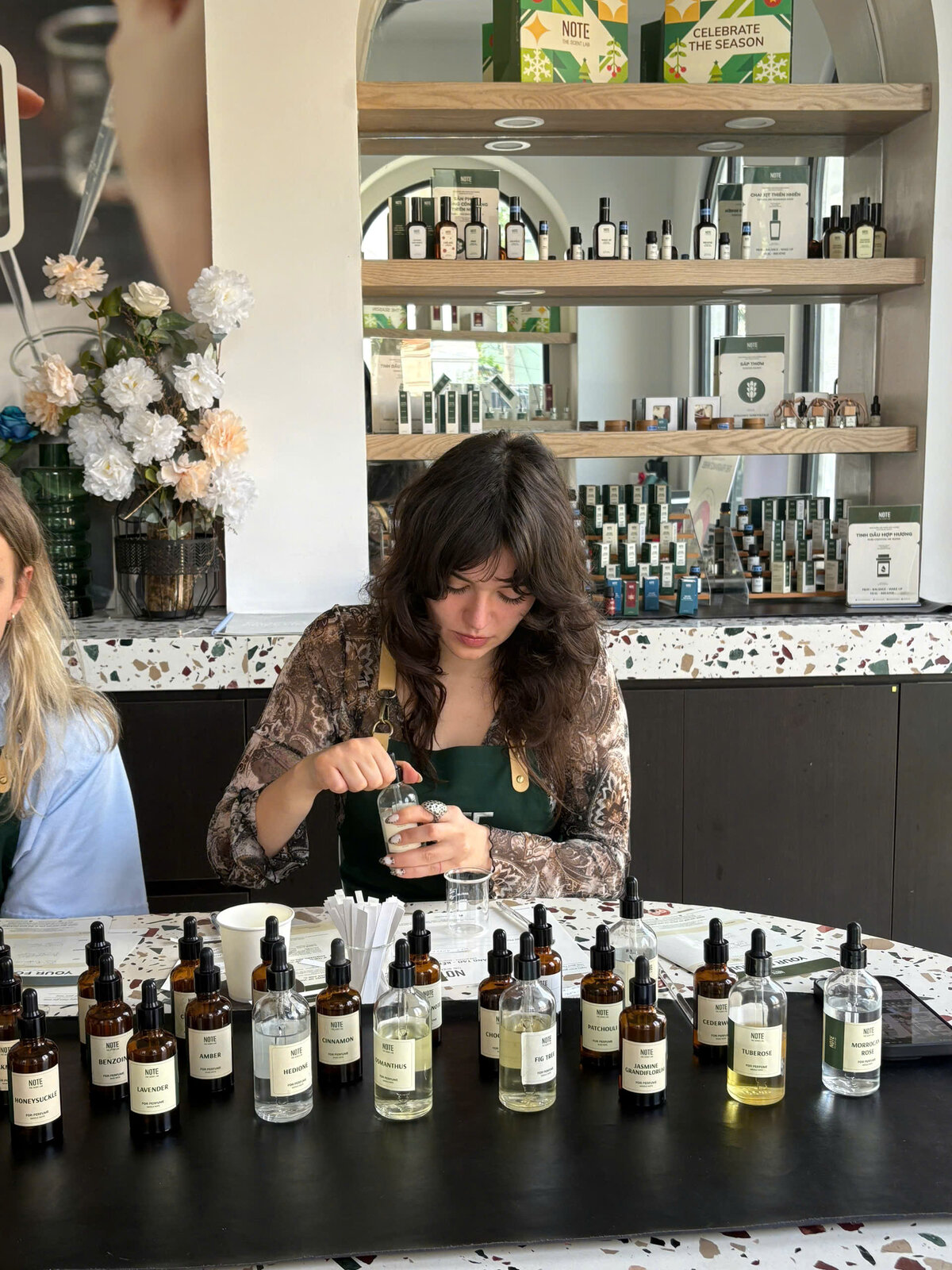
The short answer: everyone. The workshop is designed for complete beginners — you don’t need to know anything about perfumery.
- Travelers looking for a unique, hands-on experience beyond typical sightseeing
- Couples who want to create something personal together
- Solo travelers who want a meaningful, introspective activity
- Groups and families who want a creative shared experience
- Perfume enthusiasts who want to understand how fragrance is actually made
- Corporate teams looking for an alternative to standard team-building activities
“Vy took us through different layers of perfume and assisted throughout.”
A Closer Look: Who Is It Really For?
While the workshop welcomes everyone, different visitors get different things out of it. Here’s a deeper look at how each audience experiences the 120 minutes:
Travelers Looking for Something Different
You’ve done the museums. You’ve eaten the pho. You’ve walked the walking streets. The perfume workshop appeals to travelers who want to create something during their trip, not just consume it. It fills a gap that most itineraries ignore: the desire to make something with your hands, learn a new skill, and take home a result that’s genuinely personal. If you’ve ever felt that travel can be passive — looking at things, eating things, photographing things — this is the antidote. You’re an active participant, not a spectator.
Couples on a Date or Anniversary Trip
The workshop is naturally romantic without being cheesy. You’re sitting side by side, creating something personal, sharing discoveries (“smell this one — it’s incredible”), and learning about each other’s preferences in real time. The most popular couple format is creating perfumes for each other — which requires paying attention to what your partner likes, a form of active care that deepens connection. Many couples call it the most meaningful activity of their trip together — more intimate than a dinner, more memorable than a sunset.
Solo Travelers Seeking Introspection
Solo travel can be exhilarating but also relentless. The workshop offers something rare: a quiet, focused hour and a half where you sit in one place, work with your hands, and reflect. Your workshop instructor is a companion, not a crowd. The perfume you create becomes a deeply personal artifact — encoding not just travel memories but whatever you were thinking and feeling that day. Many solo reviewers describe it as one of the most grounding experiences of their entire trip.
Perfume Enthusiasts Who Want to Go Deeper
If you already love fragrance, the workshop offers something you can’t get at a department store counter: the chance to build a scent from raw ingredients, understand proportions, and work with a trained professional who can explain why certain combinations work. You’ll explore ingredients you may never have smelled in isolation, from bright florals like jasmine and osmanthus to warm base notes like sandalwood, benzoin and oakmoss. Even experienced fragrance lovers consistently report learning something new. The workshop instructors at NOTE have formal training and can engage at whatever depth your curiosity demands.
Groups and Families
Group dynamics shift during the workshop in an interesting way. The first 15 minutes are social — everyone’s smelling, reacting, laughing together. Then the blending phase arrives and each person enters their own creative zone. The final phase is social again — comparing results, sharing stories about why you chose certain ingredients. This rhythm of togetherness-and-solitude-and-togetherness creates a richer group experience than activities that are purely collective (like a group dinner) or purely individual.
What Makes Vietnam Special
for Perfume Workshops?
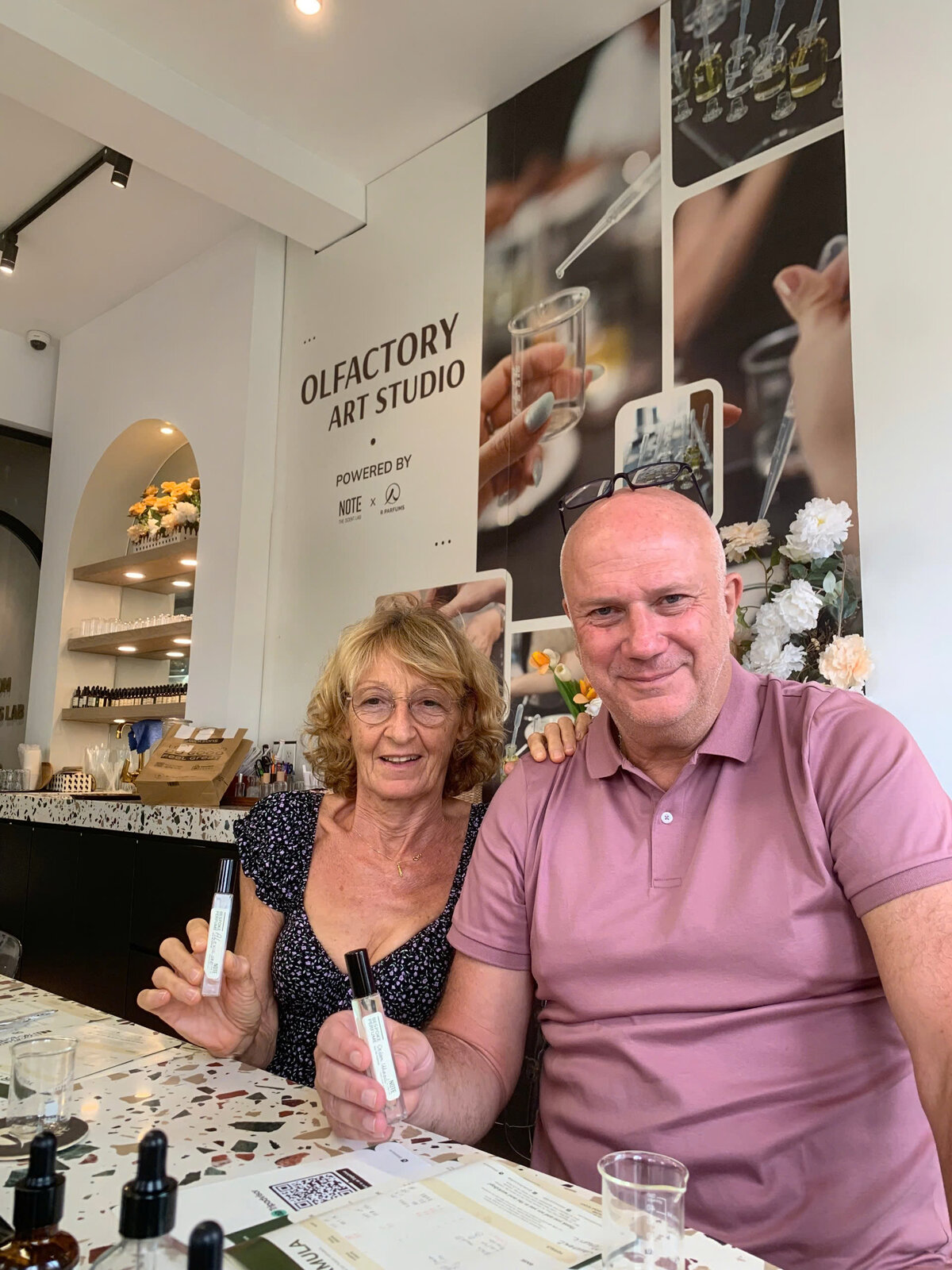
Vietnam has a deep, often overlooked aromatic heritage. The country produces some of the world’s finest raw materials for perfumery:
- Vietnamese vetiver — earthy, smoky, from the Central Highlands
- Lotus — Vietnam’s national flower, delicate and rare in perfumery
- Cinnamon — from ancient forests in the northern provinces
- Lemongrass — sharp, clean, ubiquitous in Vietnamese cuisine and aromatherapy
- Agarwood (oud) — Vietnam is one of the world’s primary sources of this precious ingredient
When you compose a perfume in Vietnam, the sense of place shapes the experience, a scent you build by hand in Saigon or Hanoi. That feeling of where you are becomes part of your creation in a way that wouldn’t be possible in a studio in London or New York.
The Ingredient Stories
Each Vietnamese ingredient carries a story that your workshop instructor shares during the workshop:
- Lotus: Harvested from ponds in the Mekong Delta and around Hanoi’s West Lake. In Vietnamese culture, the lotus symbolizes purity — it grows from mud but blooms untouched. In perfumery, lotus absolute is extraordinarily expensive because of the extraction difficulty. It remains one of Asia’s most culturally significant aromatics.
- Agarwood: Vietnam’s Central Highlands produce some of the world’s finest agarwood. The resin forms when Aquilaria trees are infected by a specific mold — a natural alchemy that takes decades. Vietnamese oud has a distinctive sweet, woody complexity that differs from Middle Eastern or Indian varieties. It remains one of the most prized and storied aromatics in the world.
- Cinnamon: Vietnamese cinnamon (Saigon cinnamon) has the highest cinnamaldehyde content of any cinnamon variety — meaning it’s the most intensely aromatic. The forests in northern Vietnam have been cultivating it for centuries. On the palette, cinnamon brings a warm, spicy note without heaviness.
How Much Does a Perfume Workshop Cost?
Pricing varies by location and package. At NOTE – The Scent Lab, all materials are included — no hidden costs. The experience typically costs less than a single bottle of niche perfume from a department store, and you leave with something no department store can offer: a fragrance that’s entirely yours.
Check current pricing here.
How to Choose a Perfume Workshop
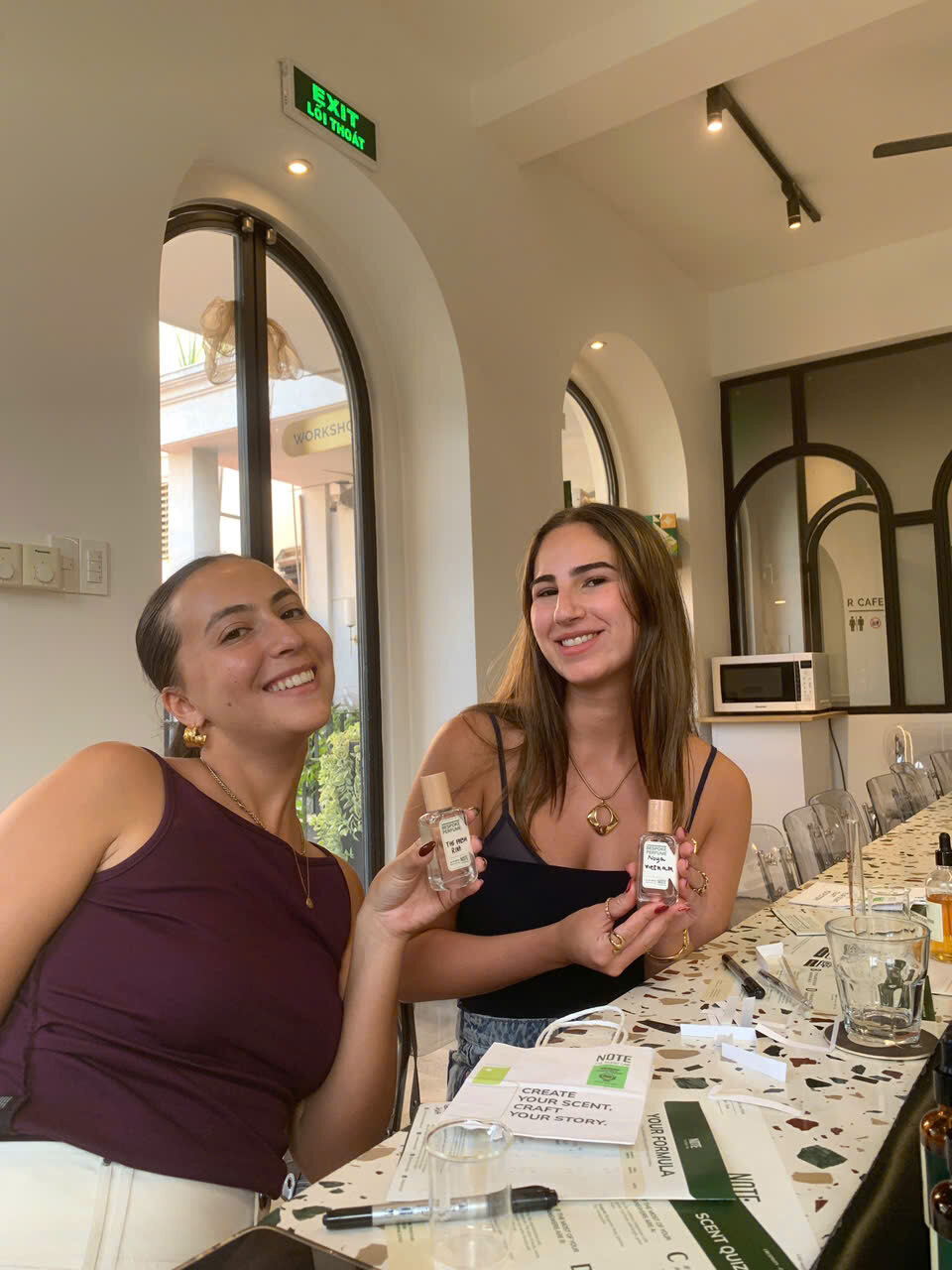
If you’re comparing options, here’s what to look for:
- Trained workshop instructors: Not just volunteers or salespeople. Look for studios where guides have formal fragrance training.
- Quality ingredients: Professional-grade essential oils and aromatic compounds — not fragrance oils from a craft store.
- Formula saved: A good workshop saves your formula so you can reorder. If they don’t, you can never recreate what you made.
- Reviews: Check TripAdvisor, Google, and online booking platform. Look for consistency — not just star ratings, but what people say about the staff and the experience.
- Duration: 60-120 minutes minimum. Anything under 45 minutes is likely a simplified experience.
At NOTE – The Scent Lab: trained workshop instructors, professional ingredients, formula saved permanently, 4.9 stars from , 120-minute sessions.
What Travelers Say
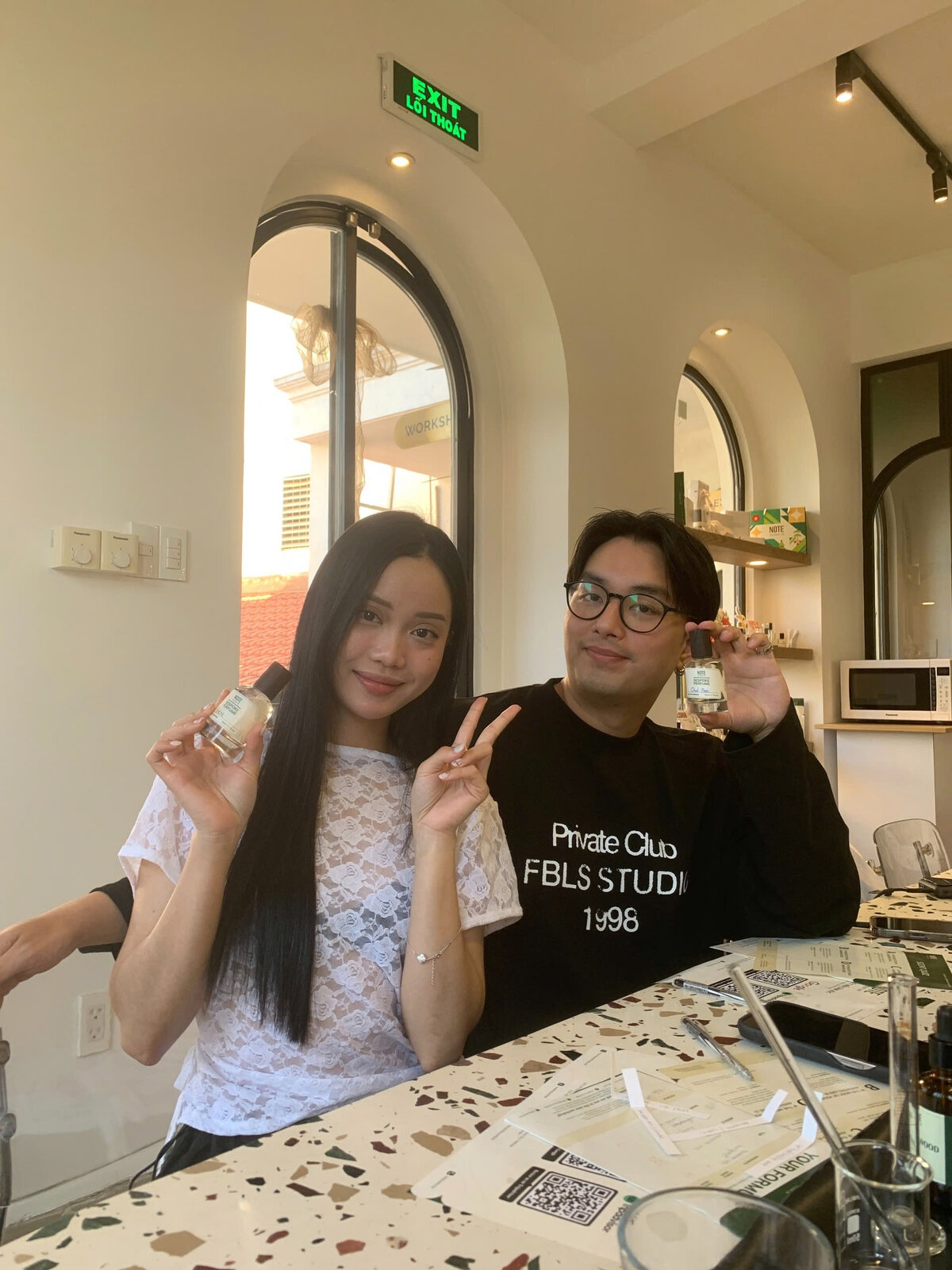
“Great experience, learnt a lot about scents. Sarah was friendly, patient and engaging.”
Ready to try it?
Create your own perfume in 120 minutes at NOTE – The Scent Lab. 3 locations in Saigon and Hanoi.
Thao Dien · Cafe Apartment ·.9★
Not traveling to Vietnam? Browse NOTE’s ready-made perfume collection, composed from the same palette of florals, spice and woods. Looking for a gift? Check out our perfume gift sets.
Find us: TripAdvisor · Instagram · Facebook
Related Reading
- The 120-minute experience: what reveal
- Last day in Vietnam — perfume workshop experience
- Beyond coffee at the Cafe Apartment — hidden gems
- Why a custom perfume is the best Vietnam souvenir
Further reading: International Fragrance Association (IFRA) | Wikipedia — Perfume
Related Articles
- The 90-Minute Workshop Experience
- Best Craft Workshops Hcmc
- First-Time Vietnam Checklist
- Perfume Workshop for Beginners — What to Expect
- Complete Guide to Perfume Workshops in Vietnam
- Your Last Day in Vietnam — Perfume Workshop
How to find us at 42 Nguyen Hue (Cafe Apartment, 2nd floor):
Frequently Asked Questions
What is a perfume making workshop?
A hands-on experience where you create a custom fragrance from scratch, guided by a trained workshop instructor. You learn about fragrance notes, blend your own perfume, name it, and take it home in a bottle. No experience needed.
How long does a perfume workshop take?
At NOTE – The Scent Lab, the workshop takes 120 minutes. Some studios offer shorter sessions (45-60 min) but these are typically simplified versions.
What is the difference between a perfume workshop and a DIY kit?
A workshop provides guidance from a workshop instructor from a trained workshop instructor, 50-100+ professional ingredients, real education about fragrance theory, and a formula saved for reordering. A DIY kit gives you 8-15 fragrance oils with written instructions. The workshop produces a significantly better perfume and a richer experience.
Do I need experience to join?
No. The workshop is designed for complete beginners. Your workshop instructor teaches you everything — from understanding notes to blending and bottling.
Where can I do a perfume workshop in Vietnam?
NOTE – The Scent Lab has three locations: two in Ho Chi Minh City (Thao Dien and the Cafe Apartment at 42 Nguyen Hue) and one in Hanoi (. Book online.
Is a perfume workshop worth it?
Based on five-star reviews, travelers consistently rank it as one of their favorite Vietnam experiences. You leave with a unique souvenir, new knowledge about fragrance, and a memory of creating something personal. Read what travelers say.
Can I make perfume as a gift?
Yes — many visitors make two bottles: one for themselves and one to give. You can also create a perfume specifically designed for someone else.
What if I don’t like the perfume I make?
This is extremely rare — your workshop instructor guides you through every step, helping you smell and adjust your blend before finalizing. You test your perfume multiple times during the blending phase, and adjustments are made until you’re happy with the result. In the unlikely event you’re not satisfied, the workshop instructor can help you modify the blend. The collaborative nature of the process means you’re never left alone with a result you don’t enjoy — that’s the whole point of having a trained professional by your side rather than following a kit at home.
Find NOTE – The Scent Lab
- 42 Nguyễn Huệ (2nd floor, Cafe Apartment) — Google Maps → · TripAdvisor
- 34 Nguyễn Duy Hiệu (Thảo Điền) — Google Maps → · TripAdvisor
How to find us:
- 📍 42 Nguyễn Huệ — Watch direction video on TikTok →
- 📍 34 Nguyễn Duy Hiệu — Watch direction video on YouTube →
- 📍 — Watch direction video on YouTube →