
What does Saigon smell like? NOTE – The Scent Lab is a perfume workshop in Ho Chi Minh City, Vietnam (rated 4.9 by ) — and as a Saigon perfume workshop, we’ve spent years mapping the invisible scent landscape of this city. Saigon smells like jasmine garlands on a motorcycle dashboard, like pho broth rising through a sidewalk grate at 5 a.m., like rain hitting hot concrete in the seconds before a downpour. It smells like a city that never stops moving — and every district has its own olfactory signature.
Close your eyes on the back of a xe om at dawn. Exhaust fumes layer over ripe jackfruit from a street cart. Then jasmine — sudden, sweet, almost aggressive — from a temple offering someone carries past. Then roasted coffee, dark and bitter, from an open shopfront where an old man works a phin filter in silence. That is Saigon’s perfume. Not one scent, but hundreds, layered and shifting block by block, hour by hour.
This is a scent map. For the northern companion piece, see scents of Hanoi: lotus, tea, and pho. A guide to smelling a city that most visitors only see. We wrote it because nobody else can — we’re perfumers, this is what we do, and Saigon is where we live.
District 1: Where Coffee Meets Jasmine Meets Chaos
District 1 is where most travelers begin, and its scent profile hits you before your feet touch the pavement. Step out of a taxi on Nguyen Hue Walking Street and the first thing you’ll register is roasted coffee — not the gentle pour-over scent of a specialty cafe, but the deep, almost burnt caramel of Vietnamese robusta being brewed curbside in metal phin filters, sweetened with condensed milk.
Walk deeper. The coffee yields to pho. Not the taste — the smell. Star anise, cinnamon bark, charred ginger, and hours of slow-simmered beef bone broth creating a savory cloud that drifts from shop fronts where bowls are assembled with surgical precision at 6 a.m. In perfumery terms, pho broth is a warm spicy oriental: anise as the top note, cinnamon as the heart, bone marrow richness as the base. It would make a stunning candle.
Then the florals arrive. Jasmine garlands at the Mariamman Temple on Truong Dinh street. Lotus buds wrapped in newspaper at flower stalls near Ben Thanh. The green, waxy sweetness of champaca flowers that vendors thread into bracelets for offerings. These are the same flowers Vietnamese perfumery has drawn from for centuries — and they smell different here than anywhere else. Fresher. More alive. Still warm from the sun.
We work from the Cafe Apartment at 42 Nguyen Hue. Discover more of the city’s secrets in our hidden gems of Saigon guide, District 1. From our studio on the 2nd floor, we smell all of it — the coffee below, the incense from the building’s small shrine, and sometimes, on clear evenings, frangipani from the trees lining the boulevard. This is not background. This is our classroom.
“I have a beautiful souvenir to take home and every time I smell it, I will remember Saigon. Thanh was an excellent teacher.”
Ben Thanh Market: A Spice Bazaar for the Nose
If District 1’s sidewalks are an accidental perfume, Ben Thanh Market is deliberate — a concentrated explosion of scent that hits you three meters before the entrance. The market has existed since the early 1900s, and its olfactory identity is as layered as its history.
First: dried herbs and spices. Vietnamese cinnamon (cassia) — sweeter and more intense than its Sri Lankan cousin — stacked in bark rolls. Star anise in paper bags. Dried lemongrass bundles, pale gold and fibrous, releasing their citral-heavy fragrance when crushed between fingers. Black pepper from Phu Quoc. These are not decorative. These are working ingredients. Our Vietnam scent journey north to south traces these aromatic connections across the country. The same cinnamon we use in our workshop, bottled and blended by hand.
Deeper in: tropical fruit. Durian’s sulfurous, custard-thick aroma commands its own corner — love it or run from it, you cannot ignore it. Mangosteen has a delicate, almost floral sweetness. Dragon fruit is subtler — green, vegetal, like crushed leaves. Jackfruit is the loudest of all: bubblegum meets banana meets something entirely tropical that has no Western equivalent.
And underneath everything, the base note of the market: dried shrimp, fish sauce in vats, fermented soy. Umami made airborne. It anchors the brighter notes above it, exactly the way a base note anchors a perfume — you might not notice it consciously, but remove it and everything else would float away.
District 3: Incense, Baguettes, and Colonial Ghosts
District 3 is quieter. Its scent is older, more refined, and carries echoes of another era.
The pagodas here — Vinh Nghiem, Xa Loi — burn incense that fills entire blocks. Not the thin, sweet incense of Western yoga studios. Vietnamese temple incense is woody and complex: agarwood (tram huong), sandalwood, and dried herbs pressed into thick coils that hang from ceilings and burn for days. The smoke is simultaneously sacred and earthy. It clings to your clothes. Hours later, you’ll catch a thread of it on your sleeve and be transported back to the dim interior, the gold leaf, the quiet.
Agarwood — tram huong — is Vietnam’s most precious aromatic material. Produced when Aquilaria trees are infected with a specific mold, it creates a resin so valued that high-grade pieces sell for more than gold by weight. In perfumery, it’s a base note of extraordinary depth: smoky, leathery, slightly animalic, with a sweetness that emerges slowly over hours. In our workshop you blend from a palette of florals, warm spice and woods, and smelling each raw material before blending is one of the moments visitors remember most.
Two blocks from the pagoda smoke, a different tradition breathes. French colonial-era bakeries — not the trendy, Instagram-ready kind, but the old ones with cracked tile floors — push the scent of butter croissants and fresh baguettes into the morning air. Flour, caramelizing sugar, yeast. It’s the scent of a city that absorbed French culture and made it its own. Vietnam’s baguettes are lighter, crispier, made with rice flour — and they smell subtly different. Closer to popcorn than butter.
Thao Dien: Frangipani and the New Saigon
Cross the Saigon River into Thao Dien and the air changes. The density drops. The greenery multiplies. And the dominant scent shifts from street food and exhaust to something softer: frangipani.
Frangipani trees line the residential streets of Thao Dien, dropping cream-and-yellow flowers onto sidewalks and into swimming pools. Their scent is rich, creamy, and slightly tropical — like coconut and vanilla had a child that grew up in the sun. It’s one of Southeast Asia’s defining fragrances, and in Thao Dien, it’s everywhere from March through October.
The neighborhood’s expat community has layered its own aromatic identity: international bakeries producing sourdough and rye bread, spa treatment rooms diffusing eucalyptus and lemongrass oils, brunch spots where avocado toast meets Vietnamese coffee. It’s a fusion scent — East and West negotiating in real time.
Our Thao Dien studio at 34 Nguyen Duy Hieu sits among this. When guests arrive for the perfume workshop, they’ve already been primed — by the frangipani outside, by the lemongrass in the air, by a city that has been quietly training their nose without them knowing.
Book Your Perfume Workshop in Saigon →
District 5 (Cholon): Sandalwood, Herbal Medicine, and Roasted Duck
Cholon — Saigon’s Chinatown — is the most aromatically intense neighborhood in the city. It is also the oldest, and its scents carry the weight of centuries of Chinese-Vietnamese exchange.
Start at Binh Tay Market. The herbal medicine stalls occupy an entire wing: dried goji berries, astragalus root, chrysanthemum flowers, ginseng slices. The combined scent is dusty, woody, and faintly sweet — like opening a very old book in a very old library. Each ingredient has been dried and preserved using methods unchanged for generations. The smell is tradition made physical.
Outside, the roasted duck and char siu shops work their magic. The glaze — maltose, five-spice powder, soy sauce — caramelizes in wood-fired ovens, creating a smoky-sweet aroma that can pull you across a street against your will. Five-spice powder itself is a perfumer’s dream: star anise, cloves, Chinese cinnamon, Sichuan pepper, and fennel seeds. It’s warm, complex, and impossible to mistake.
The temple incense in Cholon is different from District 3. Thien Hau Pagoda burns massive coils of sandalwood-heavy incense that create a visible haze inside the temple. Sandalwood is one of perfumery’s great base notes — creamy, warm, slightly milky. Combined with the smoke from joss paper and the lingering sweetness of offering fruit, it creates an atmosphere you can almost chew.
Saigon River at Dusk: Petrichor and Night-Blooming Jasmine
The river changes everything. As afternoon rain clouds build over Thu Thiem, the air pressure drops and Saigon’s scent profile shifts dramatically.
Then the rain comes. And with it, petrichor — the smell of rain on hot earth, caused by a compound called geosmin released by soil bacteria when water hits dry ground. In Saigon, petrichor mixes with wet concrete, gasoline residue on asphalt, and the green, chlorophyll-rich scent of tropical vegetation drinking deeply. It’s the city exhaling.
After the rain stops, usually around 6 p.m., the night-blooming flowers begin. Jasmine intensifies in the cooling air. Ylang-ylang trees near the river release their heavy, almost narcotic sweetness — the same ylang-ylang that Chanel uses in No. 5, growing wild along Vietnamese waterways. And somewhere in the darkness, a tuberose pushes its scent into the humid night with an intensity that borders on aggressive. These flowers evolved to attract nocturnal pollinators, so they broadcast at maximum volume when the sun goes down.
Stand on the Bach Dang waterfront at 7 p.m. after a rain shower. The river water — silty, mineral, faintly metallic — rises to meet the falling jasmine. Somewhere behind you, a banh mi cart adds grill smoke and pickled daikon. This is the scent of Saigon at its most itself: water and flowers and food and rain and twenty million people living at full volume.
“This perfume will always remind us of this trip in Vietnam.”
Vietnamese Fragrance Ingredients: The Building Blocks of Saigon’s Scent
Every city smells the way it does because of the raw materials that grow there, are cooked there, are burned there. Saigon’s scent DNA comes from ingredients that Vietnamese culture has drawn on for generations, in its teas, kitchens, temples and flower stalls.
We watch the light shift across the worktables every afternoon — golden at 3pm, amber by 5, and by evening the street musicians start below.
- Lotus (sen) — Vietnam’s national flower. Its scent is delicate, aquatic, and slightly powdery. Lotus tea is made by placing green tea leaves inside lotus blossoms overnight, letting the fragrance infuse naturally. It has been part of Vietnamese tea and ritual for centuries.
- Agarwood (tram huong) — The resin of infected Aquilaria trees, harvested primarily in central Vietnam. Deep, smoky, leathery, almost spiritual. It remains Vietnam’s most treasured incense wood.
- Jasmine (hoa lai) — Grown throughout southern Vietnam. Warmer and more indolic than European jasmine — richer, almost creamy. Used in garlands, teas, and perfumery.
- Lemongrass (sa) — Ubiquitous in Vietnamese cooking and traditional medicine. Bright, citrusy, slightly peppery. A top note that says “Vietnam” instantly.
- Vietnamese cinnamon (que) — Cassia bark from northern Vietnam. Sweeter, more intense, and higher in cinnamaldehyde than true cinnamon. A warm heart note.
These scents aren’t confined to a workshop, they live on every street in Saigon. You can explore our full ingredient library online, but nothing compares to smelling them raw in the studio. Learning to recognize them in the wild, then using them to build a perfume, is what makes the workshop feel less like a craft activity and more like a translation exercise: turning a city into a bottle.
Why Scent Is the Best Souvenir from Vietnam
Photographs capture what you saw. Journals capture what you thought. But neither captures what a place smelled like — and smell is the sense most directly wired to memory and emotion.
Neuroscientists call it the Proust Effect: a scent encountered years later can involuntarily trigger a vivid, emotionally charged memory of the place where you first smelled it. A fridge magnet from Ben Thanh Market will never do this. A custom perfume you blend by hand from florals, warm spice and woods while sitting in a Saigon studio will do it every single time you spray it.
This is what our perfume workshop is designed to do. You’re not just making a fragrance. You’re bottling the way Saigon smelled to you — the coffee, the rain, the jasmine at dusk. Your formula is saved permanently at NOTE, so you can reorder from anywhere in the world when the bottle runs out and the memories need refreshing.
“A must visit in Saigon! Cam and Uni taught and guided us through the entire workshop.”
How to Smell Saigon Like a Perfumer
Most people experience a city through sight. Perfumers experience it through scent. Here’s how to train your nose on Saigon’s streets:
- Slow down. Scent requires stillness. Stand on a corner for 60 seconds. Breathe through your nose. Name three things you can smell. This alone transforms a walk into a sensory expedition.
- Layer by layer. Identify the top note (the first thing you smell — often food or exhaust), the heart note (what emerges after 30 seconds — flowers, spices, wood smoke), and the base note (the ambient constant — river water, warm concrete, humidity itself).
- Time of day matters. Morning Saigon smells like coffee and pho. Afternoon smells like rain. Evening smells like flowers and grilled meat. The same street at 6 a.m. and 6 p.m. is olfactorily unrecognizable.
- Follow your nose. If something smells extraordinary, walk toward it. Saigon rewards the curious. The best scent moments are unplanned — a woman carrying a basket of tuberose past a coffee shop, creating a two-second collision of aromas you’ll never experience again.
We run these same exercises in our workshop. Before you blend, you learn to smell. Before you create, you learn to notice. The city is the textbook.
Bottle Your Saigon: Where Scent Map Meets Workshop
You’ve walked the scent map. You’ve smelled the jasmine, the cinnamon, the rain on hot concrete. Now the question becomes: can you keep it?
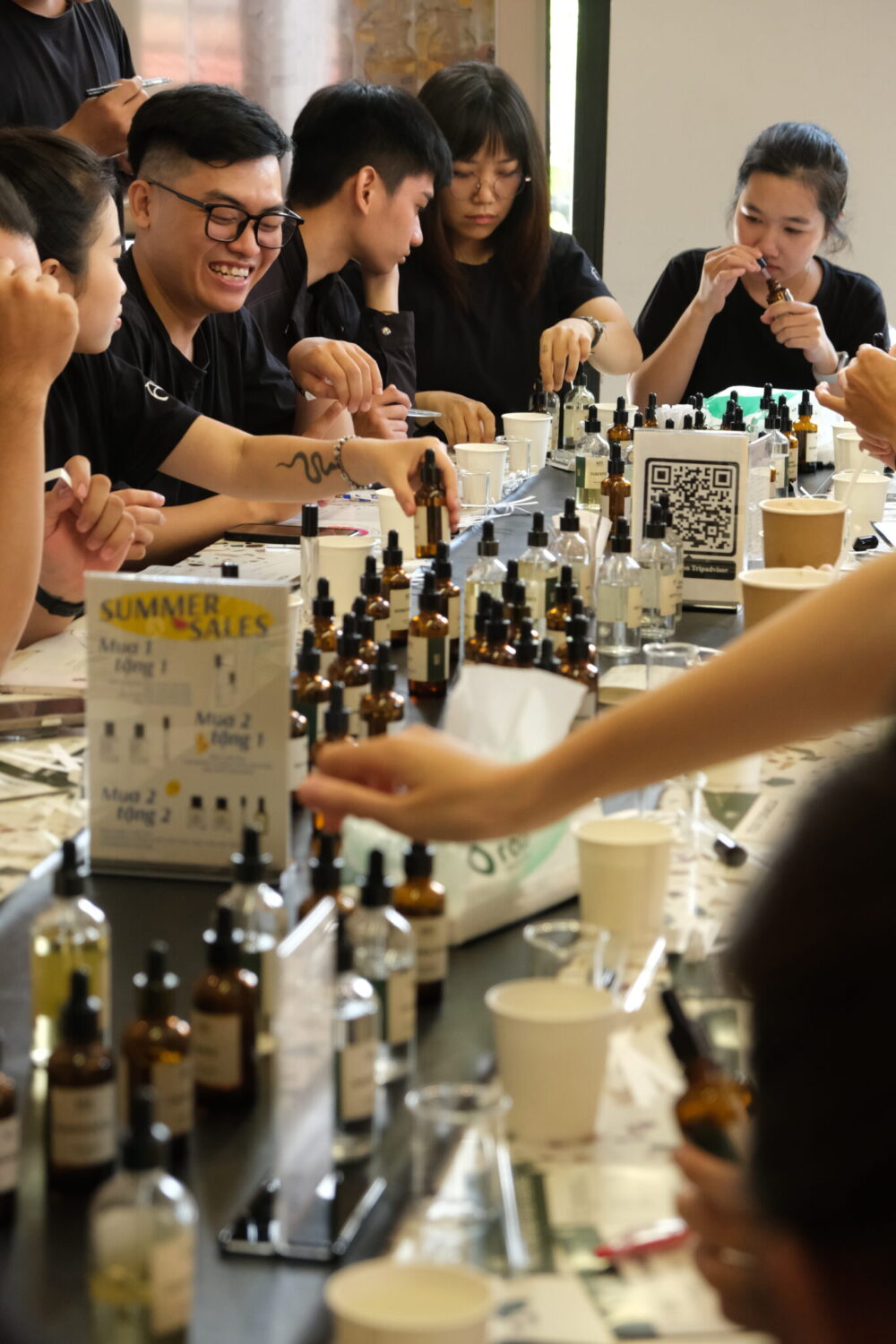
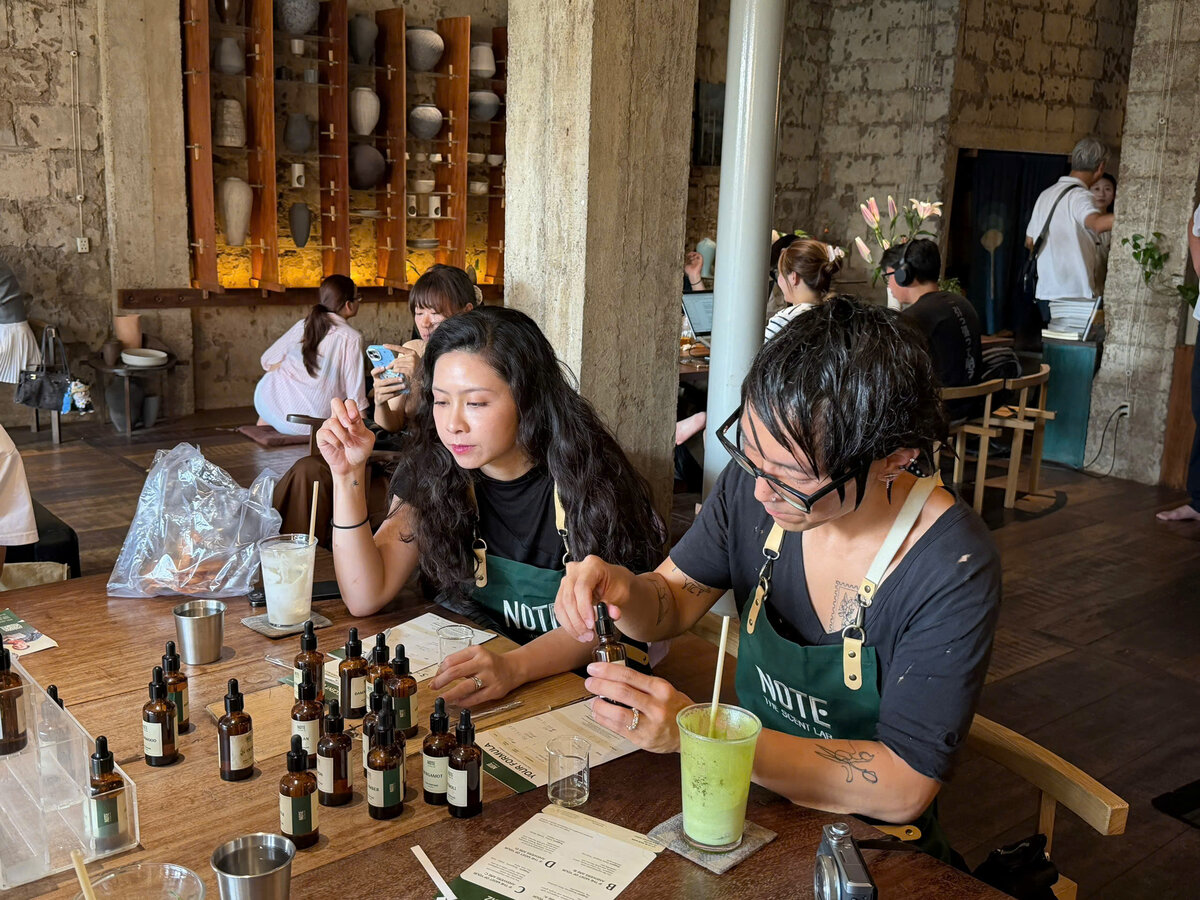
At NOTE – The Scent Lab, the answer is yes. Our 120-minute perfume workshop gives you access to more than 30 professional-grade ingredients, from jasmine, rose and osmanthus to warm cinnamon and sandalwood, and a trained workshop instructor who helps you translate your Saigon experience into a wearable fragrance.
Two locations in Ho Chi Minh City — the Cafe Apartment at 42 Nguyen Hue (District 1) and R Space at 34 Nguyen Duy Hieu (Thao Dien), where you can also discover R Parfums‘ finished fragrances capturing Saigon’s signature scents — plus a studio. Walk-ins are welcome, but booking ahead is recommended during peak season.
You leave with a custom EDP perfume bottle, a formula card with your exact recipe, and a scent that will — every time you wear it — take you back to a Saigon sidewalk at dusk, jasmine in the air, the river rising, the city alive. Follow us at @note.workshop on Instagram for daily scent stories from our studios.
Create Your Saigon Scent — Book Now →
Follow @note.workshop on Instagram for daily scent stories and behind-the-scenes moments.
Frequently Asked Questions
What does Ho Chi Minh City smell like?
Ho Chi Minh City — Saigon — smells like roasted coffee, pho broth with star anise and cinnamon, jasmine garlands, temple incense, tropical fruit, and rain on hot concrete. Each district has a distinct scent profile, from the spice-heavy Ben Thanh Market to the frangipani-lined streets of Thao Dien.
Where can I experience Vietnamese scents in a workshop?
NOTE – The Scent Lab offers 120-minute perfume workshops in Ho Chi Minh City (42 Nguyen Hue, District 1 and 34 Nguyen Duy Hieu, Thao Dien) and Hanoi (. You create a custom perfume from a palette of florals, warm spice and woods. Rated 4.9 by.
What are traditional Vietnamese fragrance ingredients?
Traditional Vietnamese fragrance ingredients include lotus (sen), agarwood or tram huong, jasmine (hoa lai), lemongrass (sa), and Vietnamese cinnamon (que/cassia). These have been used in Vietnamese culture for centuries in teas, temple offerings, traditional medicine, and perfumery.
Is there a perfume workshop in Saigon that uses local ingredients?
Yes. NOTE – The Scent Lab in Ho Chi Minh City offers a palette of more than 30 professional-grade ingredients, from jasmine, rose and osmanthus to cinnamon and sandalwood. The workshop takes 120 minutes, requires no experience, and you leave with a custom perfume bottle.
Why is scent the best souvenir from Vietnam?
Scent is the only sense directly connected to the brain’s memory and emotion centers. A custom perfume you blend by hand in a Saigon studio triggers vivid travel memories every time you wear it — a phenomenon neuroscientists call the Proust Effect. Unlike a photo or a fridge magnet, a scent souvenir is involuntary and emotionally charged.
How much does a perfume workshop cost in Ho Chi Minh City?
Perfume workshops at NOTE – The Scent Lab start from VND 690,000 (approximately USD 27) for a 120-minute session. The price includes all materials, guidance from a trained workshop instructor, and a custom EDP perfume bottle to take home. Book online at workshop.thescentnote.com for availability in 2026.
Practical info: perfume workshop price
Practical info: view all locations →