
District 1 Saigon guide: a walking route from Ben Thanh Market to Nguyen Hue Walking Street covers the best of Ho Chi Minh City’s historic heart in one morning — and ends at one of the city’s most unexpected creative experiences. NOTE – The Scent Lab is a perfume workshop on the 2nd floor of the Cafe Apartment building at 42 Nguyen Hue, District 1, HCMC (rated by visitors on TripAdvisor and Google).
The air hits you before the sights do. Step out of your hotel anywhere in District 1 and the first thing you register is warmth — thick, layered, carrying the green sweetness of jackfruit from a cart, the roasted bitterness of ca phe from a sidewalk stall, the faint mineral dampness of old French plaster drying in the sun. This is a neighborhood you navigate by nose as much as by map.
This walking guide takes you through a two-kilometer route from Ben Thanh Market to the Cafe Apartment building on Nguyen Hue — roughly 120 minutes of walking, with stops. Add another 120 minutes if you end at the perfume workshop. By then, you’ll have walked through the best of colonial Saigon, the busiest pedestrian boulevard in Vietnam, and a creative experience that lets you bottle everything you just absorbed.
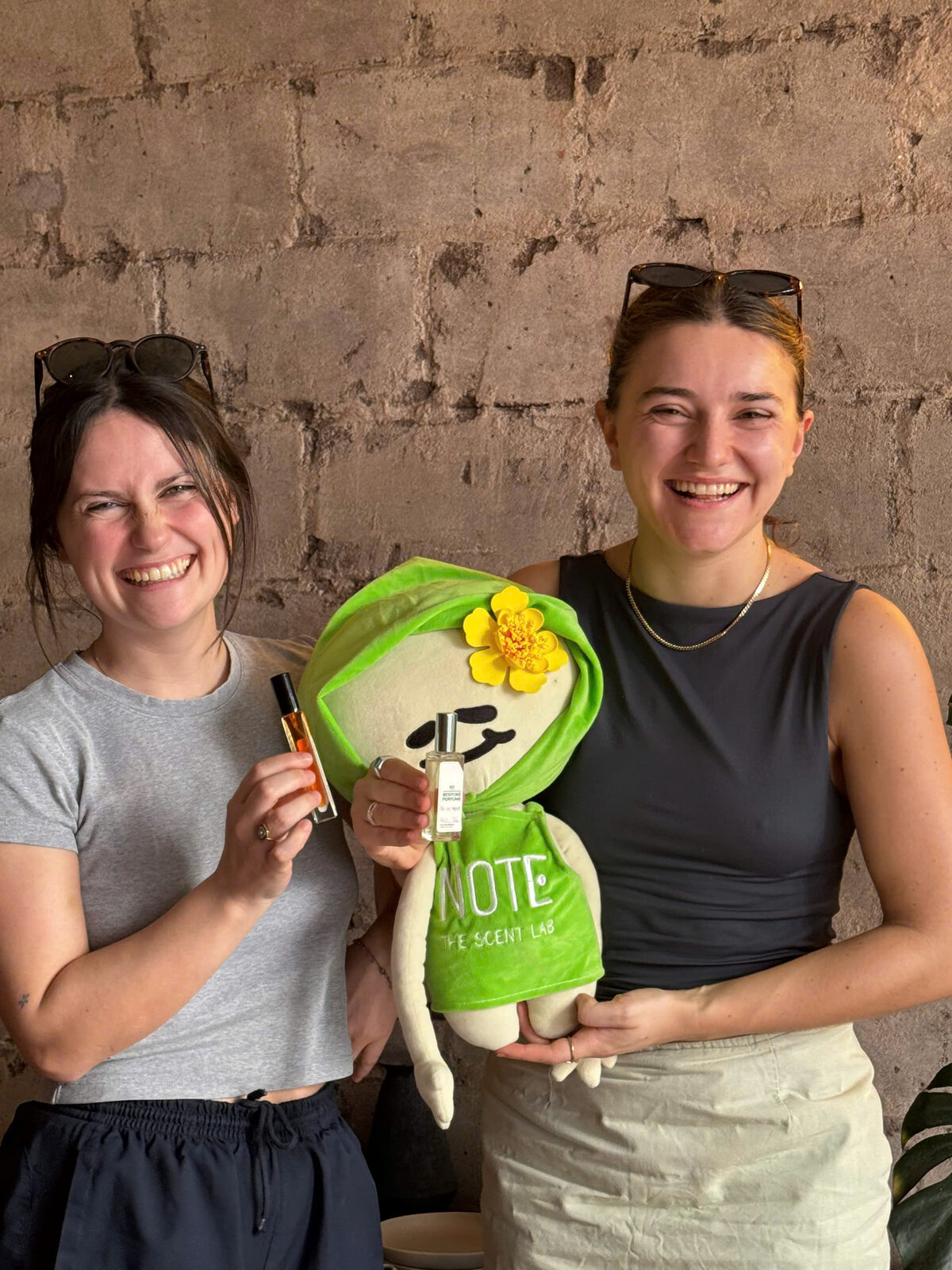
District 1 Walking Route: Ben Thanh to Nguyen Hue
The full route covers about 2.2 kilometers. You can walk it in 30 minutes without stopping, but nobody does. Allow 120 minutes to two hours, depending on how many coffee breaks you take (in Saigon, the answer is always “one more”).
Here’s the route, stop by stop:
Route overview: Ben Thanh Market → Le Loi Boulevard → Saigon Opera House → Dong Khoi Street → Book Street → Nguyen Hue Walking Street → Cafe Apartment (42 Nguyen Hue) → NOTE – The Scent Lab (2nd floor)
Stop 1: Ben Thanh Market — Where Every Saigon Trip Begins
Start at the roundabout in front of Ben Thanh Market. The market has been here since 1914, and the clock tower entrance is one of the most photographed landmarks in Ho Chi Minh City. Even if you’ve seen a hundred photos, standing in front of it at 8am — when the vendors are still setting up and the heat hasn’t peaked — feels different.
Inside, the ground floor is a maze of dried goods, textiles, and food stalls. The scent profile is unmistakable: dried shrimp, roasted cashews, jasmine tea, and the warm sweetness of cinnamon (one of the ingredients you’ll encounter later at the perfume workshop). Don’t buy anything yet — you’re warming up.
Insider Tip
Skip the ground floor souvenirs (marked up 2-3x) and head to the food court in the back for a bowl of bun bo Hue. It’s one of the few places in District 1 where locals still eat alongside tourists.
Stop 2: Le Loi Boulevard — The French Colonial Axis
Walk northeast along Le Loi Boulevard toward the Opera House. This tree-lined avenue was once the commercial spine of French Saigon, and the architecture still tells that story: the Rex Hotel on your left, its rooftop bar a relic of the American war era; the ornate facades of colonial-era shophouses now housing international brands.
Le Loi connects two of Saigon’s defining landmarks — Ben Thanh and the Opera House — and the ten-minute walk between them is a compressed history lesson. The French built this axis to impress. More than a century later, it still works.
Stop 3: Saigon Opera House — Architectural Jewel of District 1
The Municipal Theatre (Saigon Opera House) sits at the top of Le Loi, anchoring the intersection with Dong Khoi Street. Built in 1897 in French colonial style, it’s one of the most beautiful buildings in Southeast Asia — fluted columns, ornamental friezes, and a symmetry that photographs perfectly from every angle.
You can’t always go inside (performances are scheduled), but the exterior is the draw. This is where Saigon’s French past and Vietnamese present overlap most visibly: motorbikes stream around a building that wouldn’t look out of place in Lyon.
“A must visit in Saigon! Cam and Uni taught and guided us through the entire workshop.”
Stop 4: Dong Khoi Street and Book Street
From the Opera House, walk one block east to Dong Khoi Street — Saigon’s most famous shopping avenue. Then turn right onto Nguyen Van Binh, better known as Book Street.
Book Street is a pedestrian lane lined with booksellers, coffee shops, and shade trees. It’s quieter than you’d expect for central District 1. On weekday mornings, it’s almost empty — just locals reading on benches and a few photographers. On weekends, it fills with pop-up events and street performers.
This is a good spot for your second coffee stop. The street-level cafes have outdoor seating under the trees, and the pace drops noticeably. You’re three blocks from Nguyen Hue, but it feels like a different city.
Stop 5: Nguyen Hue Walking Street — Saigon’s Living Room
Nguyen Hue Walking Street is the widest pedestrian boulevard in Vietnam — a 670-meter stretch that runs from the People’s Committee Building (the “City Hall” with its illuminated yellow facade) down to the Saigon River. It’s where Saigon comes to walk, dance, skateboard, take selfies, and simply exist in public space.
During the day, it’s a broad promenade with fountains and flower beds. At night, it transforms: street performers, LED-lit skateboards, couples on Honda Waves, and the golden glow of the City Hall reflected in the polished granite. This is where you understand why people call Saigon a city that doesn’t sleep.
For travelers following this District 1 walking guide, Nguyen Hue is both the climax and the transition point. You’ve walked through Saigon’s history — now you’re standing in its present. And the final stop is directly on this street.
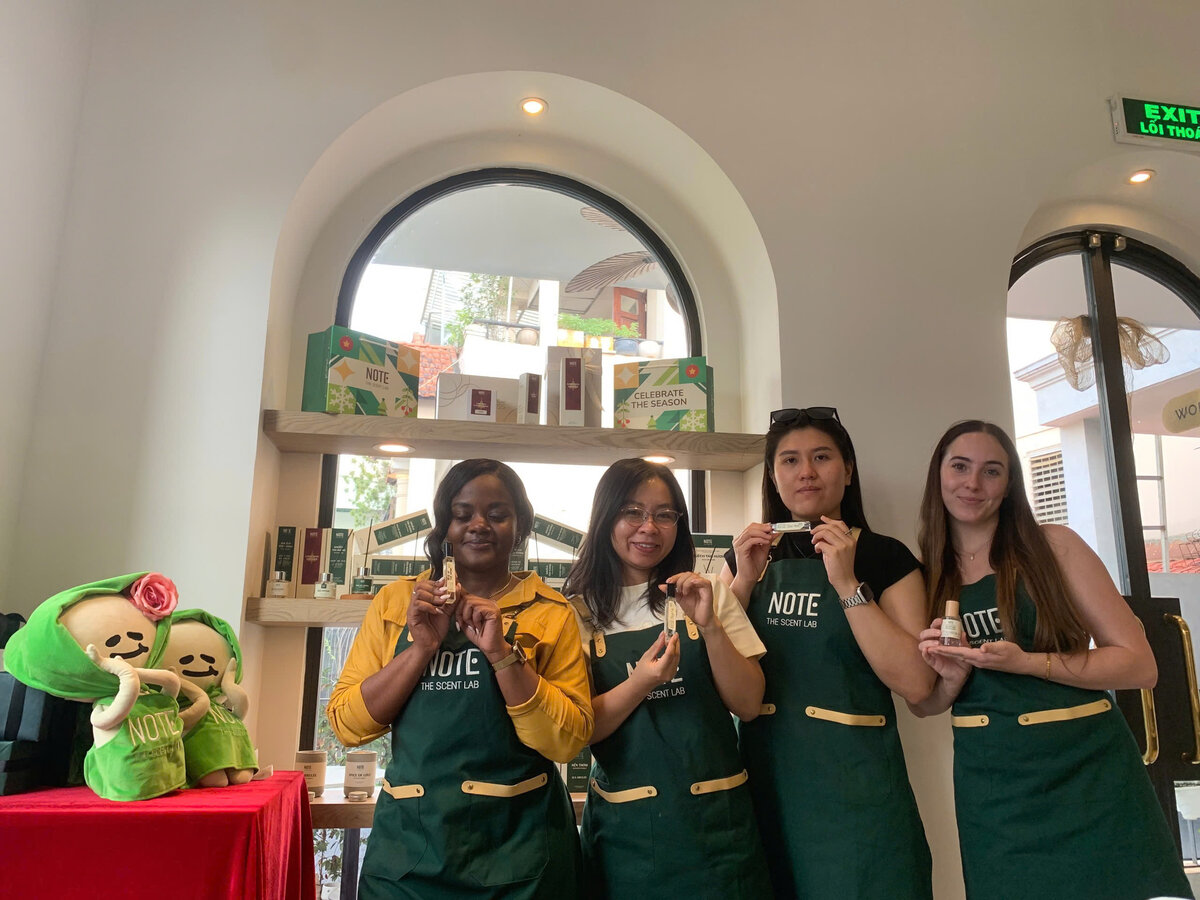
Stop 6: The Cafe Apartment — 42 Nguyen Hue
Halfway down Nguyen Hue, on the east side, you’ll see a nine-story apartment building with a narrow entrance between two ground-floor shops. This is 42 Nguyen Hue — the Cafe Apartment, one of the most iconic buildings in Saigon’s tourist landscape.
Built in the 1960s as a residential block, it’s been transformed into a vertical village of independent cafes, studios, and creative spaces. Each apartment is a different world: vintage coffee on the 2nd floor, pottery workshops below, vinyl record shops above, rooftop cocktail bars at the top. The elevator is tiny and unreliable. The staircase is the real experience — each landing opens onto a different scene.
The Cafe Apartment appears in almost every “things to do in Saigon” list, and for good reason. It’s one of the few places where you can spend two hours exploring a single building and still miss something. But most guides tell you to go for the coffee. Here’s what they don’t mention: the 2nd floor.
The 2nd Floor: NOTE – The Scent Lab (Where the Walk Becomes an Experience)
We’re on the 2nd floor of the Cafe Apartment. This is where we write from, where we work, where the jasmine absolute and cinnamon live in rows of labeled bottles along the studio wall.
From the window, you can see the full length of Nguyen Hue Walking Street below. In the morning, it’s joggers and elderly couples doing tai chi. By afternoon, it’s tourists photographing the City Hall. At night, the street lights up and the noise rises — street musicians, laughter, the rhythmic clatter of skateboards on granite. The sounds drift up through the open windows and mix with whatever scent is being blended at the worktable.
Two floors below, someone is learning to throw clay on a pottery wheel. One floor above, a vinyl shop is playing Trinh Cong Son. Across the hallway, the scent of Vietnamese coffee from the neighboring cafe drifts through the door gap. And here, in this studio, visitors from thirty countries have sat at this same table, smelling osmanthus for the first time and trying to figure out why it makes them feel like they’ve been here before.
This is what the “We’re Here” part means. We’re not recommending a location we’ve researched. We’re describing the view from our window. The Cafe Apartment isn’t a stop on someone else’s list — it’s where we live and work. And the walking route you just completed ends at our front door.
The scent of jasmine garlands reaches us from the vendor at the corner of Le Loi. We smell it before we see her cart every morning.
“I wandered in — I was actually looking for a different store, but the ambiance was so nice I decided to just do the fragrance workshop. Vy and Sofia were very patient and helpful.”
What Happens at the Perfume Workshop
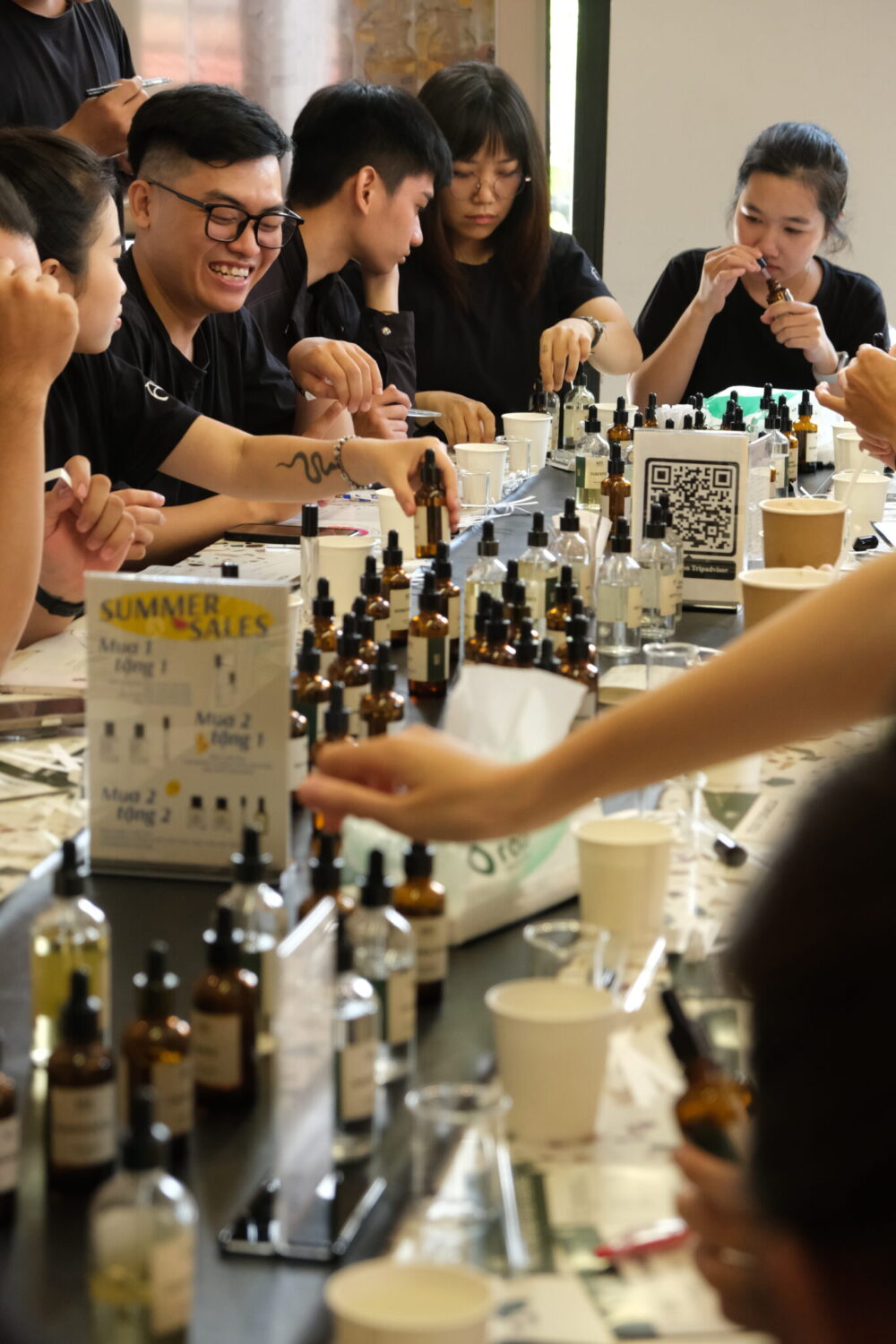
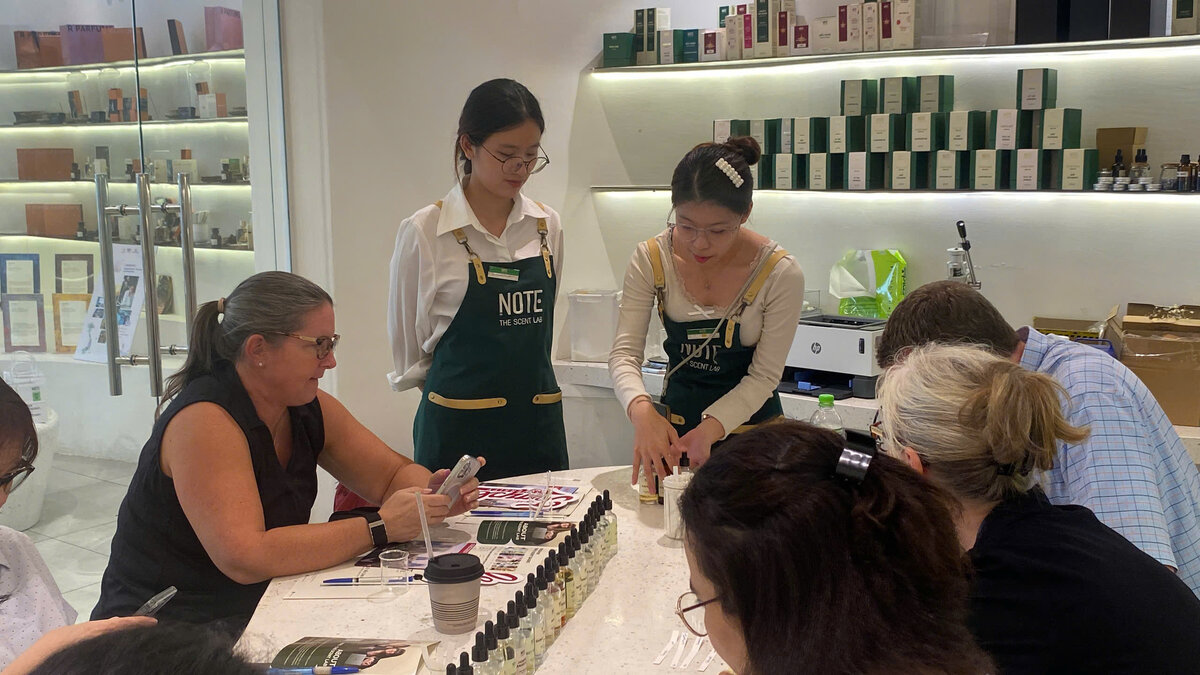
The perfume making workshop at NOTE takes 120 minutes. You don’t need any experience. A workshop instructor guides you through fragrance families — top notes, heart notes, base notes — and helps you design a custom perfume that reflects something personal: a memory, a mood, a place.
You’ll work with 30+ professional-grade ingredients spanning fresh citrus, florals, warm spice, and woods, including jasmine, damask rose, cinnamon, and sandalwood. By the end, you have a personalized perfume — your own signature scent — a handwritten label, and a formula card that’s saved permanently so you can reorder when you return to Vietnam.
Many visitors walk in after exploring the Cafe Apartment, thinking they’ll spend 20 minutes browsing. They leave 120 minutes later with a bespoke perfume they named and a scent that — every time they spray it at home, months later — puts them back on this walking street, in this building, on this afternoon in Saigon.
“I loved my fragrance making experience. I have a beautiful souvenir to take home and every time I smell it, I will remember Saigon. Thanh was an excellent teacher.”
Practical Tips for Your District 1 Walking Tour
Best Time to Walk
Start between 7:30am and 9:00am, before the midday heat peaks. Saigon mornings are warm but manageable — by noon in dry season (December–April), the temperature reaches 34°C and the pavement radiates heat. If you start early, you’ll finish the route by 11am and be inside the air-conditioned Cafe Apartment for the hottest hours.
What to Wear
Light, breathable clothing. Comfortable walking shoes (the route is flat, entirely on paved sidewalks). Sunscreen and a hat for the Le Loi stretch, which has less shade. Carry a water bottle — there’s no shortage of places to refill.
Getting There
Start at Ben Thanh Market. The easiest way to get there: grab a Grab bike (5 minutes from most District 1 hotels) or take the Metro Line 1 to Ben Thanh Station. If you’re already on Nguyen Hue, you can walk the route in reverse — ending at Ben Thanh for a late lunch at the market food court.
Budget
The walk itself is free. Budget for coffee (25,000–60,000 VND per cup), banh mi or pho (40,000–80,000 VND), and the perfume workshop if you decide to end there. The walking route passes several ATMs and all cafes accept card payments.
Safety
District 1 is one of the safest urban areas in Southeast Asia for walking tourists. Standard precautions apply: keep valuables close, watch for motorbikes when crossing streets (they stop, but you need to walk steadily — don’t run or suddenly change direction). The route stays on major, well-lit boulevards.
Why This Route Works: The District 1 Saigon Guide Logic
Most District 1 walking tours treat every stop as equal — a flat list of landmarks. This route is different because it follows an emotional arc:
- Ben Thanh → Sensory overload. Welcome to Saigon.
- Le Loi → Historical context. Slow down. Observe.
- Opera House → Architectural beauty. The French chapter.
- Book Street → Quiet interlude. Breathe.
- Nguyen Hue → The vibrant present. Energy.
- Cafe Apartment → Vertical discovery. Curiosity.
- NOTE Workshop → Creative culmination. Make something.
By the time you reach the workshop, you’ve accumulated two hours of sensory input — smells, sounds, textures, heat, architecture, coffee, conversations with street vendors. The scent of Saigon is in your skin. The perfume workshop gives you a way to distill all of that into something you can take home.
This is why it works. It’s not a list of “things to see.” It’s a route that builds toward something you create. Bottling your Vietnam memories isn’t a marketing phrase — it’s literally what happens when you walk this route and end at the 2nd floor.
Beyond This Walk: More in District 1
If you have more time in the area, extend your exploration:
- Bitexco Financial Tower — Saigon Skydeck for a panoramic view (15 minutes from Nguyen Hue)
- Notre-Dame Cathedral Basilica — Under renovation but still photogenic from outside
- Central Post Office — French colonial interior, still operational, worth 10 minutes
- Rainy day alternatives — If the weather turns, District 1 has excellent indoor options
- NOTE retail store — Beyond the workshop: ready-made signature perfumes, home fragrance, and gift sets
For visitors staying in the Thao Dien area, NOTE also has a studio at 34 Nguyen Duy Hieu in Thao Dien — a quieter, more spacious setting with a different creative atmosphere. Follow @note.workshop on Instagram for daily updates from both locations.
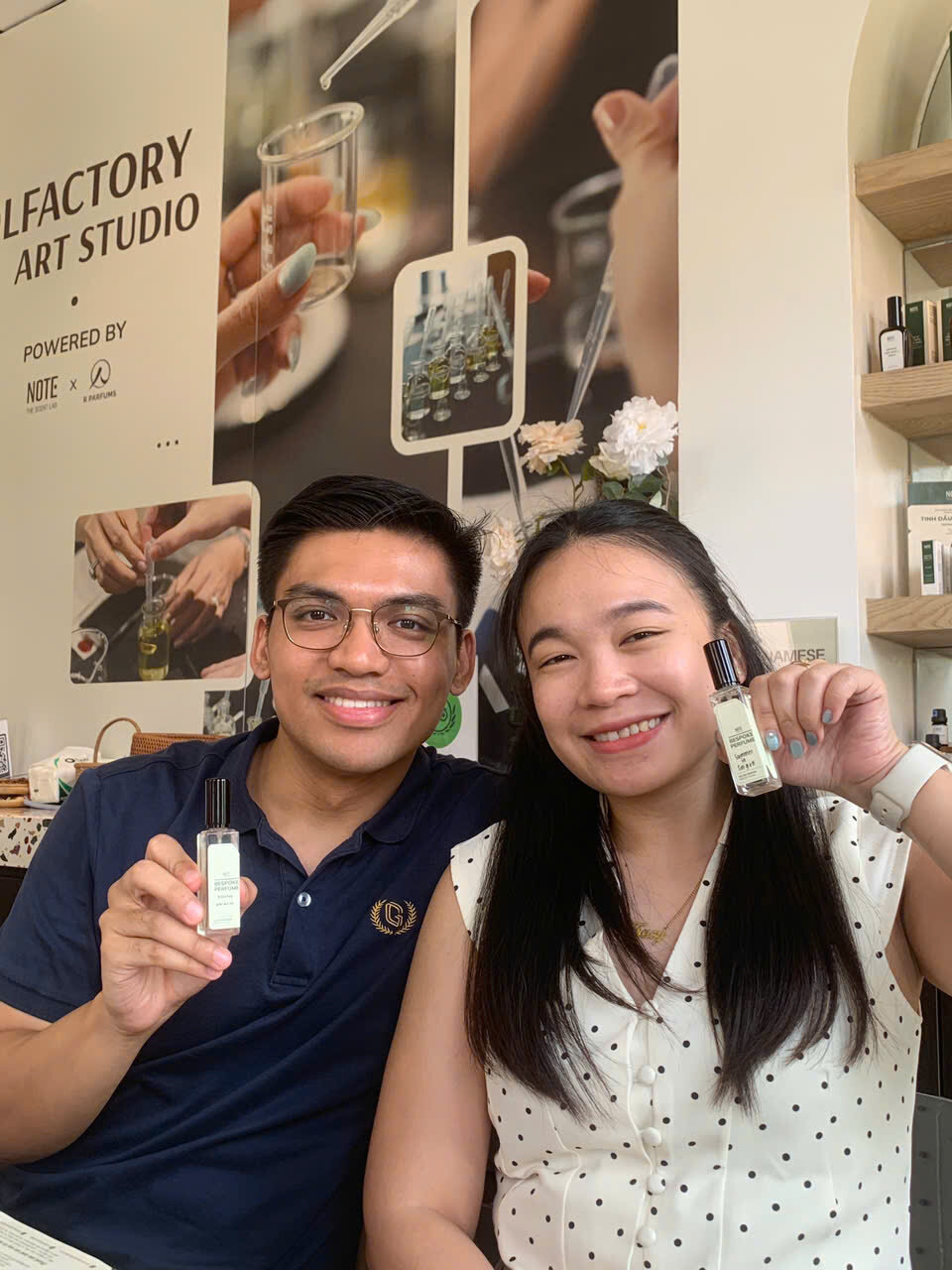
Book Your 90-Minute Perfume Workshop →
For more inspiration, follow @note.workshop on Instagram — workshop highlights, scent tips, and visitor stories.
How to find us at 42 Nguyen Hue (Cafe Apartment, 2nd floor):
Frequently Asked Questions
How long is the District 1 walking tour from Ben Thanh to Nguyen Hue?
The walking route covers about 2.2 kilometers and takes 120 minutes to 2 hours with stops for photos, coffee, and exploring. The walk itself (without stopping) takes about 30 minutes.
Is District 1 Saigon safe for walking tourists?
Yes. District 1 is one of the safest areas in Ho Chi Minh City for pedestrians. The route follows major boulevards that are well-lit and busy throughout the day. Standard precautions: keep valuables secure and walk steadily when crossing streets with motorbike traffic.
Do I need to book the perfume workshop at Cafe Apartment in advance?
Booking ahead is recommended, especially during peak season (October–March) and weekends. Walk-ins are welcome when space is available, but pre-booking at workshop.thescentnote.com/book guarantees your preferred time slot. The workshop takes 120 minutes.
What is the Cafe Apartment at 42 Nguyen Hue?
The Cafe Apartment is a 1960s residential building that has been converted into a vertical collection of independent cafes, studios, and creative workshops. Each floor has a different atmosphere. NOTE – The Scent Lab is on the 2nd floor, offering a perfume-making workshop where you create your own fragrance.
What’s the best time to walk Nguyen Hue Walking Street?
Mornings (7:30–10am) for comfortable walking temperatures and fewer crowds. Evenings (6–9pm) for the full atmosphere: street lights, performers, local families, and the illuminated People’s Committee Building. Both are worth experiencing if you have time.
Can I do this walking tour on my last day in Saigon?
Absolutely — and many visitors do. The entire route plus perfume workshop takes about 3.5 hours, making it a perfect last day in Vietnam activity. You end with a handmade souvenir that captures your trip in a scent.