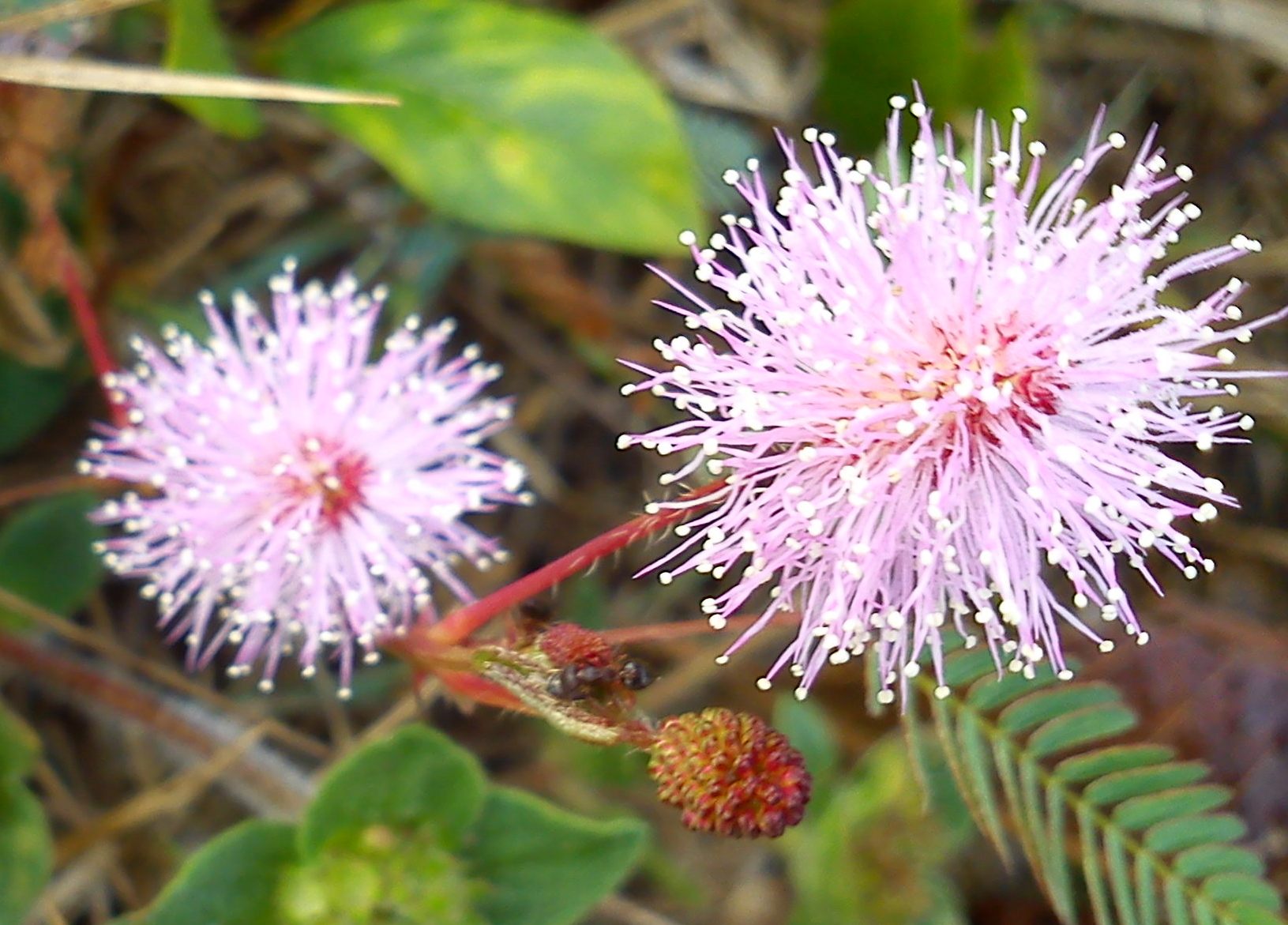

The Da Lat pine mimosa scent is a four-note highland fragrance you can only meet at 1,500 metres — pine resin off the Lang Biang slopes, yellow mimosa puffs in March bloom, jasmine warming in colonial gardens, and Cau Dat tea fields drying at first light. NOTE – The Scent Lab is a perfume workshop in Saigon, Vietnam ( from ) where travelers later bottle that exact Da Lat pine mimosa scent into a 10-50ml take-home perfume.
The first thing Đà Lạt does is push the air down a few degrees. Pine resin breeze. Yellow mimosa flickering at the road shoulder. A floral wave you cannot place at first — sweet, powdery, almost like warm honey held in a paper bag. Then cool, thin, 1500-metre air. Your shoulders drop. That stays. For travelers researching da lat pine mimosa, this guide should be a starting point — verify before booking.
A note before you read: This guide is based on our team’s research and visits to the Da Lat highlands as of May 2026. Prices, opening hours, transit schedules, bloom timing, and venue availability change — please treat the specifics as a starting point, not a guarantee, and verify with official sources or local guides before booking. The only thing we can vouch for absolutely is the perfume workshop at NOTE.

Why the Da Lat pine mimosa scent only happens at 1,500 metres
Most of southern Vietnam smells of heat. Wet asphalt. Fish sauce on the wind. Frangipani at twilight. Đà Lạt is the exception, and the exception is altitude. This is part of our broader da lat pine mimosa coverage on workshop.thescentnote.com.
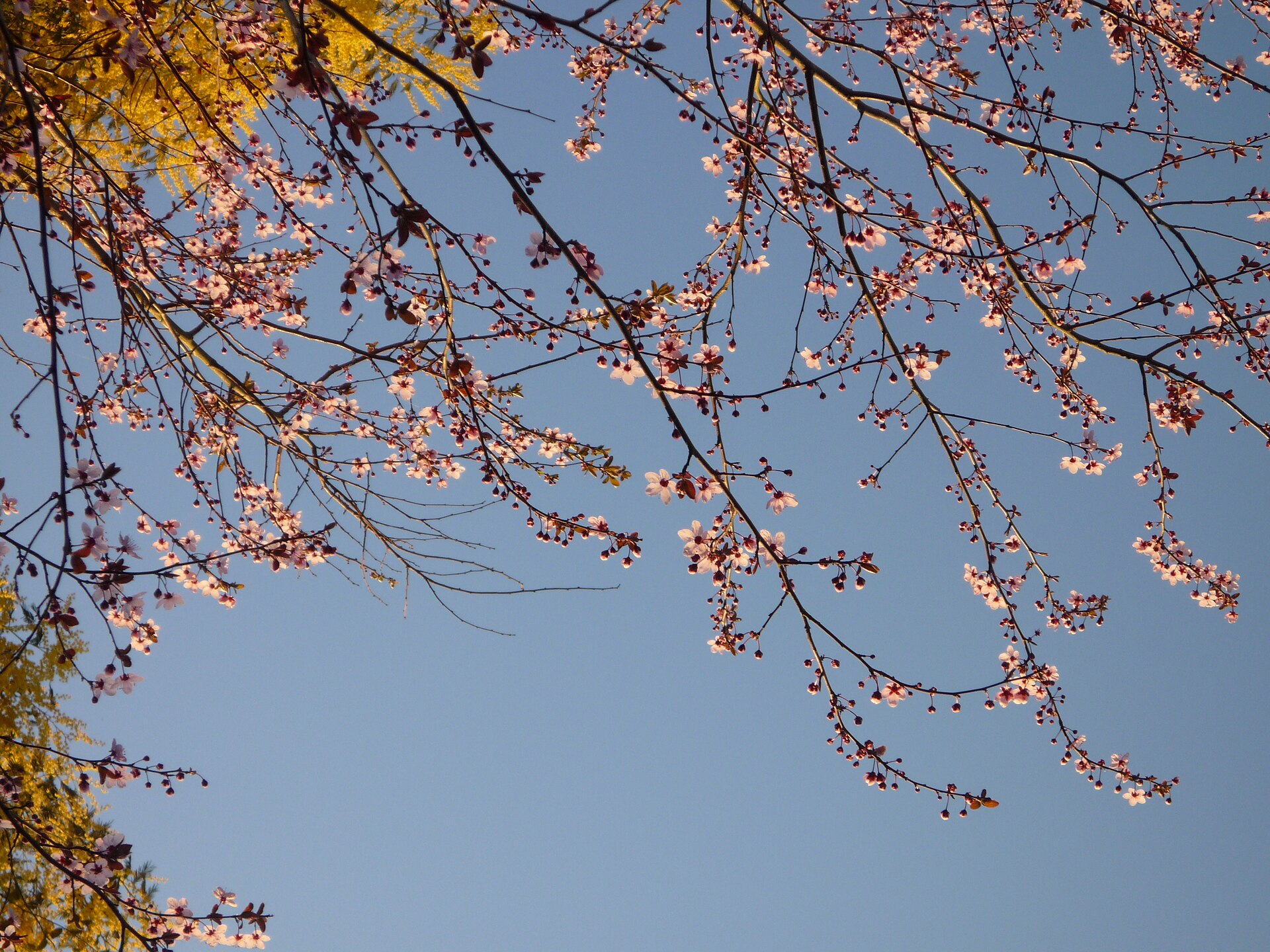
The town sits on a plateau roughly 1,500 metres above sea level. Cool nights drop into the low teens even in dry season. That cold matters. Pine trees release more resin. Mimosa holds its volatile oils longer in the bloom. Jasmine opens slower, sweeter. Tea leaves finish drying without the muggy lowland weight. The result is what perfumers call a high-elevation accord — lighter, greener, more transparent than any scent you will find in Saigon. If da lat pine mimosa is on your list, the workshop pairs well with this stop.
This is why French settlers built Đà Lạt in the first place. They came up here in the 1920s to escape the colonial heat, and they brought European gardening with them — rose hedges, wattle (mimosa), camellia. A century later, that legacy is still threaded through the air. Many guests planning da lat pine mimosa mention this in their booking notes.
Locals call it mùi của Đà Lạt. The scent of Da Lat. Most never try to describe it further. We hear this often from travelers exploring da lat pine mimosa.
Four highland scent notes — the Da Lat pine mimosa scent in detail
Below are the four notes that build the highland accord. You will smell at least three of them on any morning walk between Hồ Xuân Hương lake and the pine slopes north of town. Bloom times shift year to year, so confirm with a local before you travel for a specific flower. For first-timers researching da lat pine mimosa online, the practical details matter.
1. Pine resin — the constant base of the Da Lat pine mimosa scent
The pine is what stays. Đà Lạt is ringed by thông ba lá — the three-needled Khasi pine, native to the highlands of Vietnam, Laos, and Yunnan. In dry season the slopes around Lang Biang Mountain release a slow stream of resin into the air. Walk a forest trail at noon and the smell intensifies as the sap warms. Of all the angles in da lat pine mimosa, this is one we hear about often.
For perfumers, this is base-note territory. Pine resin and its cousin galbanum sit at the bottom of a fragrance — the part that lingers twelve hours after the citrus opening has burned off. They give a scent its spine. Recent guests interested in da lat pine mimosa have asked about this exact spot.
The easiest pine walk for travelers: the trail behind Tuyền Lâm Lake, around 7 km southwest of town. Park near the cable-car station, walk in 20 minutes, and you are inside a working pine forest. Closed shoes recommended; tracks should be passable in dry season. Our notes on da lat pine mimosa keep coming back to scenes like this.
2. Vietnamese mimosa — the yellow puff that defines a Da Lat pine mimosa scent
Mimosa is the surprise. Most travelers do not know Vietnam has a mimosa season at all. Anyone planning da lat pine mimosa will likely cross paths with this corner.
The Vietnamese mimosa is silver wattle (Acacia dealbata), introduced from Australia by French gardeners in the early twentieth century and now naturalised across the Đà Lạt highlands. The bloom typically peaks late February into early April, when whole hillsides turn pale gold. There is even a road named for it — Đèo Mimosa, the Mimosa Pass — winding up to town from the south.
The scent is hard to describe and impossible to forget. Powdery. Honeyed. A green almond underneath. Something almost suede-like at the back. In French perfumery, mimosa absolute has been a beloved soft-floral ingredient since the 1900s — Caron, Guerlain, and Frédéric Malle have all built scents around it.
If you visit in March, simply drive Đèo Mimosa with the windows down. The flowers do most of the work.
3. Jasmine — the colonial garden inheritance
Jasmine is what the French left behind in the gardens. Walk past any old villa on Trần Hưng Đạo street at dusk and the air thickens — sweet, narcotic, almost too much. Jasminum sambac, Vietnam’s national flower, climbs the colonial fences and spills over.
Đà Lạt jasmine is different from lowland jasmine. Cooler nights mean the volatile oils concentrate slowly. The bloom holds its scent longer into the morning. By 7 a.m. in Saigon, the jasmine has already exhaled itself onto the heat. In Đà Lạt, it is still working at 9.
For a deliberate jasmine walk, cross the dam at Hồ Xuân Hương at sunrise and follow the lakeside loop. You will pass private gardens behind low walls. Slow down. Breathe in.
4. Cau Dat tea fields — the soft green close
The fourth note finishes the accord. Cầu Đất, around 25 km southeast of Đà Lạt town, was planted with tea by the French in 1927 — the country’s oldest tea factory, still half-standing on the edge of the hills. Walk the rows in early morning. The leaves are damp. A smoky, hay-like smell drifts from the drying sheds. Underneath: something almost balsamic, like wet stone.
This is the close of the highland scent palette. After the sharp pine and the sweet mimosa and the heady jasmine, the tea leaves bring a soft, drying green back to earth. Together, they make the Da Lat pine mimosa scent feel less like a single fragrance and more like a small landscape.
Cầu Đất pairs naturally with a coffee farm visit; for that side of the trip, our Da Lat coffee farm tour guide covers the same plateau from the bean side.
“This was such a fun and educational experience. Thanks to Jenny for guiding us through”
— Laura, TripAdvisor ★5
A short history of French colonial gardening in Da Lat
To understand why Đà Lạt smells the way it does, you have to go back to 1893. That year, the Swiss-French physician Alexandre Yersin climbed onto the Lang Biang plateau and wrote home that he had found a place that felt like Europe. By 1907 the colonial administration had built the first villas. By the 1920s the hill station was a refuge — schools, sanatoriums, a railway, and gardens.
The gardeners were French. They planted what they missed. Wattle from Australia (mimosa), camellia from Japan, hydrangea, agapanthus, rose. They imported rootstocks for tea and arabica coffee. And they let the native pines stand around the edges of every villa garden, partly for the cool, partly because the smell reminded them of the Alpes-Maritimes back home.
A century later, very few of those original colonial gardens are left in their pure form. But the imported species naturalised. The mimosa got loose into the wild. Jasmine climbed the fences. The pines stayed. And the result is an accord no other Vietnamese city can produce — half-European, half-highland, fully its own.
This is what we mean when we say cultural perfumery. A scent does not just belong to a place. It is the residue of every hand that ever planted there.
When to come for the full Da Lat pine mimosa scent
Not all four notes are at peak together. Travelers who care about the scent palette should plan around the bloom calendar.
Late February to early April is the mimosa window. Whole hillsides turn yellow. Pine resin is steady. Jasmine has not yet opened fully but the gardens already have a faint sweetness. Tea harvest is starting on the Cau Dat plateau. This is the headline season.
May to July brings the strongest jasmine and a fresher pine note after the first rains. Mimosa is gone but the wild orchids start. The mornings are still cool.
October to January is dry-season clarity — coldest nights (down to 8-10°C), longest pine walks, the cleanest air of the year. No mimosa, but the rest of the accord is at its sharpest. Coffee harvest is also active on the same plateau.
Avoid August and September if you can. The rains come hard and the trails get muddy. The scents are still there; you just may not get to walk to them.
Bottling a Da Lat pine mimosa scent at the NOTE workshop in Saigon
Here is the part that surprises travelers. Most assume that to bring a Đà Lạt scent home, you need to buy a souvenir bottle of pine essential oil at a Lien Khuong Airport gift shop. You can. It will smell flat by the time you land in Singapore.
The other option is to do what perfumers do. Build the accord deliberately, ingredient by ingredient, in a real workshop, with the materials and the guidance to get the proportions right.
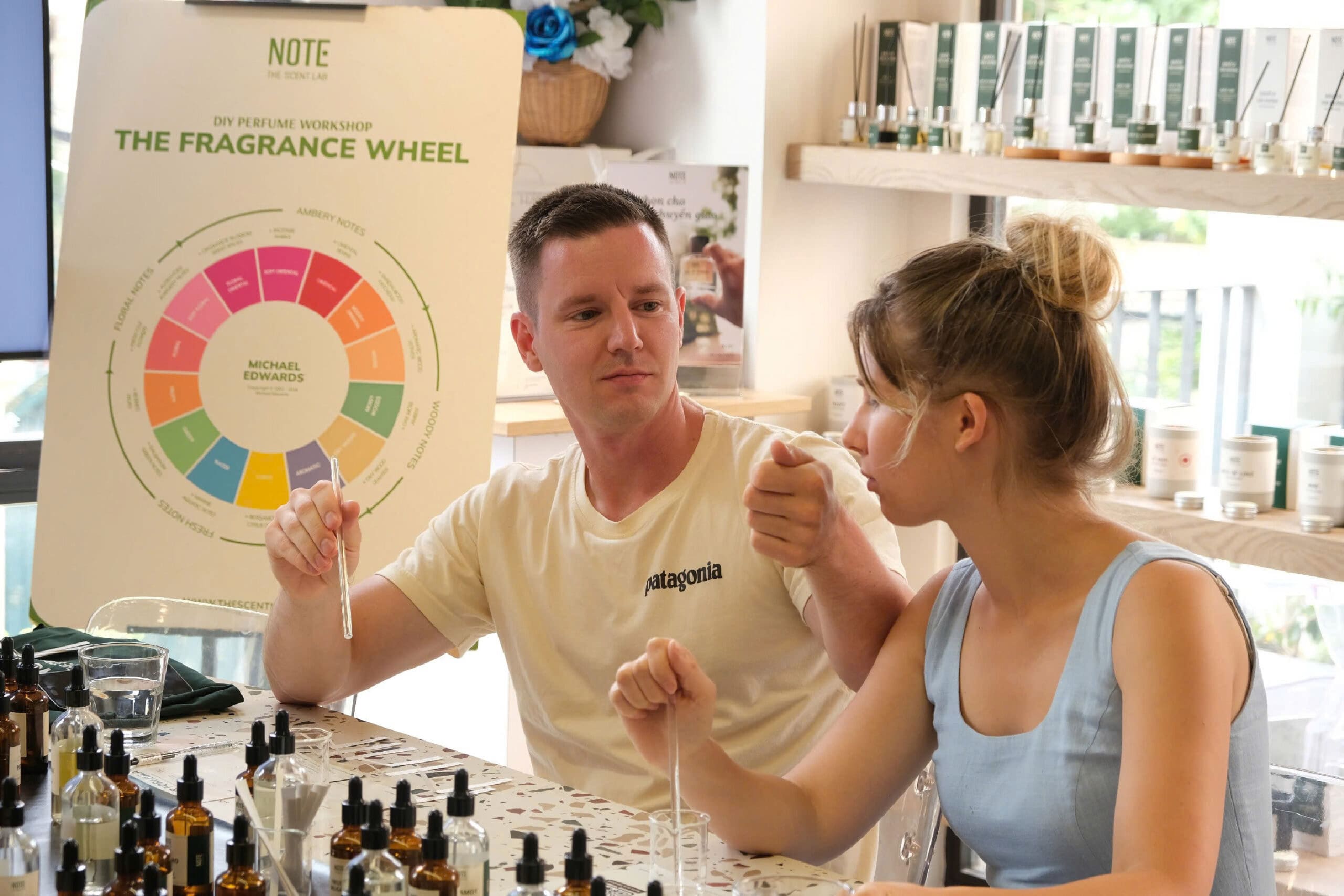
That is what the perfume workshop at NOTE – The Scent Lab does. 120 minutes. Hands-on. A wooden bench, 30+ IFRA-compliant ingredients including pine, mimosa absolute, jasmine sambac, and a green tea accord. The workshop instructors walk you through pyramid building — top, heart, base — and let you blend, sniff, adjust, and seal the bottle yourself.
“I loved my fragrance making experience. I have a beautiful souvenir to take home and every time I smell it, I will remember Saigon. Thanh was an excellent teacher”
— herbaljo, TripAdvisor ★5
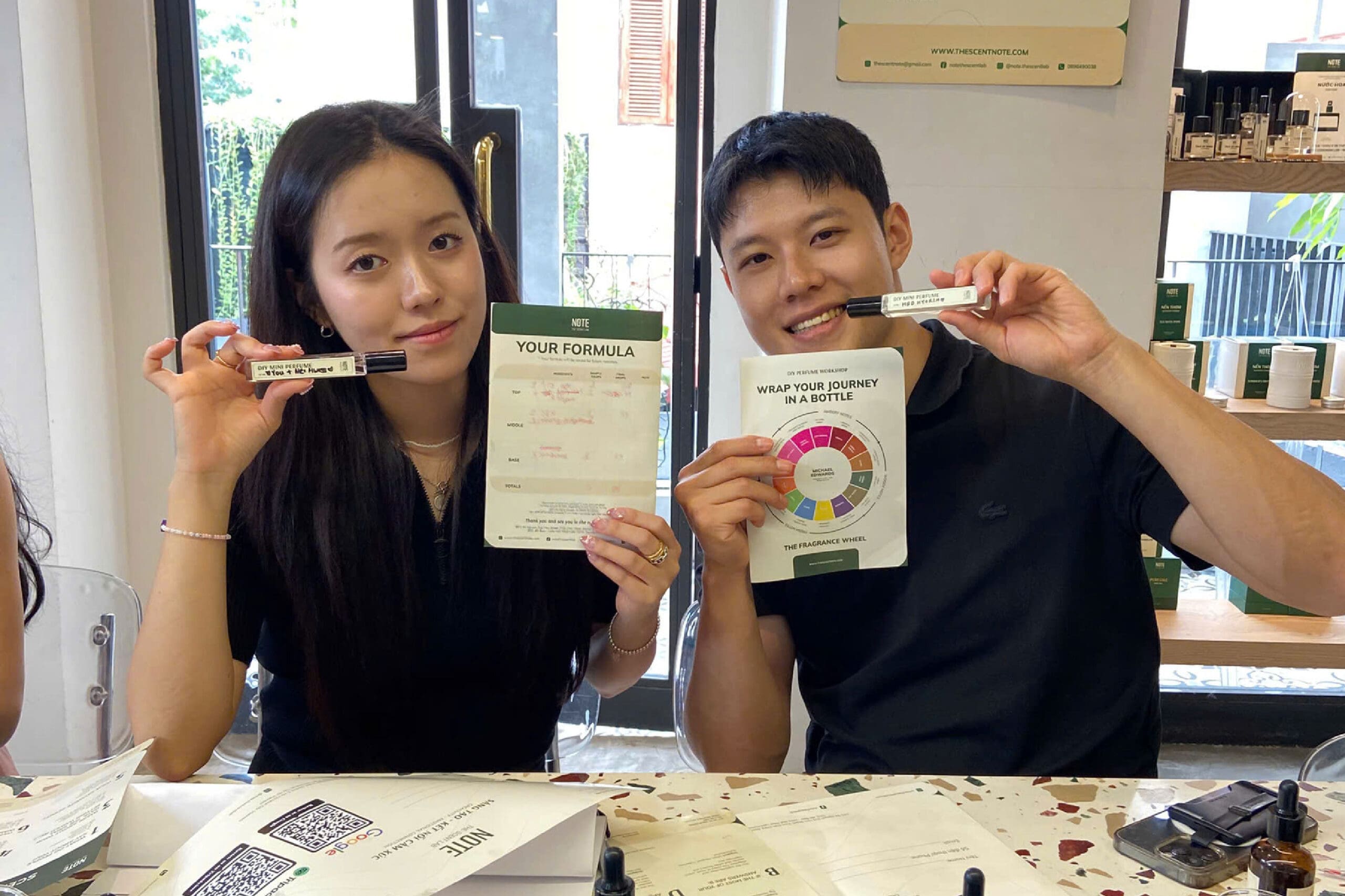
You leave with a 10-50ml bottle (from $24 / around 550,000 VND), sealed in a gift box with a complimentary leak-protection zip pouch for the flight, plus a formula card so you can recreate the scent later. The workshop instructors will not call themselves perfumers. They are guides. They have walked thousands of travelers through this exact accord — many of them, the Da Lat pine mimosa scent — and they know which proportions work.
If that sounds like your kind of afternoon, the studio in Saigon is open daily.
How to get to Da Lat and what to pack for the highlands
From Saigon: a 50-minute flight to Liên Khương Airport (DLI), then a 30-minute taxi into central Đà Lạt. Sleeper buses also run overnight in 7-8 hours at roughly a third of the airfare; schedules shift, so check close to travel date.
From Hanoi: fly via Saigon. There is no direct flight at the time of writing.
Pack a light jacket. Đà Lạt at dawn surprises tropical travelers — temperatures can drop to single digits in January. Closed walking shoes for forest trails. Cash for small purchases (smaller plots and homestays may not take card). And, if you are the kind of traveler who keeps a scent journal, a small notebook. The highland accord shifts hour by hour and you will want to write it down.
For more on the highlands beyond the scent palette — Mimosa Pass viewpoints, hill-tribe villages, hidden lakes — our Da Lat hidden gems guide covers the rest.
Last-day Saigon — turning the highland scent into a bottle
Most travelers fly out of Saigon, not Đà Lạt — which means there is usually a final day in District 1 between the highlands and the airport. A slow morning, a coffee on Nguyễn Huệ, three open hours.
This is where the workshop fits naturally into the trip arc. You arrive with two weeks of scent memory in your nose — the highland pine, the yellow mimosa, the colonial jasmine, the Cau Dat tea — and you sit down at a wooden bench and build a bottle out of it.
“Ember and Maria did an amazing job explaining the perfume wheel and how all the scents go together. This perfume will always remind us of this trip in Vietnam”
— An L, TripAdvisor ★5
The 42 Nguyễn Huệ location sits in the Cafe Apartment building, Floor 3 (Vietnamese “Lầu 2” — 2 levels up from the ground floor). The Thảo Điền location at 34 Nguyễn Duy Hiệu is quieter and greener — closer in feel to the Đà Lạt mornings you just left. Both are walkable from most District 1 hotels. Workshops are conducted in English. Vietnamese also available for local guests.
For more on shaping that final Saigon day around the workshop: our last-day Ho Chi Minh City guide. For the broader story of Vietnamese botanicals — lotus, agarwood, lemongrass and more — our Vietnamese botanicals essay connects the highland accord to the rest of the country’s scent vocabulary.
Looking for a meaningful keepsake beyond the workshop bottle? Browse NOTE’s handcrafted fragrance collection at thescentnote.biz — many of the same Vietnamese botanicals you will have just smelled on the highlands, in ready-to-wear formulations.
Frequently Asked Questions about the Da Lat pine mimosa scent
What does Da Lat actually smell like?
Đà Lạt has a distinctive four-note highland scent palette: pine resin from the surrounding three-needled Khasi pines, mimosa (silver wattle) blooming on hillsides in late February to April, jasmine spilling over colonial garden walls, and tea fields drying around the Cầu Đất plateau. The cool air at 1,500 metres concentrates the volatile oils and makes the accord lighter, greener, and more transparent than any scent you will find at lowland elevations.
When does Vietnamese mimosa bloom in Da Lat?
Vietnamese mimosa, also called silver wattle (Acacia dealbata), typically peaks from late February through early April in the Đà Lạt highlands. Bloom timing shifts year to year depending on cold-season intensity, so verify with a local guide or recent travel reports before timing your trip around the flowers. The Mimosa Pass (Đèo Mimosa) on the southern approach to town is the most accessible viewing route during peak bloom.
Why is Da Lat full of pine forests when the rest of Vietnam is not?
Đà Lạt sits on a plateau roughly 1,500 metres above sea level, cool enough year-round for the three-needled Khasi pine (thông ba lá) to thrive — a species native to the highlands of Vietnam, Laos, and Yunnan rather than the tropical lowlands. French colonial planners selected the area in the early 1900s precisely because the pine cover gave the hill station a European feel. The forests have been preserved as part of the city’s identity ever since.
Did the French really shape Da Lat’s flora?
Yes. From the 1900s onward, French settlers introduced silver wattle (mimosa) from Australia, camellia from Japan, European roses, hydrangea, and rootstock for arabica coffee and tea. Many of those species naturalised across the Đà Lạt highlands and now grow semi-wild. The colonial gardening legacy is one of the main reasons Đà Lạt’s scent palette feels half-European and half-Vietnamese — a hybrid you cannot find anywhere else in the country.
Can I bottle the Da Lat pine mimosa scent into a perfume?
Yes — and many travelers do. After visiting the highlands, fly back to Saigon (50-minute flight to Tân Sơn Nhất) and on your last day join a 120-minute perfume workshop at NOTE – The Scent Lab. Workshop instructors will guide you through pyramid building with 30+ IFRA-compliant ingredients including pine, mimosa absolute, jasmine sambac, and a green tea accord — exactly the four notes that define the highland scent palette. You leave with a 10-50ml bottle (from $24 / around 550,000 VND) and a formula card to recreate the scent later.
Is one day in Da Lat enough to experience the scent palette?
One day is enough to taste it; two to three days lets you walk into all four notes properly. A typical scent-focused itinerary might be: dawn walk around Hồ Xuân Hương lake for jasmine, mid-morning drive on Đèo Mimosa during bloom season, an afternoon pine-forest hike behind Tuyền Lâm Lake, and a Cầu Đất tea-and-coffee plateau half-day on day two. Pace it slowly. The cool air and altitude reward unhurried travelers.
Find NOTE – The Scent Lab
- 42 Nguyễn Huệ — Floor 3 (Vietnamese “Lầu 2” — 2 levels up from the ground floor), Cafe Apartment building, District 1, HCMC — Get directions → · TripAdvisor
- 34 Nguyễn Duy Hiệu — Thảo Điền, Thủ Đức, HCMC — Get directions → · TripAdvisor
How to find us:
- 📍 42 Nguyễn Huệ — Watch direction video on TikTok →
- 📍 34 Nguyễn Duy Hiệu — Watch direction video on YouTube →
Book your workshop → · Follow us on Instagram @note.workshop
This article is provided for general informational and reference purposes only. Information was accurate at the time of writing (May 2026) but may change without notice. Opening hours, prices, transit schedules, bloom timing, and availability for venues outside NOTE – The Scent Lab can change without notice — please verify with official websites, TripAdvisor, or Google Maps before your visit. We do not guarantee accuracy and are not responsible for outcomes based on outdated information.
Some places do not fit in a suitcase. They fit in a bottle.