
HCMC vs Bangkok workshops offer different experiences for Southeast Asia travelers — Bangkok leads in volume and Thai-specific crafts, while Ho Chi Minh City workshops are more personalized, intimate, and creatively hands-on. NOTE – The Scent Lab is a perfume workshop in Ho Chi Minh City, Vietnam (, ), where travelers create a custom Eau de Parfum in 120 minutes — an experience without a true equivalent in Bangkok’s workshop scene.
You are planning a Southeast Asia trip. Two weeks, maybe three. Bangkok is on the list — it always is. And Ho Chi Minh City is on the list too, because someone told you Saigon is “the new Bangkok” and you want to see for yourself. At some point, sitting in a café with your itinerary spread across a phone screen, you ask the question every experience-hungry traveler asks: where should I spend my workshop day?
This is not a question with a simple answer. For a full overview of what’s available, see our best workshops in Vietnam guide. Bangkok and HCMC are both extraordinary cities for hands-on experiences, but they are extraordinary in fundamentally different ways. Bangkok’s workshop scene is massive, polished, and deeply integrated into its tourism infrastructure. Saigon’s is smaller, rougher around the edges, and — for travelers who value authenticity over convenience — often more memorable. The difference is not better versus worse. It is scale versus soul.
The Workshop Landscapes: Scale vs. Intimacy
Bangkok: The Workshop Supermarket
Bangkok’s creative workshop scene is enormous. Cooking classes alone number in the hundreds — from Silom Thai Cooking School to acclaimed hotel experiences at the Mandarin Oriental. Add in Muay Thai camps, fruit carving, Thai massage certification, temple-painting classes, flower garland workshops, and batik dyeing, and you have a city that has industrialized the craft experience with impressive efficiency.
The advantage is choice. Whatever you want to create, Bangkok probably offers a class. The disadvantage is that scale often means standardization. Many Bangkok workshops run groups of 15-30 people through identical scripts, with limited room for personalization. You create the same pad Thai as everyone else. You paint the same temple motif. The souvenir is consistent, photogenic, and — if you are being honest — interchangeable with what the person next to you made.
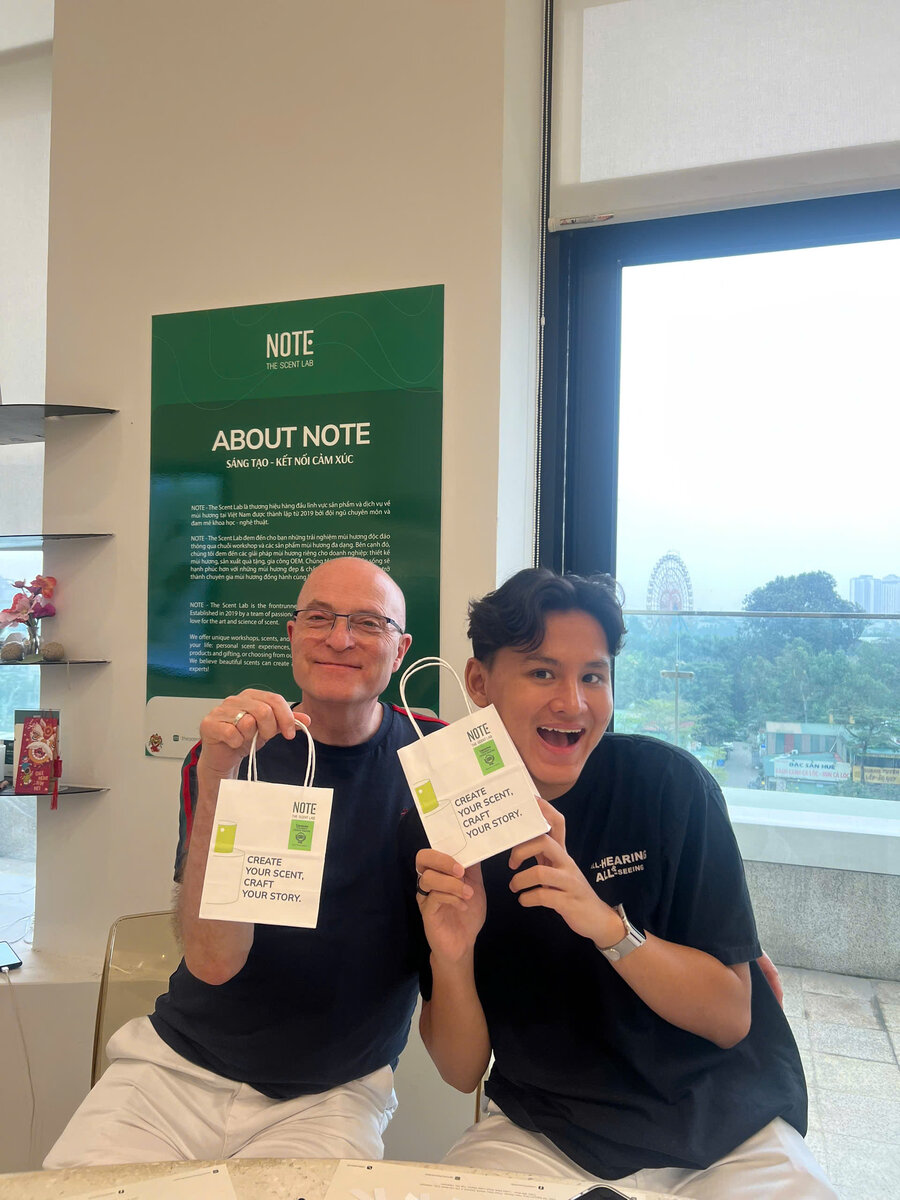
From the studio window on the 4th floor, you can see Nguyen Hue stretching toward the river — motorbikes circling the roundabout below, tourists taking photos on every landing.
HCMC: The Workshop Boutique
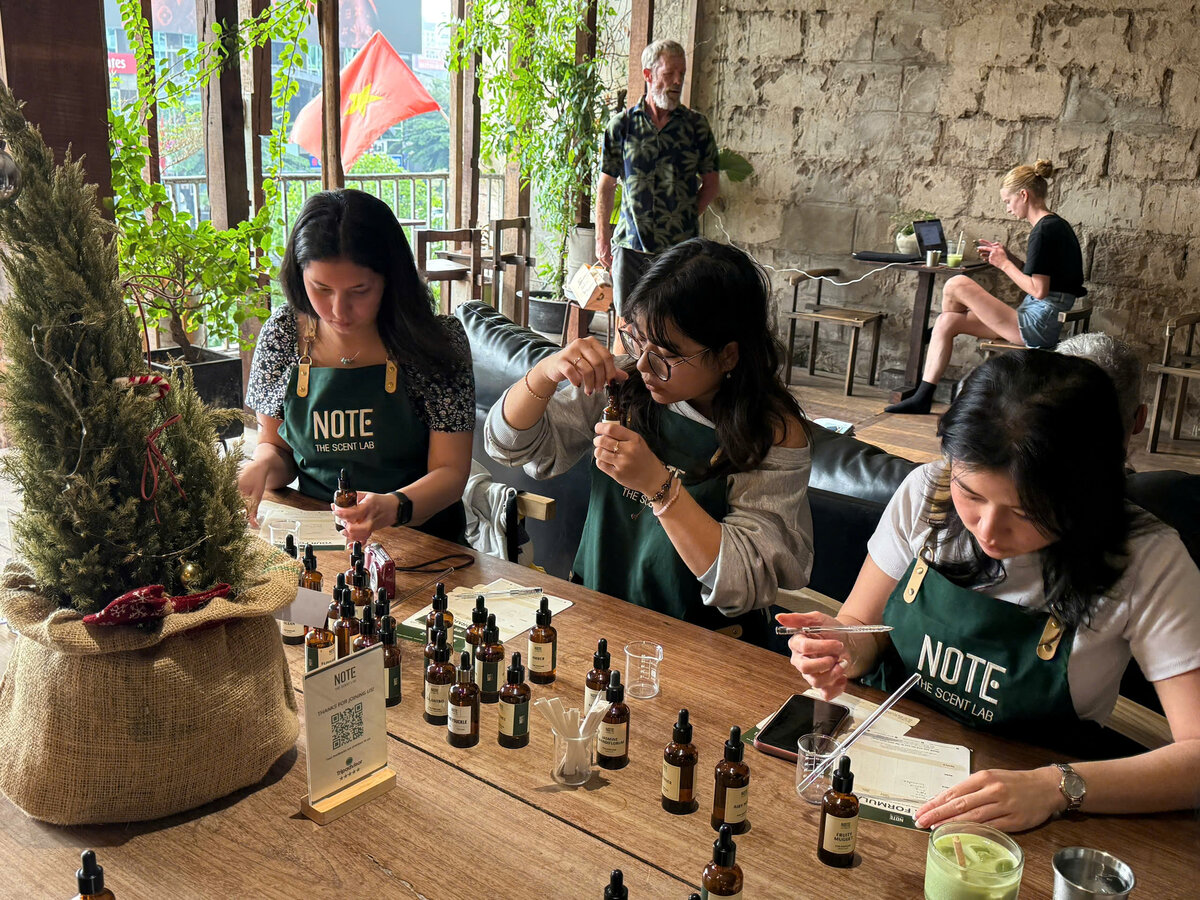
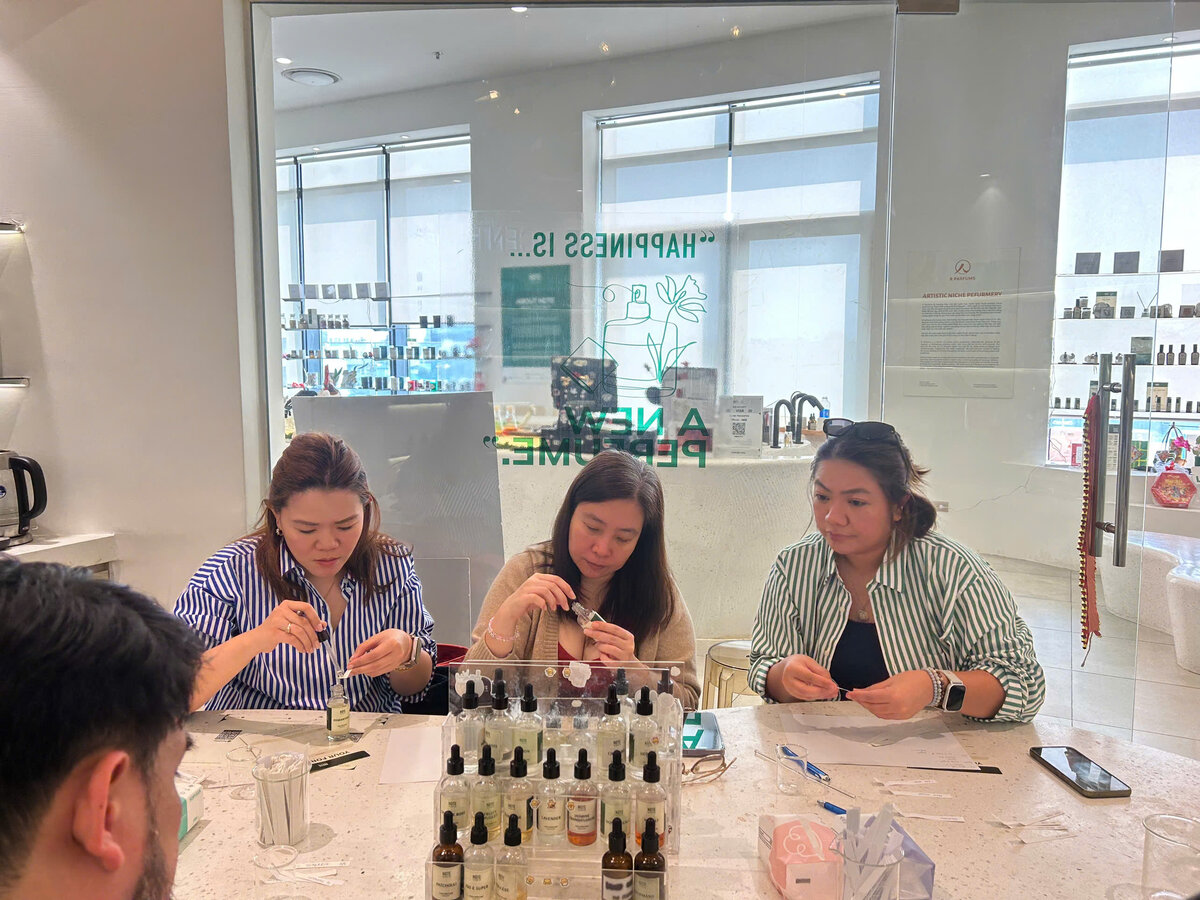
Saigon’s workshop scene is younger, leaner, and more personal. The city has fewer options than Bangkok, but the experiences that do exist tend to be deeper. Group sizes are smaller — typically 2-8 people rather than 15-30. Instructors spend more time with each participant. And the workshops that have emerged in HCMC over the past few years tend to be passion projects rather than tourism businesses, which changes the energy in the room.
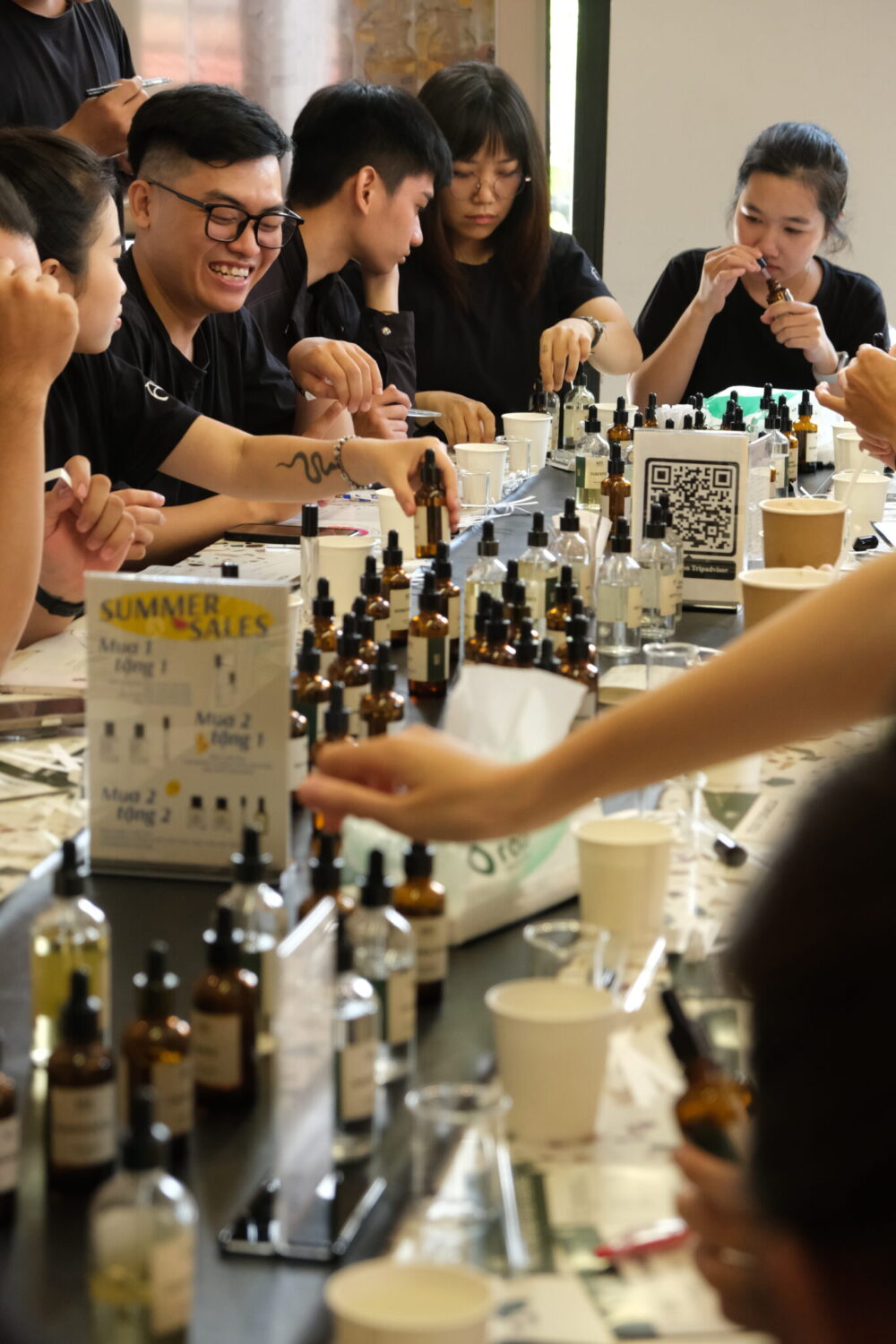
The perfume workshop at NOTE – The Scent Lab is the clearest example of this difference. You create a custom perfume — your own signature scent — guided personal by a trained workshop instructor. There is no equivalent in Bangkok — not because Bangkok lacks creativity, but because this kind of personalized perfume experience requires a specific combination of expertise, intimacy, and cultural context that has not been replicated in Thailand’s workshop market.
Perfume Making: Where HCMC Has No Competition
Bangkok has a handful of fragrance experiences — candle-making classes, essential oil blending, and the occasional hotel spa that lets you mix massage oils. These are pleasant activities. They are not perfume making.
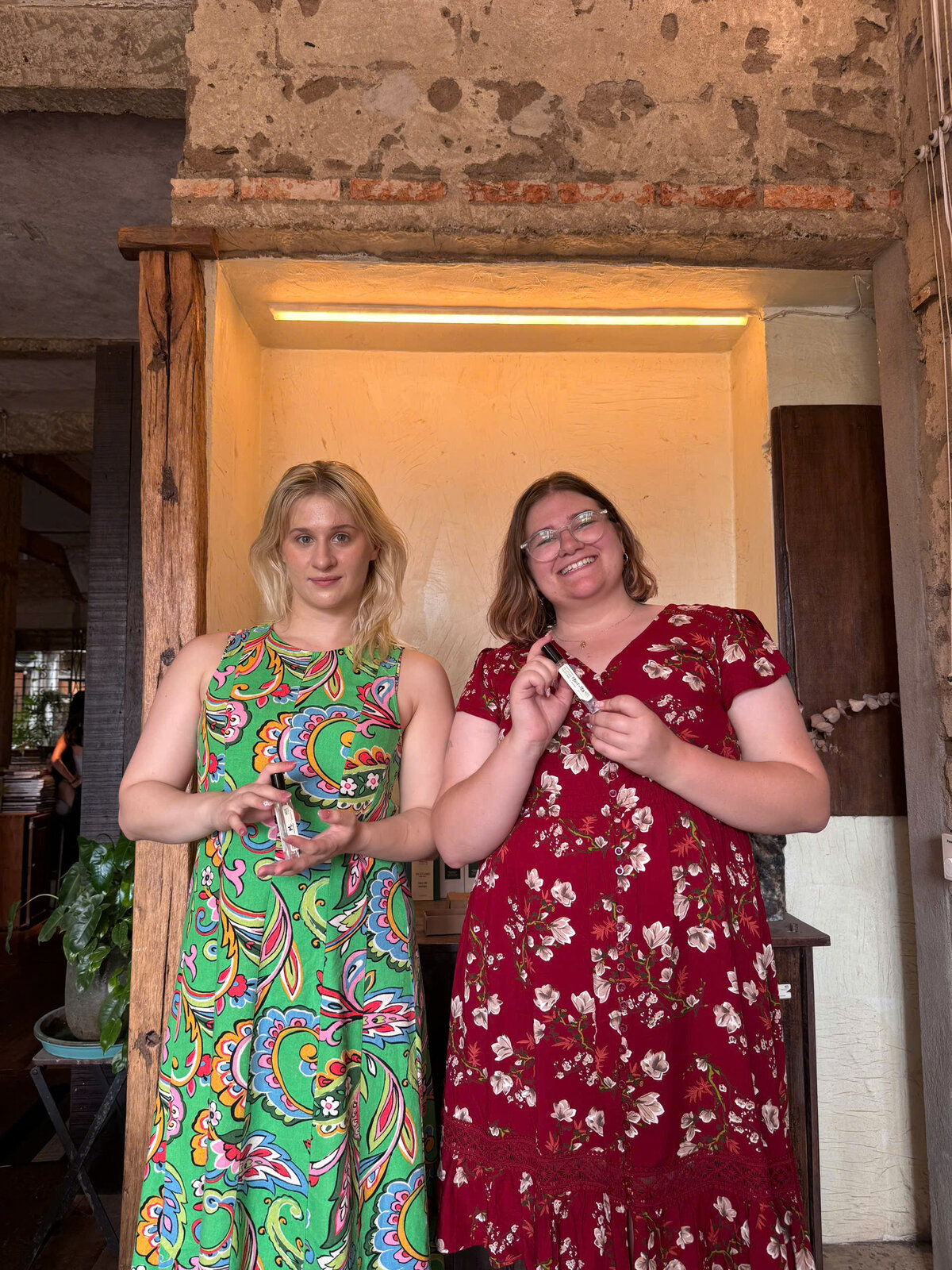
At NOTE, the 120-minute workshop teaches actual perfumery — learn more in our what is a perfume making workshop guide — fragrance families, note structure (top, heart, base), how ingredients interact over time, and the technical skill of building a balanced composition. You work with 30+ professional-grade ingredients, from citrus and green top notes to florals like jasmine, osmanthus and damask rose, plus warm spice and woods like cinnamon, sandalwood and cedarwood. The result is not a novelty candle or a room spray. It is an Eau de Parfum — a wearable fragrance you designed, blended, and bottled yourself, with a formula card so you can reorder.
“As someone in the beauty industry for over 20 years, I was extremely impressed by their knowledge and professionalism,” wrote Geneva on online booking platform. That review matters because it comes from someone who knows the difference between a tourist activity and genuine craft instruction. The workshop attracts beauty professionals, fragrance enthusiasts, and creative travelers specifically because it operates at a level most workshop experiences — in any city — do not attempt.
Bangkok’s closest comparison might be an upscale hotel spa experience, but the framing is different. Hotel spas sell relaxation. NOTE sells creation. You are not a customer being pampered. You are a maker being guided. That distinction changes everything about how the memory lands. Booking is straightforward — reserve online for instant confirmation with no deposit required. Credit card, bank transfer, or cash on arrival.
Book Your Saigon Perfume Workshop →
Cooking Classes: Bangkok Leads, But HCMC Surprises
This is Bangkok’s home turf. Thai cooking classes are a mature, well-reviewed, globally recognized product. The best ones — Baipai Thai Cooking School, Silom Thai Cooking, Amita Thai Cooking — deliver excellent instruction with market tours, beautiful facilities, and dishes you can actually replicate at home.
HCMC’s cooking class scene is smaller but growing fast. Vietnamese cuisine is arguably more complex than Thai — more herbs, more textures, more regional variation — and the classes that have emerged reflect that complexity. Morning market tours through Bến Thành or Bà Chiểu markets, followed by hands-on sessions where you roll your own fresh spring rolls and learn the fish sauce balance that separates good Vietnamese food from great — these are genuine and increasingly well-run.
The difference, again, is scale. Bangkok cooking classes are slick. Saigon cooking classes are intimate. If you want polished production, go Bangkok. If you want to feel like you are cooking with a Vietnamese friend’s family, book Saigon. For travelers doing both cities, the smart play is to do a cooking class in Bangkok and a perfume workshop in HCMC — two completely different creative experiences that complement rather than duplicate each other. We compared the two in our cooking class vs. perfume workshop guide.
Craft Workshops: Different Traditions, Different Strengths
Bangkok’s Craft Scene
Bangkok excels at traditional Thai crafts adapted for tourists: fruit carving (a beautiful art form), Phra Pidta amulet-making workshops, silk weaving at Jim Thompson House, Thai floral garland (phuang malai) workshops, and pottery at studios in Ari or Thonglor. The craft infrastructure is deep because Thailand’s tourism industry has had decades to develop it.
HCMC’s Craft Scene
Saigon’s craft workshops are newer but often more distinctive. Pottery at The Workshop Pottery or Saigon Ceramic Art Studio. Leather-working at small ateliers in Thảo Điền. Coconut shell crafting. Conical hat decorating. And the perfume workshop — which is less “craft” and more “applied chemistry meets personal expression.” The city’s craft scene reflects its personality: unpolished, energetic, and obsessed with making things that are genuinely yours rather than generically pretty.
Our guide to HCMC’s best craft workshops covers the full landscape for travelers who want to spend a day creating.
The Location Factor: Where You Create Matters
Bangkok workshops tend to happen in dedicated tourism zones — Silom, Sukhumvit, Khao San. The spaces are purpose-built and efficient. HCMC workshops tend to be embedded in the city’s living fabric. NOTE’s main studio is inside the Cafe Apartment — a repurposed 1960s residential building at 42 Nguyễn Huệ in District 1, where each apartment has been converted into a small business. Pottery below, vinyl records above, coffee shops on every floor, and a perfume studio on the 2nd floor with windows overlooking Saigon’s main pedestrian boulevard.
The Thảo Điền location (34 Nguyễn Duy Hiệu) sits in a quiet, tree-lined neighborhood — a contrast to the District 1 energy. And in Hanoi, the workshop.
The point is not that one city’s locations are better. It is that the location IS the experience. A perfume workshop inside a building where you can smell pottery clay from two floors down and hear Vietnamese indie music from a café across the hall creates a sensory context that a dedicated workshop space in a Bangkok mall cannot replicate.
Price Comparison: What Your Money Gets You
Southeast Asia travelers are savvy about value, so let us be direct. Bangkok workshops generally run 800-2,500 THB ($22-70 USD) for cooking classes and 500-1,500 THB ($14-42 USD) for craft workshops. HCMC workshops are comparable — cooking classes at 400,000-900,000 VND ($16-36 USD) and craft workshops at 300,000-800,000 VND ($12-32 USD).
The perfume workshop at NOTE is positioned higher because the output is higher — you leave with an actual Eau de Parfum, not a sample or a novelty item. The value equation is: 120 minutes of professional instruction + 30+ premium ingredients + a wearable perfume you designed + a formula card for life. When travelers compare this against what a Bangkok fragrance experience delivers (typically an essential oil blend or a candle), the differentiation is clear.
“Good price, high quality material. Very well trained staff. Highly recommended,” said Chanya on TripAdvisor — a sentiment that reflects the value-conscious Southeast Asia traveler’s calculus: not how cheap, but how much you get for what you pay.
The Verdict: Why Not Both?
The smartest Southeast Asia travelers do not choose between Bangkok and HCMC. They design their trip so each city delivers what it does best. Bangkok for the cooking class, the temple tours, the Thai massage mastery. Saigon for the perfume workshop, the street food depth, the raw creative energy of a city still figuring itself out.
“I wandered in — I was actually looking for a different store, but the ambiance was so nice I decided to just do the fragrance workshop. Vy and Sofia were very patient and helpful,” shared a TripAdvisor reviewer. That spontaneous quality — the sense that remarkable experiences in Saigon find you — is what makes it one of the most unique things to do in HCMC rather than the other way around — is something Bangkok’s more organized tourism scene cannot manufacture.
If you are building a Southeast Asia itinerary and want to make sure your HCMC days are packed with creating rather than just sightseeing, our 3-day HCMC itinerary integrates the perfume workshop with the city’s other best experiences. And for the full workshop deep-dive, the complete guide to perfume workshops in Vietnam covers everything from booking to what to expect.
Follow @note.workshop on Instagram to see what travelers from both Bangkok and Saigon legs of their trips are creating. Visit thescentnote.biz to explore NOTE’s professional fragrance collection — the same expertise behind the workshop, in ready-to-wear form.
Book Your Saigon Perfume Workshop →
Want to compare for yourself? See what travelers say on TripAdvisor, online booking platform, and Google Maps.
Curious what a workshop looks like? Follow @note.workshop on Instagram for photos and visitor stories.
Frequently Asked Questions
Is Ho Chi Minh City or Bangkok better for workshops?
Both cities are excellent but different. Bangkok offers more variety and scale — especially for cooking and Thai crafts. HCMC offers more intimacy and personalization, with smaller groups and more personal instruction. For perfume making specifically, HCMC has no equivalent in Bangkok.
Does Bangkok have perfume making workshops?
Bangkok has candle-making and essential oil blending classes, but no full perfume-making workshop comparable to NOTE – The Scent Lab in HCMC. NOTE’s 120-minute session uses 30+ professional-grade ingredients, resulting in a custom Eau de Parfum — a format not available in Bangkok.
How do workshop prices compare between HCMC and Bangkok?
Prices are similar for comparable experiences. Cooking classes run $16-36 in HCMC vs. $22-70 in Bangkok. Craft workshops are $12-32 in HCMC vs. $14-42 in Bangkok. HCMC is generally 10-20% less expensive, though the perfume workshop is positioned at a premium because you leave with a genuine Eau de Parfum.
Can I do workshops in both cities during one Southeast Asia trip?
Absolutely — and we recommend it. A cooking class in Bangkok plus a perfume workshop in HCMC gives you two completely different creative experiences. Flights between the cities take about 2 hours, and many travelers do 4-5 days in each city.
What makes HCMC workshops more personal than Bangkok?
HCMC workshops typically run groups of 2-8 people compared to Bangkok’s 15-30. Instructors at NOTE, for example, work personal to guide your scent selection and blending technique. The result is a genuinely personalized creation — your perfume will be different from anyone else’s.
Where is NOTE – The Scent Lab located in HCMC?
NOTE has two HCMC locations: 42 Nguyễn Huệ (Cafe Apartment), District 1, in the heart of the city; and 34 Nguyễn Duy Hiệu, Thảo Điền, in a quieter neighborhood. There is also a Hanoi location. All locations are rated from.
Practical info: get directions