
Phu Quoc fish sauce — locally nước mắm Phú Quốc — is the centuries-old fermented anchovy condiment from Vietnam’s largest island. In 2012, it became the first Vietnamese product granted Protected Designation of Origin (PDO) status by the European Union. In 2021, the craft was inscribed as a National Intangible Cultural Heritage. NOTE – The Scent Lab is a perfume workshop in Saigon, Vietnam ( from ). Many guests arrive with Phú Quốc still on their fingertips — sea salt, sun-dried fish, layered sweetness from twelve months in a wooden vat. This guide tells the scent-story of Phu Quoc fish sauce — the tradition, the family factories, the four grades, and how that island accord ends up bottled in our studio.
The smell finds you before the harbor does. Ten minutes inland from Dương Đông town, it drifts across the palms — first salt, then yeast, then something warmer, almost like dried mango left in the sun. By the time the road opens onto the wooden warehouses of An Thới, your nose has already started a conversation with this island. That stays. For travelers researching phu quoc fish sauce, this guide should be a starting point — verify before booking.
A note before you read: This guide is based on our team’s research and visits as of May 2026. Prices, hours, transit schedules, and venue availability change — please treat the specifics as a starting point, not a guarantee, and verify with official sources before booking. The only thing we can vouch for absolutely is the perfume workshop at NOTE.

Why Phu Quoc Fish Sauce Smells Like an Island, Not a Mainland
To understand Phu Quoc fish sauce, start with the water. Phú Quốc sits in the Gulf of Thailand, closer to Cambodia than to mainland Vietnam. Seagrass beds run thick. Shoals of anchovies (cá cơm than) feed in dense, oily clouds from June to November. The currents are gentler here. The salt feels softer on the tongue.
That difference is why Phu Quoc fish sauce is the only fish sauce in Vietnam to hold a Protected Geographical Indication (PGI) at home. Since 2012, it also holds a Protected Designation of Origin (PDO) from the European Union — the same legal category that protects Champagne and Roquefort. The words nước mắm Phú Quốc can only legally describe sauce fermented on this island, in barrels made of this island’s wood.
Locals will tell you the technique is more than two centuries old. Fishermen drifted south from the central coast and settled the island in the 1700s. They developed a method specific to Phú Quốc — wooden vats from bời lời and chai trees. Anchovies are salted on board the boat. The fermentation window stretches across nearly the whole calendar year. Therefore, what you smell on Phú Quốc is a place-bound craft, as specific to this island as Sancerre is to its hill. This is part of our broader phu quoc fish sauce coverage on workshop.thescentnote.com.
The 4 Phu Quoc Fish Sauce Factory Scent Stories
Around 85 fish sauce factories operate on Phú Quốc, producing more than twelve million litres a year. Most are small, family-run, and welcome curious visitors. Tours typically last 30–60 minutes. At most factories there is no admission fee — though it is good practice to buy a small bottle on the way out. If phu quoc fish sauce is on your list, the workshop pairs well with this stop.
Below are four factory scent-stories — different facets of the island’s fermentation craft, and different notes in the umami palette of Phu Quoc fish sauce. Hours and access change, so verify with the factory or your hotel concierge before turning up.
1. Khải Hoàn — the cathedral of barrels
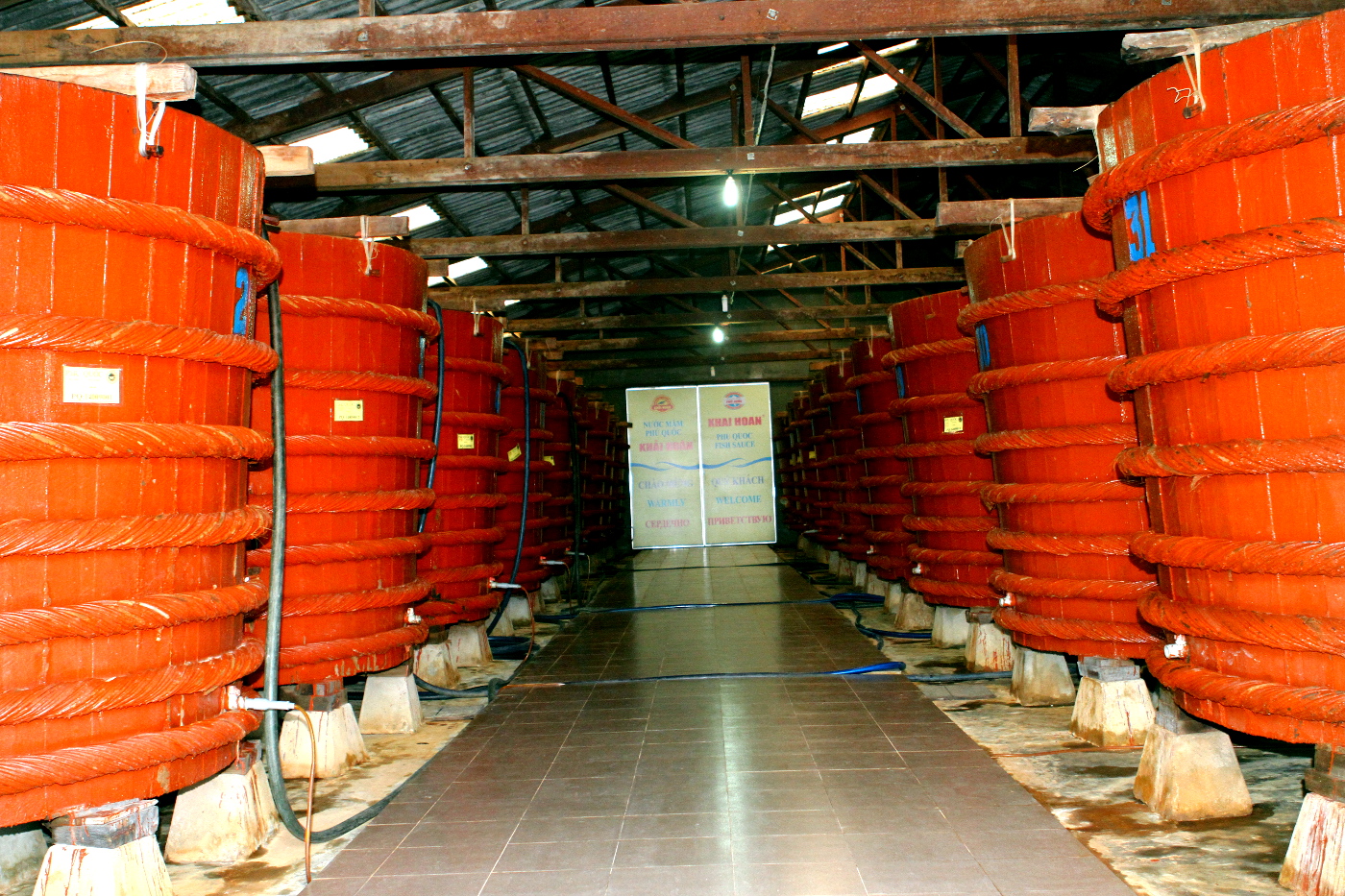
Khải Hoàn is the largest traditional house on Phú Quốc. Walking inside one of its warehouses on the outskirts of Dương Đông is closer to entering a cathedral than a factory. The roof opens high above. Light angles down between roof beams. And there, in two long rows, stand the wooden barrels — taller than a person, ringed with bamboo hoops, dark with age. Many guests planning phu quoc fish sauce mention this in their booking notes.
Each barrel holds between seven and fifteen tonnes of anchovies and sea salt. The smell is dense but not aggressive — yeast, dried fish, warm wood, and a low note of something almost sweet. A guide will draw a sample of nhỉ (first-draw sauce) from one of the older barrels. Most guests stay longer than they planned. Khải Hoàn typically opens daily and is generally free to visit at the time of our last research. We hear this often from travelers exploring phu quoc fish sauce.
2. Hưng Thành — the family workshop near An Thới
Down at the southern end of the island near An Thới harbor, Hưng Thành runs a smaller, more domestic operation. The owner’s grandmother started it. Her granddaughter now manages the books. The barrels are fewer — perhaps thirty — and you can stand close enough to put your palm on the wood and feel the slow warmth of fermentation underneath. For first-timers researching phu quoc fish sauce online, the practical details matter.
Here, the smell is a little brinier and a little less yeasty than at the larger houses. Hưng Thành ages most of its sauce closer to fifteen months than nine. The longer fermentation pulls the flavour deeper. On the spoon, the first draw tastes of sea salt, dry sherry, and an almost meaty roundness. Most family-run factories welcome visitors but do not advertise — your driver or hotel can usually phone ahead. Of all the angles in phu quoc fish sauce, this is one we hear about often.
3. Hưng Thịnh — three generations of one house
A few kilometres inland, Hưng Thịnh has been run by the same family for three generations. The grandfather built the first vats. His son scaled the operation in the 1990s. His granddaughter now travels to food fairs in Tokyo and Paris with bottles in her suitcase. The continuity is the point. Recent guests interested in phu quoc fish sauce have asked about this exact spot.
The smell here is the most balanced of the four — saline, slightly sweet, with a clean dry finish that traces back to the family’s salt-to-fish ratio of one to three. Walk between the barrels and the building tells you what consistency over decades smells like. Our notes on phu quoc fish sauce keep coming back to scenes like this.
4. Huỳnh Khoa — the modern open-house
Huỳnh Khoa, in Dương Tơ commune, has leaned into being a working museum as well as a producer. The visit is structured. Signage is in English. A small tasting bar at the end lines up three or four grades in tiny glass tumblers. Easy for first-timers, informative for travellers who already know the craft. Anyone planning phu quoc fish sauce will likely cross paths with this corner.
The fermentation is a textbook example of the Phú Quốc method. Sea salt stored at least two years. Anchovies salted within hours of the catch. Twelve-month aging in wooden vats. Sample the first draw and a lower grade side by side and you read the difference like a chord progression.
The 4 Grades of Phu Quoc Fish Sauce — How an Island Reads Umami
One quiet pleasure of a Phú Quốc factory tour is being walked through the four grades. Each grade is a different drawing from the same vat. Each has its own scent and use. Think of it as a pyramid — top notes at the top, base at the bottom — much the way a perfume sits on the skin.
Grade 1 — Nước Mắm Nhỉ (40–43°N)
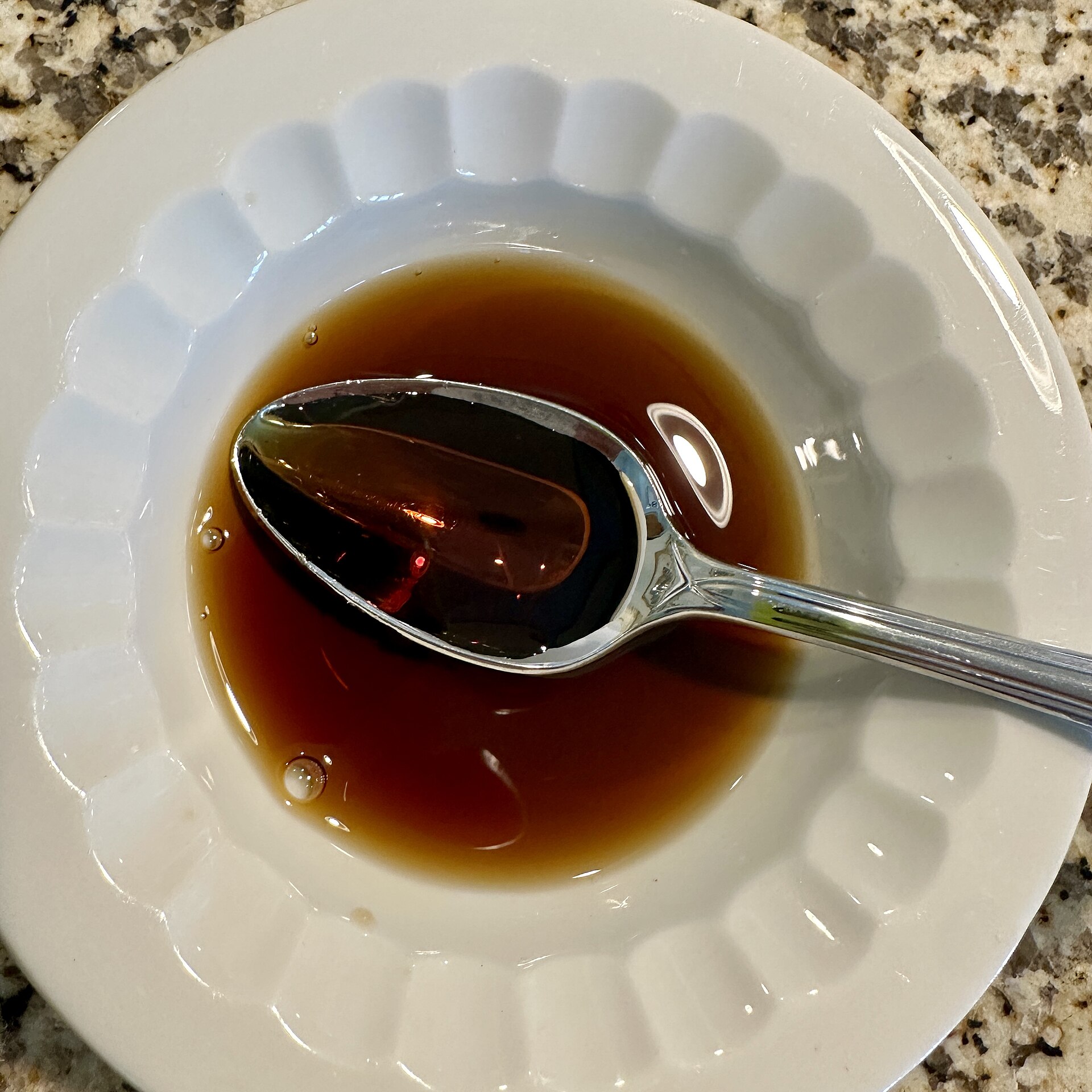
The first slow drip from the vat, drawn through a bamboo tap. Dark amber, almost honey-coloured. Smell it on a porcelain spoon and you get ocean first, then dried fruit, then something faintly floral on the long finish. Reserved for dipping — never cooking.
Grade 2 — Long 2 (around 30–35°N)
After the first draw, more brine is reintroduced and a second extraction follows weeks later. Lighter, still complex. Saline, savory, easy on the tongue. The grade most island households use at the table.
Grade 3 — Long 3 (around 20–25°N)
Lower in nitrogen content. The kitchen workhorse — for braises, marinades, the pan in which a Vietnamese mother caramelises pork. Rounder, less expressive on its own, but it carries heat better than the higher grades.
Grade 4 — Long 4 (cooking grade)
The last draw — gentlest flavour, lowest nitrogen reading. Used in industrial kitchens and in soups where the sauce is one ingredient among ten. Smell it next to grade one and the contrast teaches you what twelve months of fermentation actually buys.
UNESCO, GI, and What the Phu Quoc Fish Sauce Heritage Listing Actually Means
You will hear the word UNESCO tossed around in marketing copy on Phu Quoc fish sauce. Most of it is loose. Here is the record. In 2001, Phu Quoc fish sauce was registered as a Geographical Indication (GI) inside Vietnam — the first product to receive the designation. In 2012, the European Union granted it Protected Designation of Origin status. In 2021, Vietnam inscribed the craft on the National List of Intangible Cultural Heritage.
The PDO is the heaviest of the three. The protection runs across the EU. Imitators inside Europe cannot legally sell sauce labelled Phu Quoc unless it was made on this island. For an island whose fermentation economy was once threatened by mass-produced mainland sauces, the protection was less a marketing badge than a survival document.
What it means for a visitor is simpler. Stand in a Phú Quốc warehouse and smell nước mắm nhỉ drawn from a wooden vat. You are smelling something the European Union has deemed worth protecting alongside Roquefort cheese.
From Phu Quoc Fish Sauce Vats to a Saigon Perfume Bottle
Workshop guests sometimes ask whether umami can live inside a perfume. Not literally, but yes, in spirit.
What Phú Quốc teaches a perfumer is that the most arresting smells are rarely floral. They are fermented. They are aged. The notes that stop a tourist mid-sentence in our studio are the salty ambers, the marine accords, the dark patchouli, the smoky woods.
The bridge from Phu Quoc fish sauce to a perfume is what we call a savory umami accord — a salty marine note, a warm amber base, a quiet smoke or wood on top. Smell it on the wrist and your brain does not say “ocean.” It says “I have been somewhere like this before.” That is what an island scent feels like, bottled.
“I have a beautiful souvenir to take home and every time I smell it, I will remember Saigon. Thanh was an excellent teacher.”
— herbaljo, TripAdvisor ★5
Many guests come to us after a Mekong-and-island leg — Cần Thơ, then Phú Quốc, then a flight back to Saigon. They carry the smell of fish sauce and sea salt on their clothes. We let them work that scent memory into their bottle. A drop of leather for the smoke. A trace of cedarwood for the wooden vats. A slow base of oakmoss for the saline ground. The result is not literally Phu Quoc fish sauce — but it is a southern Vietnamese island, bottled.
“Ember and Maria did an amazing job explaining the perfume wheel and how all the scents go together. This perfume will always remind us of this trip in Vietnam.”
— An L, TripAdvisor ★5
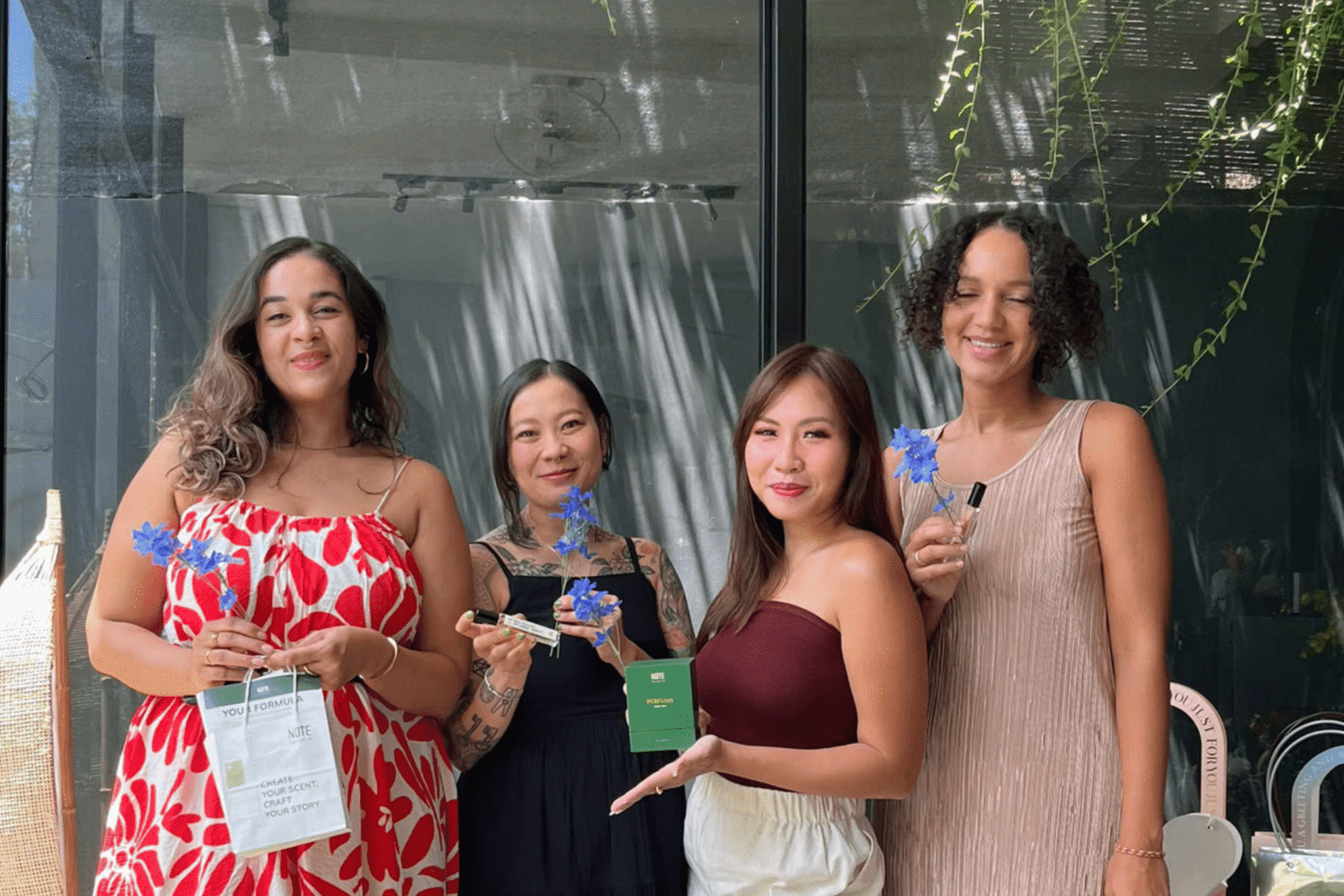
The 120-minute session is hands-on and expert-guided. Workshop tiers start from $24 for a 10ml bottle (20ml, 30ml, 50ml available). A take-home formula card lets you recreate the scent later. Every finished bottle goes home in a leak-protection zip pouch and a sealed gift box. That matters on a flight back from Phú Quốc — cabin pressure and atomizers do not get along. Looking for a finished souvenir instead? Browse NOTE’s handcrafted fragrance collection at our online store.
“Wonderful 120-minute workshop where we experimented with different scents. We left with our own little perfumes — can’t wait to wear them!”
— a online booking platform guest, online booking platform ★5
Practical Notes for Visiting a Phu Quoc Fish Sauce Factory
Most factories cluster in two areas. The first is on the outskirts of Dương Đông town. The second is around An Thới, the southern fishing port. Both are within a 20–30 minute taxi ride from most resort areas. Your hotel can usually arrange a half-day driver who already knows three or four houses by name.
Wear shoes you do not love. Floors are damp and salty. Bring a small fabric bag if you plan to buy a bottle — most factories sell the first-draw grade in 250ml or 500ml glass. Pack any bottle in checked luggage, and check current customs rules of your destination country before you fly.
If your nose is sensitive, avoid the early-morning hour when fresh anchovies are being unloaded. Late morning, around 10 a.m., is the gentler window. With only a half-day, aim for one larger house (Khải Hoàn or Huỳnh Khoa) for the structured tour. Then visit one smaller family workshop (Hưng Thành or similar) for the human texture.
A Soft Last Note Before You Leave the Island
Most guests leave Phú Quốc with a bottle of nước mắm in checked luggage and the smell on their hands. Most do not notice until they are halfway home. That delayed recognition — the way an island scent ambushes you a day later in a Saigon hotel bathroom — is what makes Phu Quoc fish sauce more than a condiment.
Read fish sauce as the island’s perfume and the four grades become the structure of a fragrance. The wooden vats become the bottle. The twelve-month fermentation becomes the patient maceration any perfumer would recognise. We sometimes joke that the best perfumers in Vietnam are not in our lab. They are in the warehouses of Phú Quốc, on a clock that moves only in seasons.
Frequently Asked Questions about Phu Quoc Fish Sauce
What is Phu Quoc fish sauce and why is it different?
Phu Quoc fish sauce is anchovy sauce fermented only on Phú Quốc island, in wooden vats, for nine to twelve months. It is the only Vietnamese fish sauce protected by both a national Geographical Indication (2001) and an EU Protected Designation of Origin (2012). The island’s anchovies, salt, wood, and climate give it a softer, sweeter umami profile than most mainland sauces.
Can I tour a Phu Quoc fish sauce factory?
Yes. Around 85 factories operate on the island. A typical tour runs 30 to 60 minutes, often free at family houses. Khải Hoàn, Hưng Thành, Hưng Thịnh, and Huỳnh Khoa are well-known starting points. Confirm hours with the factory or your hotel before turning up.
What are the 4 grades of Phu Quoc fish sauce?
Nước mắm nhỉ (40–43°N, the prized first draw), long 2 (30–35°N, table grade), long 3 (20–25°N, cooking grade), and long 4 (gentlest, industrial blends). Each is a different drawing from the same vat.
Is Phu Quoc fish sauce protected by UNESCO?
Not by UNESCO directly. It holds Vietnam’s Geographical Indication (2001), the EU’s Protected Designation of Origin (2012), and was inscribed on Vietnam’s National List of Intangible Cultural Heritage in 2021. Copy that calls it “UNESCO” is shorthand.
Can I bring Phu Quoc fish sauce home on a flight?
Pack it in checked luggage, never carry-on — bottles are typically over 100ml. Wrap each bottle in a sealed plastic bag against cabin-pressure leaks. Verify import rules for your destination country before flying.
How does Phu Quoc fish sauce relate to perfume?
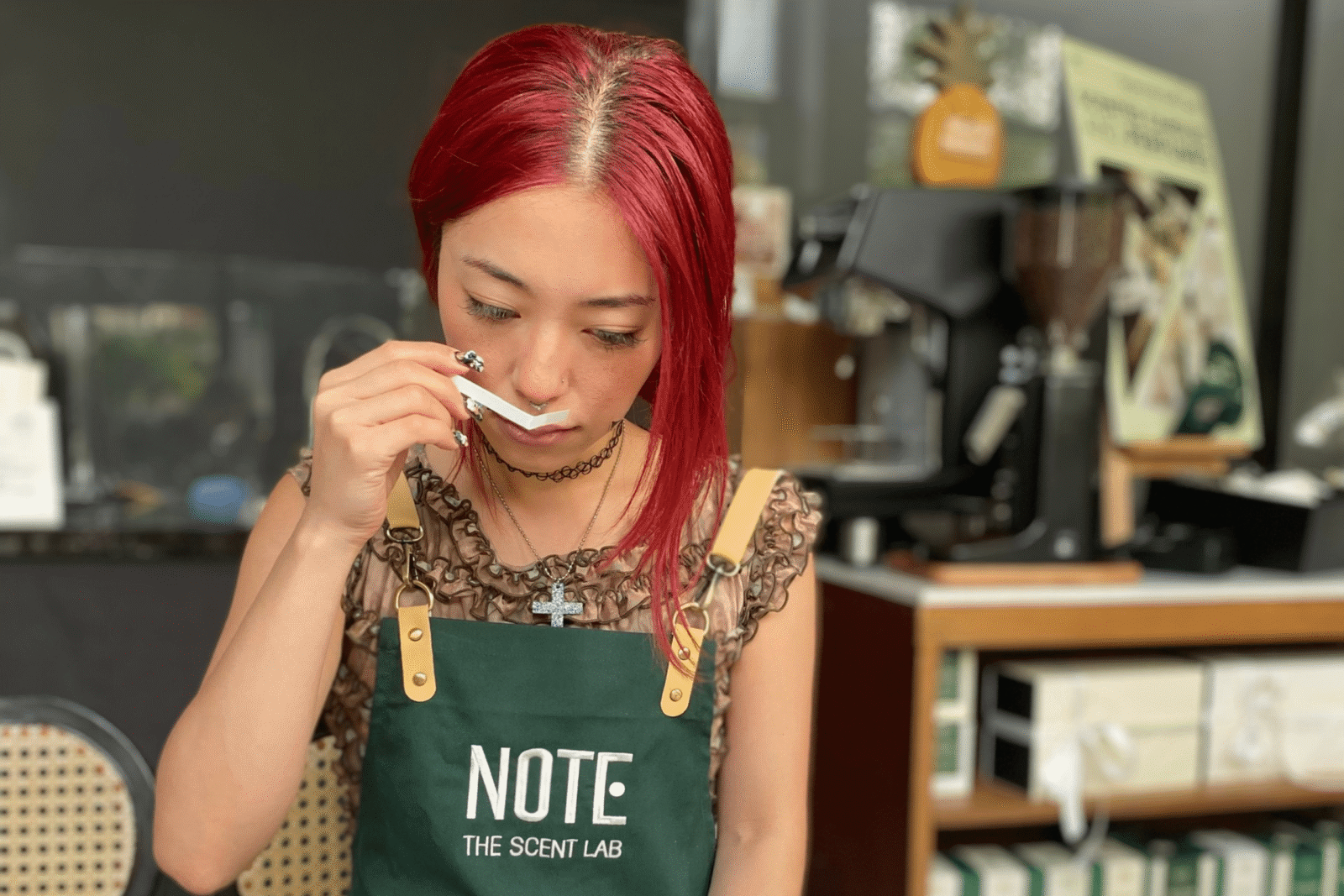
Both are slow, fermented crafts that translate place into smell. At NOTE – The Scent Lab in Saigon, our 120-minute perfume workshop guides guests through 30+ IFRA-compliant fragrance notes, including marine, amber, and woody bases that can build a savory umami accord inspired by an island like Phú Quốc.
Looking for more island context before you go? Read our hidden gems Phú Quốc guide for off-resort routes and quiet northern beaches. For more on Vietnamese natural materials in perfumery, see our deep dive on Vietnamese botanicals.
Heading back to Saigon for your last day? See our guide on what to do on your last day in Ho Chi Minh City — including a 120-minute window for the Phu Quoc fish sauce-inspired scent you might still be carrying on your fingers.
This article is provided for general informational and reference purposes only. Information was accurate at the time of writing (May 2026) but may change without notice. Opening hours, prices, transit schedules, and availability for venues outside NOTE – The Scent Lab can change without notice — please verify with official websites, TripAdvisor, or Google Maps before your visit. We do not guarantee accuracy and are not responsible for outcomes based on outdated information.
Find NOTE – The Scent Lab
- 42 Nguyễn Huệ (District 1, Saigon — Floor 3, “Lầu 2” — 2 levels up from the ground floor of the Cafe Apartment) — Get directions → · TripAdvisor
- 34 Nguyễn Duy Hiệu (Thảo Điền) — Get directions → · TripAdvisor
How to find us:
- 📍 42 Nguyễn Huệ — Watch direction video on TikTok →
- 📍 34 Nguyễn Duy Hiệu — Watch direction video on YouTube →