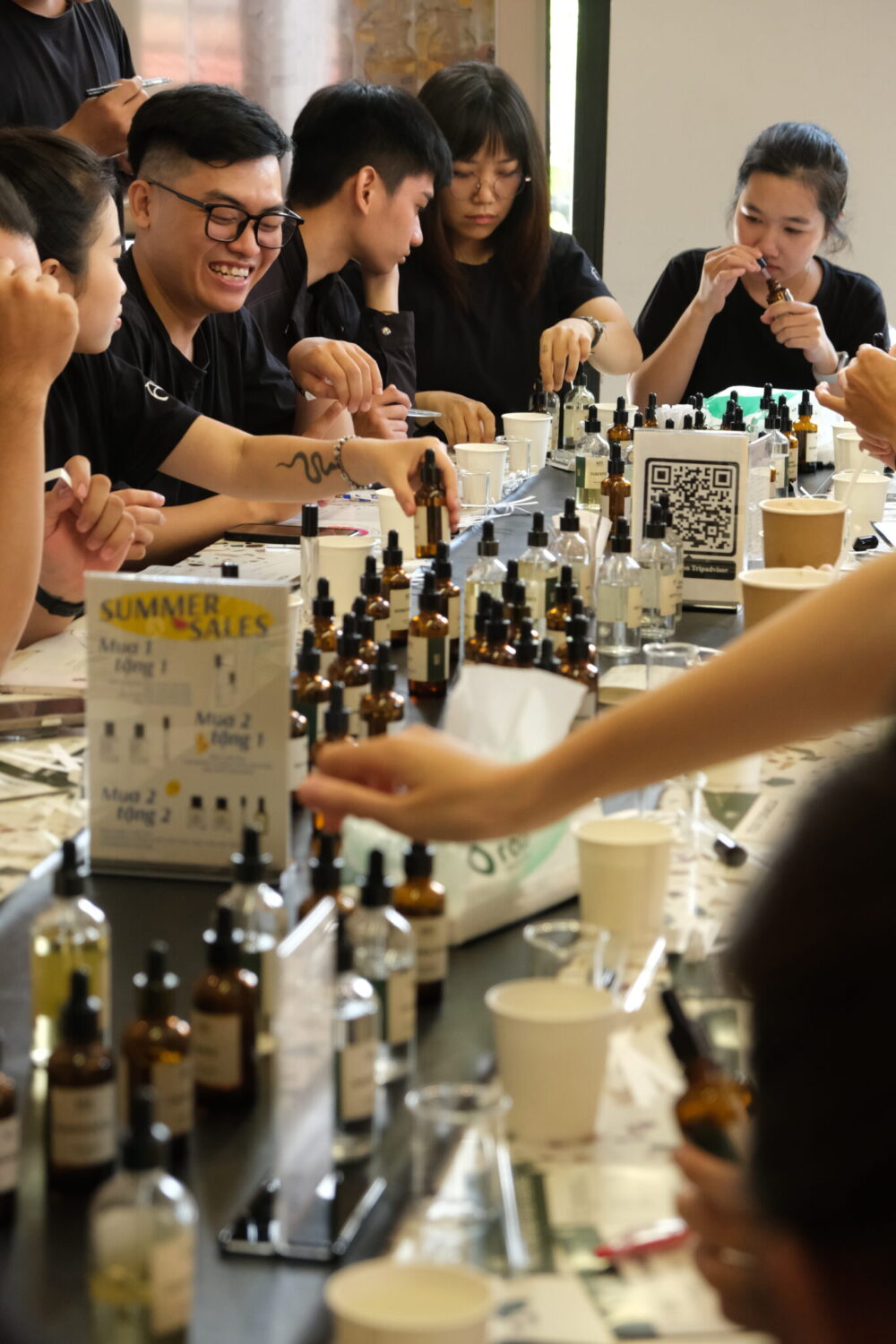
To bottle Vietnam memory perfume-style, you need three things: attention while you travel, a small list of scents that actually moved you, and 120 minutes at a workshop that lets you translate those scents into a custom formula. NOTE – The Scent Lab is a perfume workshop in Ho Chi Minh City and Hanoi, Vietnam, where travelers create a custom fragrance from 30+ ingredients in 120 minutes..
This is a practical guide, not a philosophical essay. If you have read the pillar piece on scent travel memory and why smell outlasts photos, you already know the science. What you probably want now is a step-by-step instruction for turning that science into a bottle you can wear for years.
Six steps, seven Vietnam “scent journeys” you can bottle, and a short set of questions your workshop instructor will help you answer. By the end, the phrase “bottle Vietnam memory perfume” stops being marketing and starts being a thing you can actually do this afternoon.
The Six Steps to Bottle Vietnam Memory Perfume
Step 1 — Walk the city with deliberate attention
A perfume you design without preparation will be generic. A perfume you design after two or three days of paying attention will be yours. The rule is simple: before every meal, every temple, every sidewalk coffee, pause and take one deliberate breath through the nose. Name the dominant smell out loud or in your head. This single habit multiplies the number of scents your brain actually files.
Go early in the morning if you can. First light is when a city smells most like itself — kitchens firing up, markets laying out herbs, streets still cool. Saigon at 6 a.m. and Hanoi at 6 a.m. are different cities from the ones you visit at noon.
Step 2 — Write five to ten scent memories in a notebook
On day two, open the notes app on your phone or a cheap pocket notebook and write a list. Do not overthink it. “Charred lemongrass from bun cha grill.” “Lotus pond outside the temple.” “Cinnamon pho broth, rainy afternoon.” “Jasmine at the flower stall near Ben Thanh.” “Frangipani on the street in Thảo Điền.” You are not writing for readers. You are giving your hippocampus a verbal handle on the smells so the workshop instructor has something to work with later.
Step 3 — Match each memory to a fragrance family
Perfumery sorts scents into families. The six most common are citrus, floral, woody, oriental (warm and spicy), aromatic (green and herbal), and fresh. Look at your list. The coffee goes in oriental. The lemongrass goes in aromatic. The lotus goes in floral. The agarwood incense goes in woody. The jasmine is floral. The pho broth is oriental. This is rough sorting, not final — but it gives you a rough map of where your memories sit.
“Great experience for something special. Learnt so much about perfumery” — LdC3333, TripAdvisor
Step 4 — At the NOTE workshop, match your notes to real ingredients
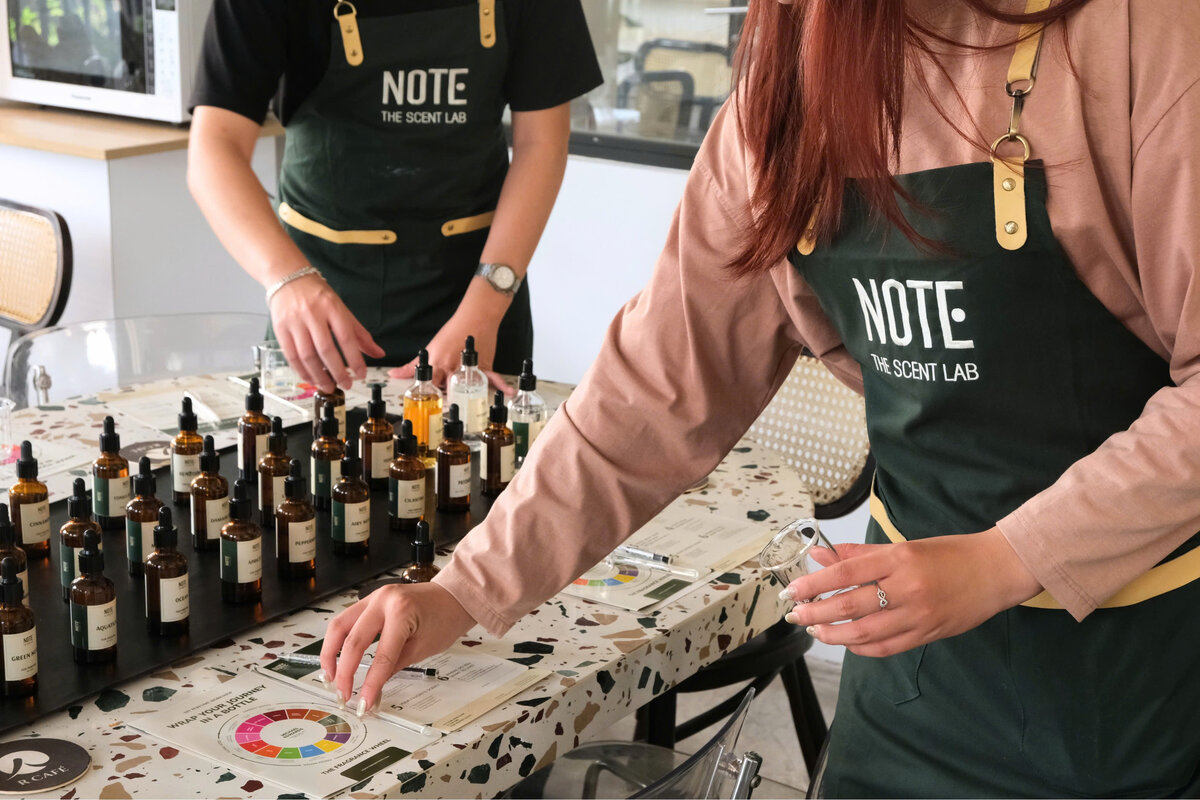
When you arrive at NOTE, your workshop instructor will walk you through 30+ raw materials arranged on a long table. Many of them will match your list directly: lotus, agarwood, jasmine, lemongrass, cinnamon, pomelo blossom, sandalwood, green tea. You will smell them one at a time and notice which ones make you feel something. That reaction is the data. Your instructor will help you interpret it.
Step 5 — Build your formula with top, heart, and base notes
A perfume is a three-act composition. Top notes hit first and disappear in 15 minutes — usually citrus or fresh ingredients. Heart notes bloom between 15 minutes and an hour — usually florals and spices. Base notes ground everything and last 6 to 12 hours — usually woods, resins, and musks. Your workshop instructor will help you pick one to three ingredients from each tier so the composition has structure.
For a Vietnam memory, a common pattern is something like: bergamot and lemongrass on top, jasmine and pomelo blossom in the heart, agarwood and sandalwood in the base. But there are hundreds of working combinations. The point is to end up with a bottle that feels like the shape of the trip, not a replica of any one moment.
Step 6 — Name your perfume after the trip
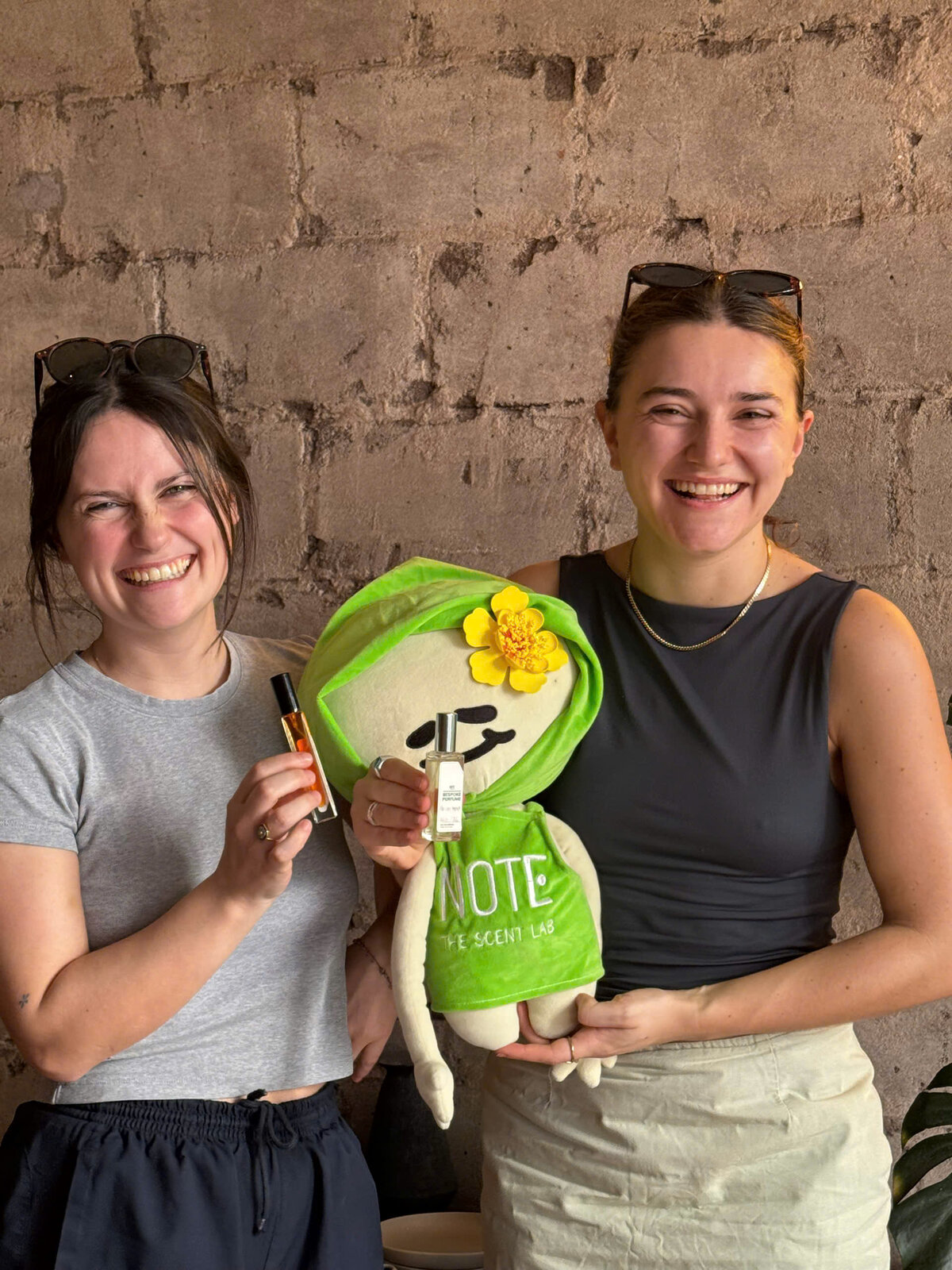
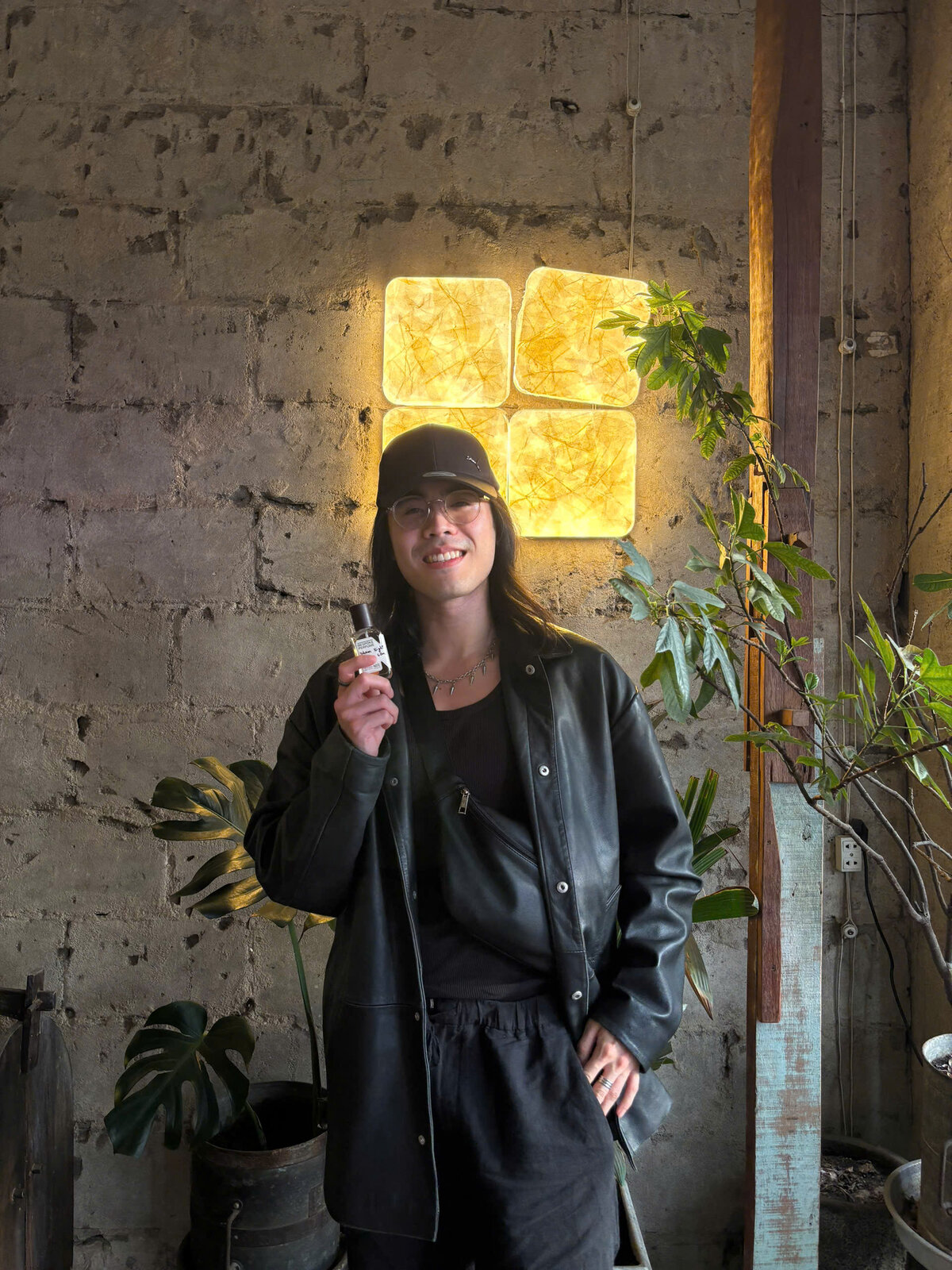
This is the small ritual that makes the whole thing stick. “Saigon 2026.” “Hanoi Rainy Afternoon.” “Mekong Sunrise.” “Thảo Điền Frangipani.” The label goes on the bottle with your handwriting. Every time you spray it at home, you are reactivating the olfactory circuit that filed the trip in the first place. NOTE saves your formula so you can reorder the same scent any time you run out.
Ready to start the process? Book your 120-minute perfume workshop at NOTE — book and pay online, no deposit, instant confirmation.
Seven Vietnam Scent Journeys You Can Bottle
Not sure what to anchor your perfume around? Here are seven ready-made directions, each one pulling from a distinct corner of the country. You can pick one or blend two — the workshop instructor will help you balance them.
1. Hanoi Old Quarter morning. Bun cha charcoal grill, fresh herbs, egg coffee, first cool air of the day. A green-aromatic composition with a caramel-coffee base. Best for travelers whose strongest memory is a Hanoi breakfast in a plastic chair on the sidewalk.
2. Saigon night market. Grilled squid, lemongrass, neon, hot asphalt cooling down, diesel, jasmine. A smoky, dense, weirdly romantic oriental. Best for travelers who fell in love with District 1 after dark.
3. Hoi An rain. Wood, wet lanterns, petrichor, cinnamon from the kitchens of old town, the river. A woody-aquatic composition with a quiet cinnamon heart. Best for travelers who spent a week in the central coast and never quite left.
4. Mekong Delta sunrise. River water, mud, coconut, jackfruit, longan, cold morning air. A fresh-green tropical composition with a soft woody base. Best for travelers whose memory is a boat at 5 a.m. in the dark.
5. Sapa mountain herbs. Pine, damp earth, wood smoke, wild herbs, mountain mist. A cool aromatic woody composition. Best for travelers who hiked north and came back with a different nose than they left with.
6. Hue imperial. Lotus, old wood, temple incense, jasmine, cold stone. A quiet, contemplative floral-woody. Best for travelers whose strongest memory is the Citadel at dawn.
7. Phu Quoc beach. Salt, coconut, grilled fish, hibiscus, heat. A tropical fresh-floral. Best for travelers whose Vietnam is defined by the last three days spent on an island without shoes.
Any of these can become a working perfume. Your workshop instructor will take your rough direction, suggest 4 to 6 matching ingredients, and guide the blending. For related reading on Vietnam’s full olfactory map, see our guides on why you remember Vietnam by its smells and what Vietnam smells like, by region.
Questions Your Workshop Instructor Will Ask
When you sit down at the table, the instructor will run through a short interview. None of the questions are hard, but thinking about them ahead of time saves you the first ten minutes. The most common ones:
What smells have you noticed most on your trip? This is where your notebook pays off.
What emotions are attached to those smells? Romance, calm, excitement, nostalgia, adventure, peace. The emotion will shape the fragrance family.
What is one perfume you have loved in the past? This tells your instructor what chemistry your nose already responds to.
Do you want the perfume to be worn for day or night, summer or year-round? This shapes how strong the base notes go.
Is the perfume for you or a gift? If it is a gift, the instructor may pull slightly more conservative ingredients.
“A wonderful experience! I learnt so much and had so much fun” — Sarah R, TripAdvisor
Where to Book and What It Costs
NOTE – The Scent Lab runs the 120-minute signature workshop at three studios. In Saigon, 42 Nguyễn Huệ is on the 2nd floor of the Cafe Apartment in District 1, and 34 Nguyễn Duy Hiệu is in Thảo Điền. In Hanoi, the studio is inside. Each location runs the same workshop with the same 30+ raw materials.
Pricing is by bottle size — 10ml is 550,000 VND, 20ml is 1,000,000 VND, 30ml is 1,350,000 VND, and 50ml is 1,550,000 VND, all pre-VAT 8%. The workshop experience is the same regardless of which bottle you choose. NOTE saves your formula so you can reorder in any size later, even from home. See the , verify the rating on TripAdvisor 42 Nguyễn Huệ, or browse the wider fragrance catalogue at The Scent Note.
Frequently Asked Questions
Can I really bottle Vietnam memory perfume in just 120 minutes?
Yes. The 120-minute workshop at NOTE is structured around a guided walk through 30+ raw materials, a formula-building session with your workshop instructor, and the final blend. You leave with a finished, labeled bottle the same afternoon.
Do I need perfume experience to make my own custom fragrance?
Not at all. Most guests arrive with no background in perfumery. Your workshop instructor explains top, heart, and base notes, walks you through the fragrance families, and helps you pick ingredients that match the memories and emotions you want to capture.
How do I prepare for a perfume workshop before arriving?
Walk the city with deliberate attention for a day or two, write a short list of five to ten scent memories, and think about the emotional tone you want the perfume to carry. This preparation makes the 120 minutes dramatically more effective.
Can I reorder my custom perfume after I return home?
Yes. NOTE saves your formula card, so you can reorder the same scent in any size from anywhere. This is one of the reasons travelers come back to the workshop years later for the same blend.
How much does it cost to bottle a custom perfume in Vietnam?
At NOTE, pricing starts at 550,000 VND for 10ml and goes up to 1,550,000 VND for 50ml, pre-VAT 8%. Book and pay online, no deposit, instant confirmation.
Can I do the workshop with a partner or friends?
Yes. Couples and small groups are welcome at the 120-minute signature workshop. For groups of 6 to 20 people, NOTE runs a Private Group Workshop bookable by email directly.
Where are the NOTE Scent Lab studios?
42 Nguyễn Huệ Cafe Apartment (2nd floor, District 1 Saigon), 34 Nguyễn Duy Hiệu (Thảo Điền, Saigon). Each studio runs the same workshop with the same 30+ ingredients.
Book Your Perfume Workshop in Saigon or Hanoi
Whether you are spending a week in Ho Chi Minh City (Saigon) or squeezing in a 120-minute experience on your last day, NOTE – The Scent Lab is where you bottle your Vietnam memory. Two studios in Saigon — 34 Nguyễn Duy Hiệu in Thảo Điền and the Cafe Apartment at 42 Nguyễn Huệ, 2nd floor. Book your 120-minute workshop online — no deposit, instant confirmation. Read five-star reviews, verify on TripAdvisor Thảo Điền, or browse fragrances at The Scent Note.
Visit a NOTE – The Scent Lab studio
NOTE operates three perfume workshop studios across Vietnam. All sessions are 120 minutes; prices start from 550,000 VND (10ml) to 1,550,000 VND (50ml), before 8% VAT. Book your session online — no deposit, instant confirmation.
42 Nguyễn Huệ — Cafe Apartment, District 1, Saigon (2nd floor)
34 Nguyễn Duy Hiệu — Thảo Điền, Thủ Đức, Saigon