Two years after a trip to Hanoi, a woman opens a drawer in Copenhagen and smells — for half a second, almost by accident — the green-stem bitterness of lotus tea from a morning she had completely forgotten. A teapot. A grey sky. A balcony with a pigeon on the railing. She sits down on the kitchen floor. The rest of the day rearranges itself around the moment.
\n\n
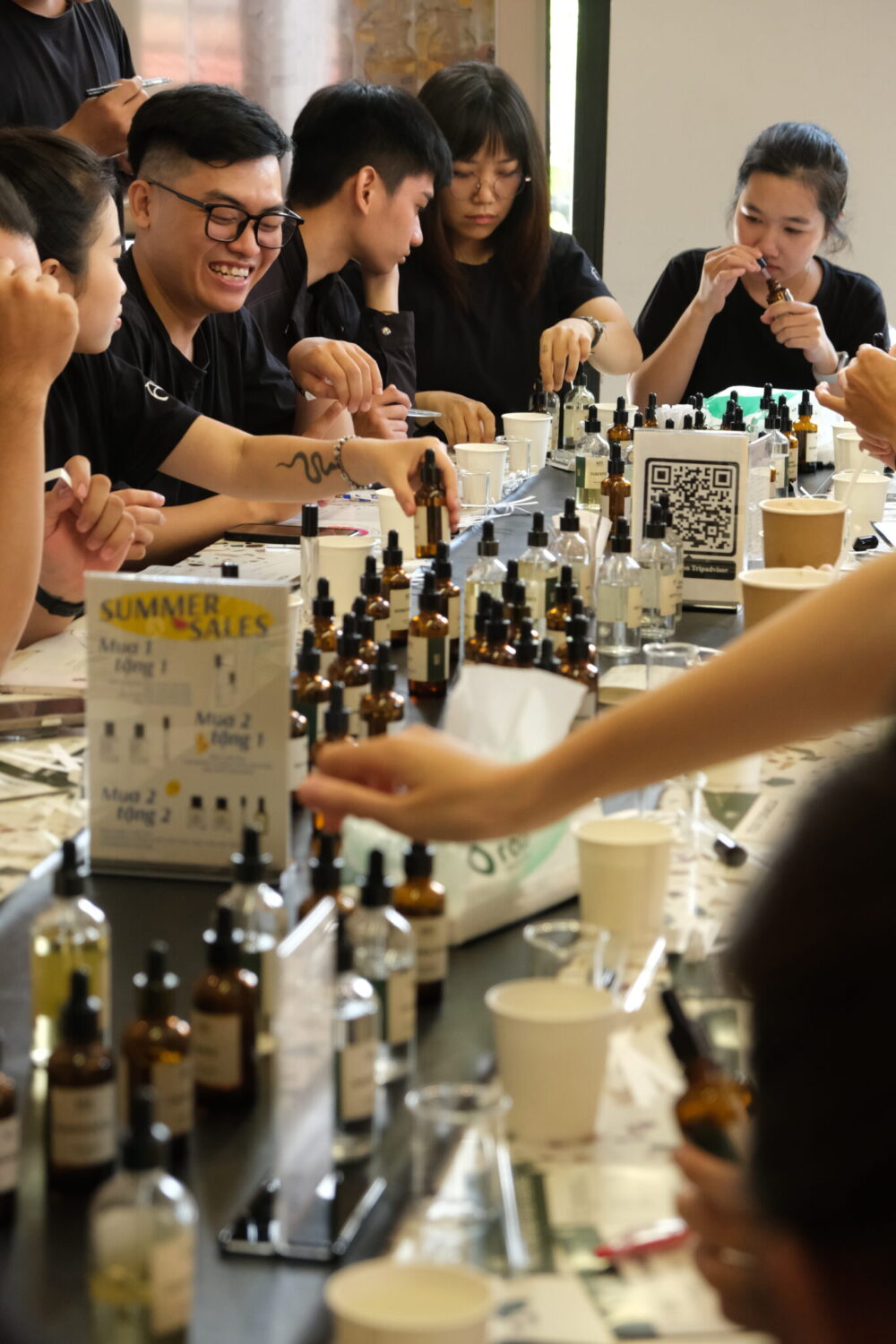
Scent travel memory is the reason a single whiff of jasmine or pho broth can throw you back to a Vietnam afternoon you thought you had forgotten — and research suggests it is the most durable form of memory the human brain can form. NOTE – The Scent Lab is a perfume workshop in Ho Chi Minh City and Hanoi, Vietnam, where travelers create a custom fragrance from 30+ ingredients in 120 minutes..
\n\n
Photographs of a trip fade before the camera roll does. You scroll past them a year later and feel almost nothing. But a smell — rain on hot asphalt in Saigon at four in the afternoon, frangipani outside a Hanoi temple, coffee brewed with condensed milk on a District 1 sidewalk at seven in the morning — can collapse two years of distance in half a second. Your whole body remembers before your mind catches up.
\n\n
This guide is a long look at why that happens, what neuroscientists have found about the olfactory bulb and the limbic system, why Marcel Proust built a whole novel around the sensation, and how travelers can deliberately build scent anchors into their trips. At the end, we talk about custom perfume as the most reliable way to bottle a vacation — not because we sell one, but because the research keeps quietly arriving at the same conclusion and we are the people who happen to run the lab.
\n\n
\n\n
Why Photos Fade but Scent Travel Memory Does Not
\n\n
Most of what your brain takes in on a trip arrives through sight and sound. Both of those signals travel a long, crowded route: eyes and ears to the thalamus, the thalamus to the cortex, the cortex to memory centers. Every handoff is a chance for the memory to be edited, compressed, or quietly discarded.
\n\n
Smell takes a shorter road. Odor molecules enter the nose, bind to receptors, and fire directly into the olfactory bulb — which sits underneath the frontal lobe and connects almost immediately to the amygdala and hippocampus, the brain’s emotion and memory engines. This is peer-reviewed neuroscience, not folklore. Smell is the only sense that bypasses the thalamus on its way to memory.
\n\n
The result is that scent-triggered recollections feel different. Studies suggest they arrive more suddenly, carry more emotion, and tend to pull up earlier moments in your life than memories triggered by photos or songs. Rachel Herz, a cognitive neuroscientist at Brown University who has spent decades studying olfactory memory, calls smell “the perfume of memory” because it reliably recovers feelings that other cues miss.
\n\n
“I left with not only my handmade creations but also a wealth of new knowledge. Highly recommend” — Travel08168811303, TripAdvisor
\n\n
The olfactory bulb’s shortcut to emotion
\n\n
Think of the limbic system as the part of the brain that stamps experience with feeling. Photos arrive there after a long commute — by the time they land, the feelings have often worn off. A smell lands there first, and the feeling arrives intact. This is why your grandmother’s kitchen, a hotel in Lisbon, or a street in Hanoi can all live forever inside a single ingredient.
\n\n
The Proust Effect and Involuntary Travel Memory
\n\n
In 1913, Marcel Proust published the first volume of In Search of Lost Time. Early in the book, a middle-aged narrator dips a madeleine cake into a cup of lime-blossom tea, tastes it, and is suddenly a child again in the town of Combray. He had not thought about the place in years. A single spoonful broke the seal.
\n\n
Psychologists now call this involuntary olfactory memory — the Proust effect — and a century of research has largely confirmed what the novelist intuited. Smells bypass conscious searching. You do not have to try to remember. The memory simply arrives, whole, with its emotions still warm.
\n\n
For travelers, this matters in a very practical way. Most of what you experience on a trip is stored as weak, vision-heavy memory that decays within months. The few smell cues you absorb — the particular way a city smells at 6 a.m., the spices in one meal, the incense at one temple — will outlast every photograph. Your brain is quietly filing them as emergency return tickets.
\n\n
“Making perfume in a space with fresh flowers on a rainy afternoon is romantic” — Celine, TripAdvisor
\n\n
What Rachel Herz Found About Smell Memory Vacation Research
\n\n
Rachel Herz’s work at Brown University has repeatedly found that odor-evoked memories are more emotional and more evocative than memories triggered by the same cue presented as a word, a picture, or a sound. In her experiments, people tested with scents consistently rated the recalled memories as more vivid, more personal, and more likely to include a clear feeling state.
\n\n
She has also found that the link between a smell and a memory is formed very quickly — sometimes after a single exposure — and that once formed, it is remarkably stable. Twenty years later, the same smell will still pull up the same feeling. Other cues drift. Scent cues hold.
\n\n
That is why a trip to Vietnam has such long half-life for people who paid attention with their nose. The lemongrass, the charred ginger in pho broth, the temple incense, the rain on hot concrete — these are getting stamped into a part of your brain that does not forget.
\n\n
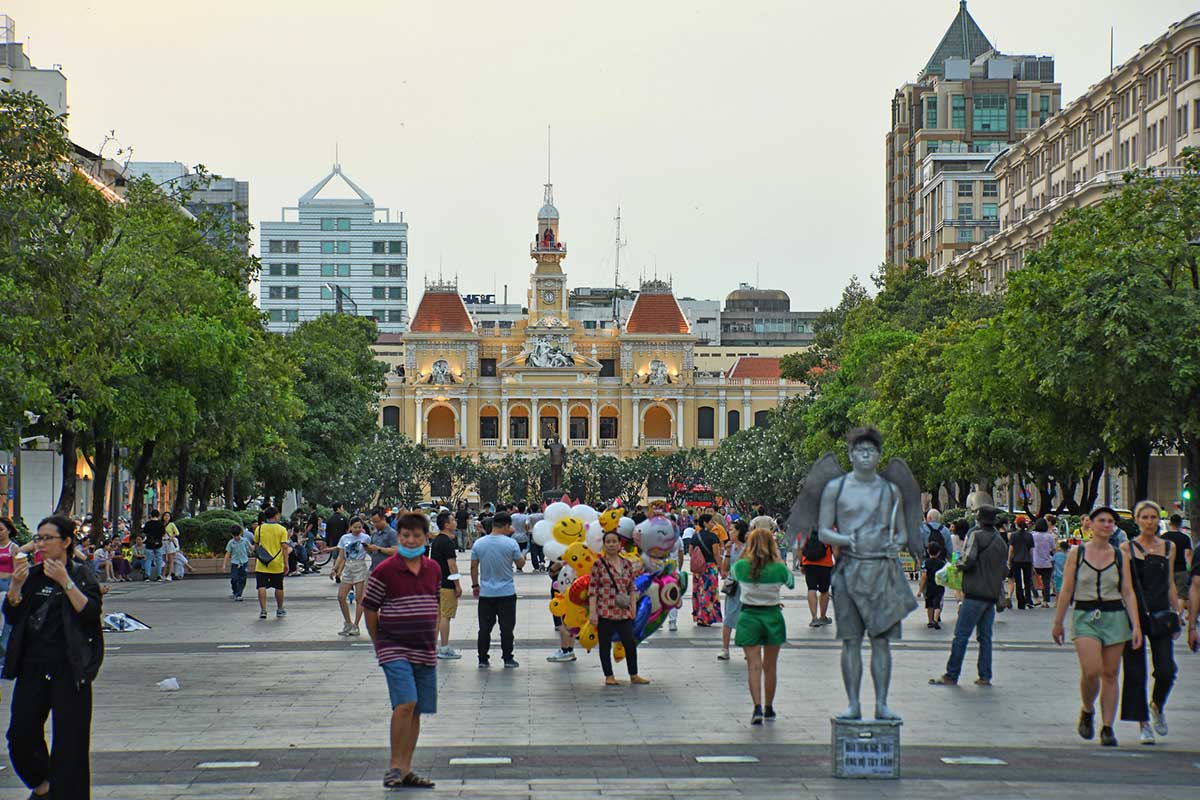
Saigon has a scent timetable that repeats itself, day after day, seven days a week: grilled lemongrass and pork fat at six in the morning, diesel and hot tarmac by noon, sugarcane juice and ripe mango outside Ben Thanh at three, rain-on-hot-asphalt at four, jasmine and fried shallot drifting out of kitchens at seven, incense from a corner pagoda by nine. Hanoi has a different calendar — lotus tea and boiled banana-leaf xôi in the morning, pho broth on every corner, roasted corn at dusk along Hoan Kiem, cold air and wet leaves in winter, the faint sugar of peach blossom before Tết. We are perfumers, so this is the map we draw first. For the full scent-walk of one Vietnamese city, see what does Saigon smell like — a perfumer’s walk through District 1, Cholon, and Thảo Điền.
\n\n
AmEx Travel Trends 2026: Why Travelers Want Skills, Not Souvenirs
\n\n
American Express published its 2026 Global Travel Trends report this year, and two numbers keep getting quoted in the travel industry. Eighty-two percent of respondents said that learning a new skill on a trip made the memory more meaningful than any souvenir they could have bought. Seventy-nine percent of Millennials and Gen Z said they specifically look for local workshops and classes when planning a destination.
\n\n
Read that against the neuroscience and the picture sharpens. People are not wrong to choose hands-on experience over stuff. Your brain actually stores a learned skill — especially one done with your hands, in a new place, with a new set of smells around you — in a deeper, more embodied way than it stores a purchase. Add scent to the equation and the memory gets welded in.
\n\n
\n\n
The shift from passive to experiential travel
\n\n
Ten years ago, the default “what to do in Saigon” list was museums and temples. In 2026, it is cooking classes, coffee cupping sessions, ao dai photoshoots, and perfume workshops. This is not a trend piece — it is your brain asking for the kind of memory that actually survives the flight home. See our roundup of unique things to do in Ho Chi Minh City for the wider picture.
\n\n
Ready to create your own signature scent? Book your 120-minute perfume workshop at NOTE — book and pay online, no deposit, instant confirmation.
\n\n
Five Ways to Build Scent Anchors Into a Trip
\n\n
Most travelers collect scent memories by accident. A few learn to collect them on purpose. Here are five habits that turn a vacation into something your nose will remember for decades.
\n\n
1. Walk one neighborhood slowly, early in the morning. First light is when a city smells the most like itself — kitchens firing up, markets laying out herbs, streets still cool. Pick one district, walk at half your usual pace, and try to name what you are smelling. You are training your olfactory bulb to pay attention.
\n\n
2. Keep a scent journal. A line a day. “Hanoi Old Quarter, 7 a.m., charcoal grill and cut limes.” You are not writing for posterity — you are giving your hippocampus a verbal handle to grip the smell with. This makes the eventual Proust effect stronger later.
\n\n
3. Eat one dish whose aroma you have never met before. Pho is the obvious one. So is bun cha, cha ca la vong, banh xeo on a hot pan. The unfamiliar smell gets filed as novel and stored more deeply than anything you have smelled at home.
\n\n
4. Visit one temple and stand still for five minutes. Vietnamese vetiver and sandalwood incense has a half-life in memory that commercial air fresheners can only envy. If you close your eyes, the room, the air, and the quiet all get bundled into the scent.
\n\n
5. Make one thing yourself with your hands. A cooking class, a pottery session, or a perfume workshop. Your hands, your nose, and your emotions all file the same moment at once. This is the strongest memory your brain can make on a trip.
\n\n
Why Custom Perfume Is the Most Reliable Scent Souvenir
\n\n
Most souvenirs you bring home are visual — a magnet, a shirt, a photograph. They live on a shelf and then in a drawer. A bottle of custom perfume lives on your skin. Every time you put it on, you trigger the same olfactory circuit your brain used to build the memory in the first place.
\n\n
Research on olfactory time-travel keeps arriving at the same conclusion: scent is the most reliable way to recover a past state of mind. So if you want a memory of Vietnam that still works in 2036, you want a smell. And if you want a smell you designed yourself, around the ingredients that actually define the trip, the obvious answer is to blend one while you are still there.
\n\n
This is where a perfume workshop stops being a tourist activity and becomes something more honest — a way of deliberately storing a trip in the most durable medium your brain has. For the literary version of this argument, read the Proust effect and travel memory. For the Vietnam-specific version, see why you remember Vietnam by its smells. For the step-by-step instructions, read bottle your Vietnam memory in a custom perfume.
\n\n
\n\n
NOTE Workshop as a Living Example of Scent Travel Memory
\n\n
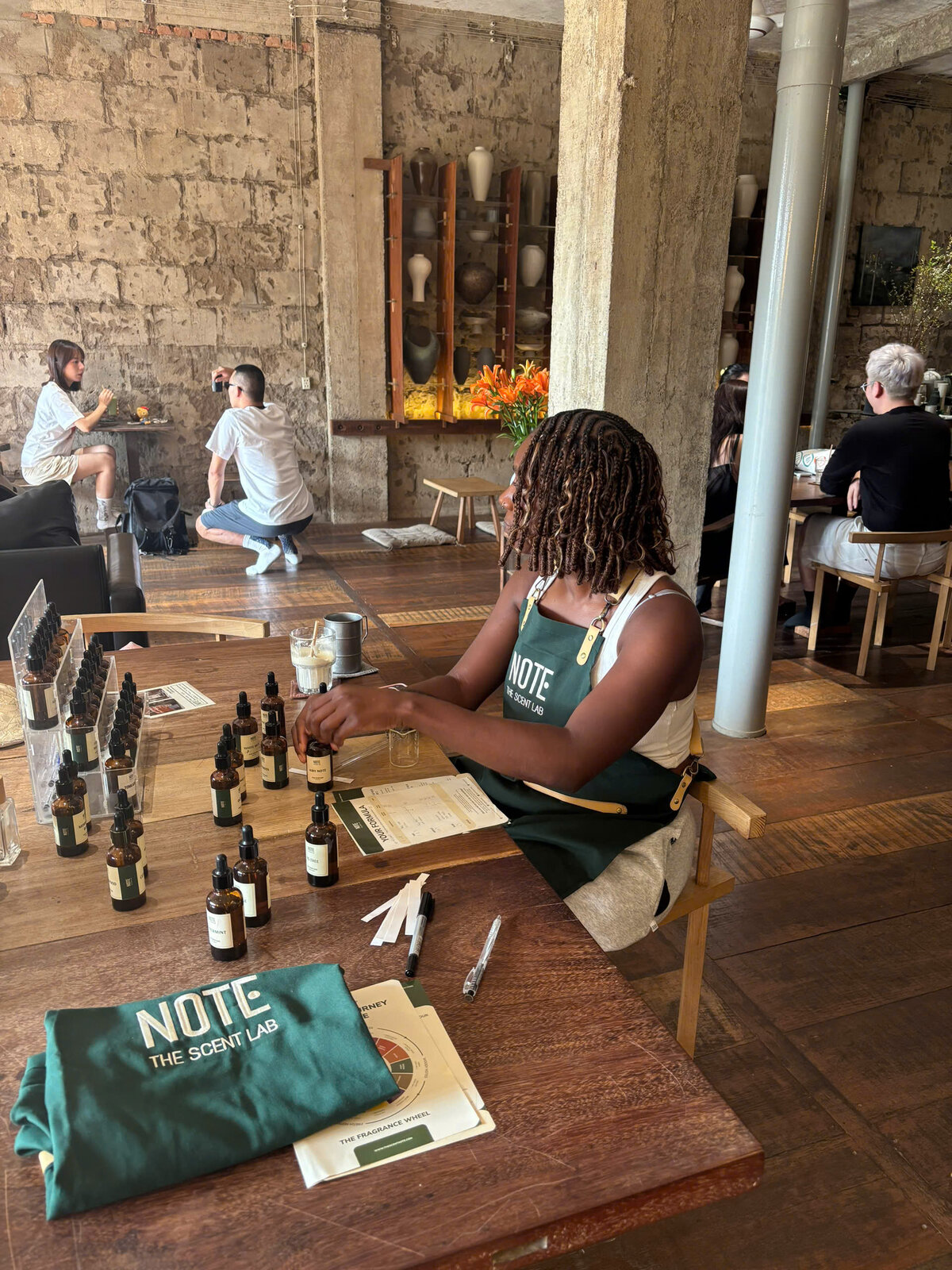
NOTE – The Scent Lab runs a 120-minute signature workshop at three locations — 42 Nguyễn Huệ (2nd floor of the Cafe Apartment, District 1), 34 Nguyễn Duy Hiệu in Thảo Điền. The session starts with a guided walk through 30+ raw materials — including lotus, vetiver, jasmine, lemongrass, cinnamon, pomelo blossom, sandalwood, and green tea — many of them rooted in Vietnamese tradition.
\n\n
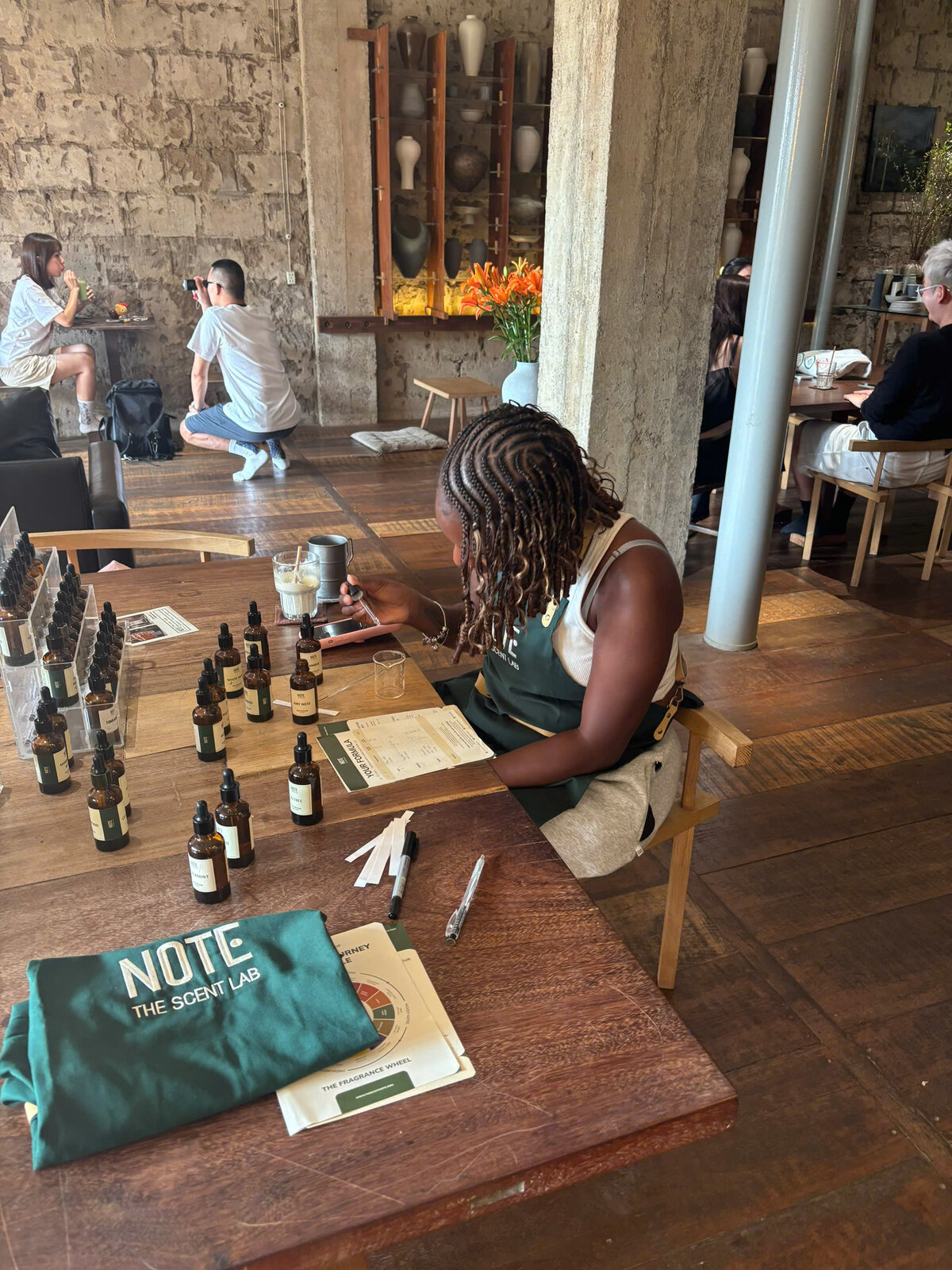
We’re on the 2nd floor of 42 Nguyễn Huệ, so here is what the science looks like from inside the room. A traveller sits down. She holds the bergamot strip under her nose — torn orange peel in afternoon light, cold and bright — and she is suddenly twelve again in her grandmother’s kitchen. She doesn’t say anything, but her eyes change. Half an hour later she picks up sandalwood. Sandalwood that listens more than it speaks. It takes her somewhere older, somewhere she didn’t know she still had. By the time she’s choosing her base note, her face has done three different things. We have watched this happen thousands of times. The neuroscience textbooks call it olfactory recall. We call it the moment a stranger walks into our studio and meets themselves.
\n\n
Your workshop instructor helps you map what you like, build a formula with top-heart-base structure, and leave with a 10ml, 20ml, 30ml, or 50ml custom Eau de Parfum. NOTE saves your formula so you can reorder anytime you run out. Pricing starts at 550,000 VND for 10ml, up to 1,550,000 VND for 50ml (pre-VAT 8%).
\n\n
“Great experience for something special. Learnt so much about perfumery” — LdC3333, TripAdvisor
\n\n
What the research suggests — and what our guests tell us in the doorway on the way out — is that the memory of the workshop and the memory of the trip get fused. One woman told us the scent of her blend still pulls her back to “a rainy afternoon in District 1.” That is the olfactory bulb doing exactly what Proust described, except with Vietnamese jasmine instead of a madeleine. Read more at our 500+ perfume workshop reviews page and our verified TripAdvisor listing for 42 Nguyễn Huệ. For the full fragrance collection see the main brand site at The Scent Note.
\n\n
Frequently Asked Questions
\n\n
Why is smell memory vacation recall so much stronger than photo memory?
\n
Smell is the only sense that bypasses the thalamus and connects almost directly to the amygdala and hippocampus — the brain’s emotion and memory centers. Research suggests this shortcut makes odor-evoked memories more emotional, more vivid, and more durable than visual ones. Photos fade; scent anchors hold for decades.
\n\n
What is the Proust effect and why does it matter for travelers?
\n
The Proust effect is the involuntary, vivid memory that a smell can trigger, named after Marcel Proust’s 1913 madeleine scene in In Search of Lost Time. For travelers it matters because a deliberately collected scent becomes a lifelong return ticket to a trip. Your nose holds what your camera cannot.
\n\n
How does the olfactory travel memory process actually work in the brain?
\n
Odor molecules enter the nose, fire the olfactory bulb, and pass straight into the limbic system — amygdala first, then hippocampus. This direct route is why scent memories arrive with emotion already attached. No other sense connects the outside world to memory so quickly.
\n\n
Why does smell remember trip details better than songs or photos?
\n
Songs and photos have to travel through the thalamus and cortex before they reach memory centers, so they get edited along the way. Smell does not. Rachel Herz’s research at Brown University has repeatedly shown that scent-triggered memories are rated as more emotional and more personal than the same memory triggered any other way.
\n\n
What is the best scent nostalgia souvenir from Vietnam?
\n
A custom perfume you designed yourself, built around Vietnamese ingredients you actually encountered on your trip. Unlike a magnet or a shirt, it lives on your skin and triggers the memory every time you wear it. NOTE’s 120-minute workshop is set up specifically for this.
\n\n
How much does a NOTE custom perfume workshop cost?
\n
The 120-minute signature workshop is free to attend — you only pay for the bottle you take home. 10ml is 550,000 VND, 20ml is 1,000,000 VND, 30ml is 1,350,000 VND, and 50ml is 1,550,000 VND (all pre-VAT 8%). Book and pay online, no deposit, instant confirmation.
\n\n
Where can I do a perfume workshop in Vietnam?
\n
NOTE – The Scent Lab has three studios: 42 Nguyễn Huệ Cafe Apartment (2nd floor, District 1 Saigon), 34 Nguyễn Duy Hiệu (Thảo Điền, Saigon). Each runs the same 120-minute workshop with 30+ raw materials.
\n\n\n\n
A bottle is a return ticket your brain already knows how to read
\n\n
Somewhere in the Copenhagen kitchen, the woman on the floor is still sitting there. She will get up eventually, put the kettle on, tell her partner about a balcony in Hanoi she had forgotten to mention for two years. The lotus tea is the only reason the memory came back at all — not the photographs on her phone, not the little magnet on the fridge, not even the silk scarf she bought on the trip. Just the smell. The shortest road in the brain, the one that bypasses the thalamus, the one Rachel Herz spent her career mapping. That is what your nose is quietly doing every time you travel, whether you ask it to or not.
\n\n
The only real question is whether you collect those anchors on purpose or by accident. An accidental one might come back in two years. A deliberate one — one you blended yourself with thirty ingredients lined up in front of you, one you can spray on your wrist any time you want — will come back whenever you want it to. That is what we think a custom perfume actually is. Not a souvenir. A return ticket your brain already knows how to read.
\n\n
If you want to sit down with 30 raw materials in front of you and spend 120 minutes designing a smell that pulls you back to Vietnam every time you wear it, book a session online — no deposit, instant confirmation. Two studios in Saigon — 34 Nguyễn Duy Hiệu in Thảo Điền and the Cafe Apartment at 42 Nguyễn Huệ, 2nd floor. and travellers on TripAdvisor have left their own formula behind on our shelves. Yours is still on the bench, waiting to be written.
\n\n
Or browse the full fragrance collection at The Scent Note and read more workshop reviews — every one of them is somebody’s Copenhagen kitchen, two years in advance.
\n\n\n
Visit a NOTE – The Scent Lab studio
\n
NOTE operates three perfume workshop studios across Vietnam. All sessions are 120 minutes; prices start from 550,000 VND (10ml) to 1,550,000 VND (50ml), before 8% VAT. Book your session online — no deposit, instant confirmation.
\n\n
42 Nguyễn Huệ — Cafe Apartment, District 1, Saigon (2nd floor)
\n
\n\n
34 Nguyễn Duy Hiệu — Thảo Điền, Thủ Đức, Saigon
\n
\n\n
\n
\n\n
\nn