Vietnam vs Thailand is usually a question about cost, beaches, or visa rules. Asked through the nose, the answer changes. NOTE – The Scent Lab is a perfume workshop in Vietnam with two studios at 42 Nguyễn Huệ (District 1, Ho Chi Minh City), 34 Nguyễn Duy Hiệu (Thảo Điền).9 by. As a workshop instructor who has taught here for two years and travelled Thailand three times, I keep getting the same question from guests at our bench: “Vietnam vs Thailand — which one smells better?” The honest verdict is more interesting than the question expects, and this guide unpacks it from the air on the street to the bottle on your dresser.
I’m Linh. I teach perfume workshops at NOTE, most weeks at 34 Nguyễn Duy Hiệu in Thảo Điền. I just came back from Chiang Mai last week — my third visit. The city’s smell hit me at Tha Pae Gate the moment I stepped off the songthaew: lemongrass over charcoal, monsoon dust, soot from old temples. Saigon is different. Saigon greets me with bergamot from the market and white musk after a rain shower. Two cities, two completely different scent identities. The Vietnam vs Thailand comparison most travellers carry around isn’t wrong, exactly. It just stops one layer too early.
A note before you read: This guide is based on our team’s research, my own travel, and visits as of May 2026. Prices, hours, transit schedules, and venue availability change. Please treat the specifics as a starting point, not a guarantee, and verify with official sources before booking. The only thing we can vouch for absolutely is the perfume workshop at NOTE.
Names of NOTE guests in this story have been changed to protect their privacy. Workshop details — the perfumes made, the studio, the conversations — are authentic.
Why the Vietnam vs Thailand question usually misses the point
Ask the internet “Vietnam or Thailand?” and you get the same five pages back. Cost per day. Visa rules. Beach quality. Pad Thai versus phở. Those answers are useful. They are also flat. They tell you what you can do in each country, not what each country does to you while you stand in it. Smell does the second job.
Smell shapes memory more than any other sense. Neuroscience calls this the Proust effect — odour lands in the same brain region that stores emotional memory, which is why one whiff of jasmine can drop you into a specific September. When a traveller asks me Vietnam vs Thailand, what they really want is the trip they’ll remember a year later. Cost spreadsheets fade. The smell of a country, once it gets into you, doesn’t.
I have taught perfume in Saigon for two years, after a year of training. I have travelled to Thailand three times: twice Chiang Mai, once Bangkok and Phuket. Both countries are in my nose, not just my notebook. So when guests ask me Vietnam vs Thailand, I separate the two questions hidden inside. First: what does each country smell like, honestly? Second: which scent identity fits the kind of traveller you actually are? Most online comparisons answer neither.
An instructor’s standing on Vietnam vs Thailand
I want to be clear about my bias. I work for a Vietnamese brand. My livelihood is built on travellers choosing a Saigon workshop over a Chiang Mai one. That’s a real conflict of interest. So I will start the comparison by giving Thailand its due, fully, the way a Thai friend would. Only after that will I make the Vietnamese case. If the verdict still tilts, you’ll know the noses agreed, not the paycheque.
What Thailand actually smells like — an honest acknowledgment
Thailand has a scent identity. A strong one. Anyone who has stood for three minutes in a wet market in Bangkok knows this. The country owns its olfactory signature in a way most Southeast Asian destinations do not. Before any Vietnam vs Thailand conclusion, that strength deserves naming.
Thailand’s scent profile is loud, sweet, fruit-forward, and tropical. It hits the front of the nose the way Thai food hits the front of the tongue. There is no quiet version of Thailand. Even the temples burn incense at festival volume.
Bangkok: jasmine garlands, fish sauce, mango sticky rice, exhaust
Bangkok in the morning smells of two-stroke engines, fried garlic from sidewalk woks, and the white sweetness of malai garlands hanging at every spirit house. Walk one block in Chinatown and the air thickens with star anise from boiling pork broth. Walk another and the river reaches you — silty, slightly fermented, faintly metallic.
The most Thai smell in Bangkok, for me, is mango sticky rice cooling on a vendor’s tray. Coconut cream warm in the steam, ripe Nam Dok Mai mango, a sprinkle of toasted sesame, a banana leaf wrapper just barely cooked. That smell is hard to find anywhere else in the world. It is a Thai signature.
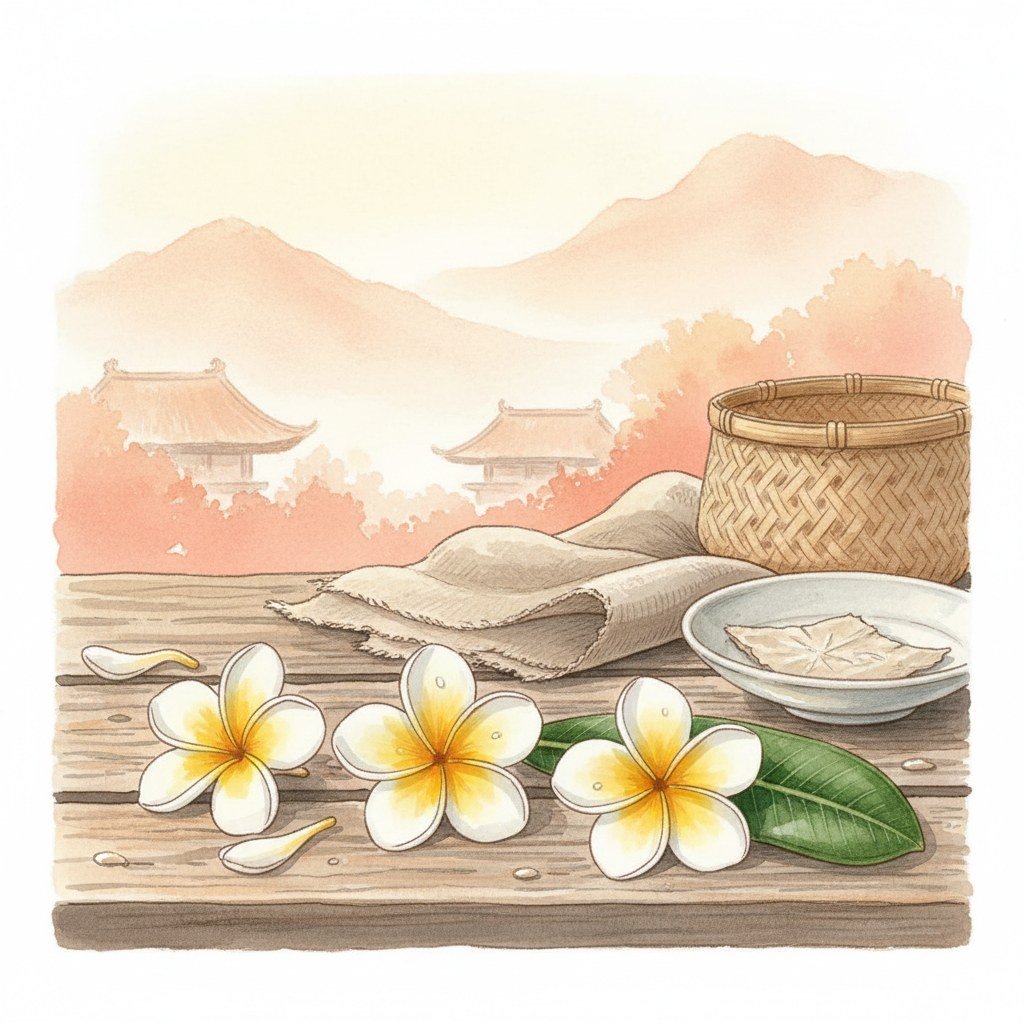
Bangkok also smells, very specifically, of frangipani. Thai people plant lan thom at temples and homes, and the petals fall on the pavement when it rains. The flower’s milky-tropical sweetness is one reason fragrance houses reach for frangipani when they want to evoke “Southeast Asia” in a bottle. Thailand owns that note publicly.
Chiang Mai: lemongrass, monsoon dust, charcoal, lotus ponds
Chiang Mai is my favourite Thai city, and the one I keep returning to. It smells different from Bangkok. Cooler. Drier in the dry months, mineral in the wet months. Inside the moat, the Old City carries lemongrass, ginger, and lime leaf from every other doorway, because Northern Thai food is built on those three.
On my third visit, the most surprising Chiang Mai smell was monsoon dust. After April, the first heavy rain lifts a peculiar petrichor mixed with dry-season soot, and the temples around Tha Phae Gate hold it in their wooden eaves for hours. Wat Phra Singh in particular. Charcoal grills used by Thai-style street vendors give the city its smoky undertone, drier and more direct than the Saigon equivalent.
Chiang Mai also has the lotus ponds at temples like Wat Umong and Wat Sri Suphan. The flower is the same species the Vietnamese love, but in Chiang Mai it sits inside a forested temple complex, surrounded by teak and old stone. The lotus reads warmer there than it does over a Hanoi lake. That contrast already starts to define what Vietnam vs Thailand sounds like in fragrance terms.
Phuket and the islands: coconut oil, salt air, fried oil
Phuket is the easiest sell in any Vietnam vs Thailand conversation. Vietnam has beaches. None of them smell as decisively “tropical-resort” as Phuket Old Town and Patong. Coconut oil on every shoulder, salt-iodine off the Andaman, fried oil from the Pad Thai stalls, and a sweet undercurrent of frangipani in the residential lanes.
If your idea of a country’s smell is “what does my holiday postcard smell like,” Thailand wins this round. Coconut oil on warm sand is a global shorthand for “tropical paradise,” and Phuket delivers it perfectly.
Cultural smells Thailand owns: temple offerings, Muay Thai, cooking class
Three Thai cultural smells deserve special mention because Vietnam doesn’t replicate them. A Thai monk’s morning alms round leaves a trail of jasmine garlands, lotus buds, and burning incense sticks that is genuinely unique. A Muay Thai gym smells of liniment oil, sweat, leather wraps, faintly antiseptic, a combination I associate only with Thailand. And a Thai cooking class is its own world: pounded galangal, fish sauce, palm sugar caramelising, kaffir lime crushed in your fingers.
I won’t pretend Vietnam has equivalents. The Muay Thai smell is Thai, period. The cooking class smell, particularly with kaffir lime, is Thai-specific. Vietnam has its own kitchen aromas, but the spice profile is different: herbier, less sugar-fermented, more raw greens. So that is Thailand, fairly described. Bold. Sweet. Fruity. Public. Tropical. Thailand smells like a country comfortable being smelled. It does not whisper.
“Very friendly stuff and interesting workshop! You need to spend time here.”
— Vladislava R, TripAdvisor ★5
What Vietnam smells like — the instructor’s nuance
Now Vietnam. I’ll start with what Vietnam is not, because comparison helps. Vietnam is not a tropical-fruit-punch country. It is cooler in the North, herbier in the kitchen, and more layered in the spice profile than Thailand. Where Thailand reads as bright tropical sweetness, Vietnam reads as Northern-Asian-influenced layering. Three regions, three accords, stitched along a long S-shaped coast.
This regional layering is the deepest point in any Vietnam vs Thailand comparison. Thailand is mostly a single olfactory region, with island variation. Vietnam is genuinely three. A traveller who covers Hanoi, Hội An, and Saigon has smelled three different countries in a single trip.
Hanoi: jasmine cooler and drier, phở broth, lotus on West Lake
Hanoi mornings are the closest Southeast Asia gets to a “cool” perfume environment. November to February the air drops below 18°C in the early hours. Cool dry air thins a fragrance and sharpens its edges. That is why Hanoi jasmine smells more focused, more honeyed, more like itself than the same flower in Bangkok or Saigon.
The signature Hanoi morning smell is phở broth — beef bone simmered with charred ginger, charred shallot, star anise, cassia bark from Yên Bái, and cardamom. Walk through the Old Quarter at six and the smell will catch you a block before you see the pot. It is a savoury, deeply layered, almost meditative scent. Thai street food does not cook this way.
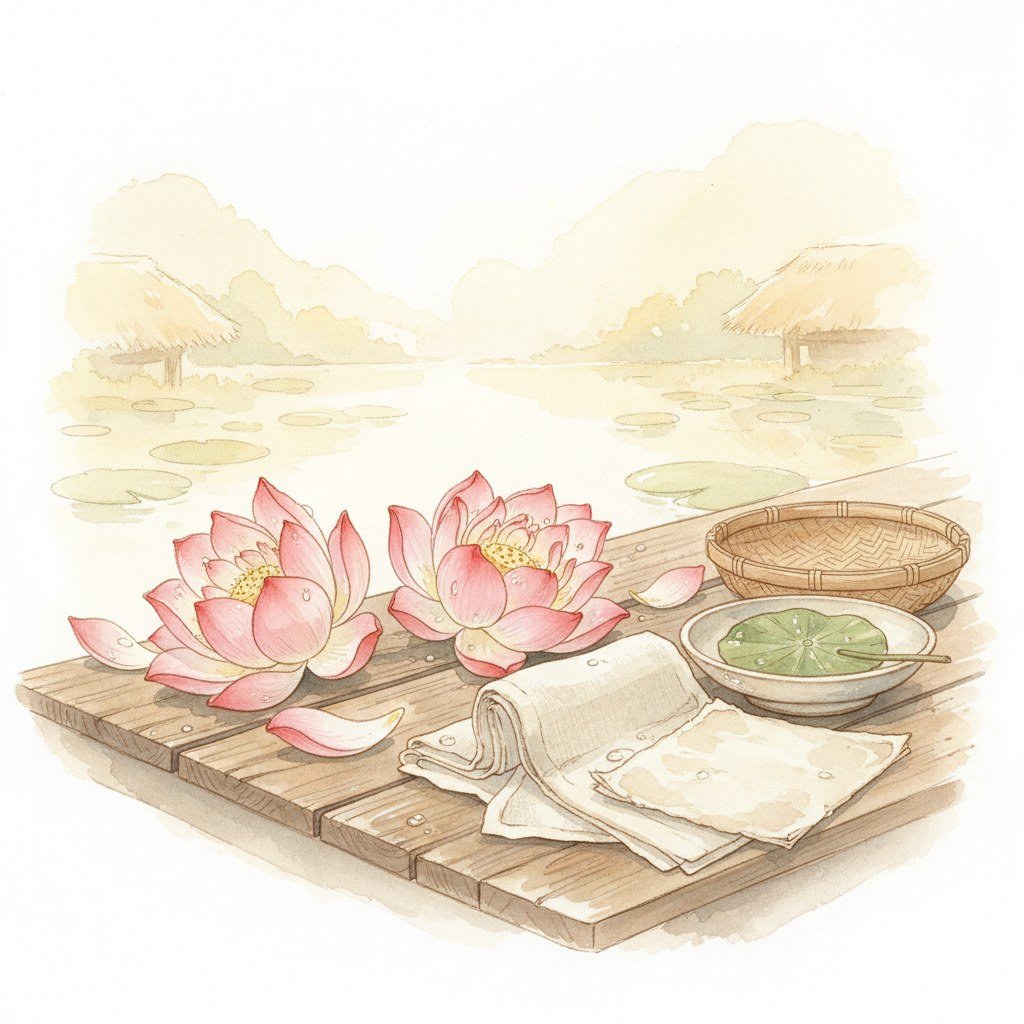
West Lake in summer is the lotus moment. Hanoi has a tea ceremony built around lotus: tea leaves are sealed inside the closed bud overnight, then dried. Lotus tea, held a few centimetres under the nose, is the closest thing Vietnam has to a daily perfume ritual. In a workshop palette, our lily-of-the-valley note reads green, watery, slightly powdery, with a clean sweetness like fresh laundry dried in cool air.
Hội An: Cham spice rolls, lantern paint, dried fish, Yên Bái cinnamon
Central Vietnam smells like a heat bowl in slow motion. Hội An’s lanes hold cinnamon, fish sauce, and old wood at body temperature. The Cham minority cuisine still survives in the spice rolls and rich curries served around the Old Town. The lanterns hung over the river on the 14th of every lunar month carry a particular sweetness in the night air: candle wax, river water, orange blossom, and ylang-ylang.
Yên Bái cinnamon, grown in the Northwest, is sharper and brighter than Indonesian cassia. It shows up in royal Hue cuisine, in dried bark for incense, and in our workshop palette as a Central-leaning warm note. A Hội An lane on a wet evening smells faintly of cinnamon, woodsmoke, and rain on tile — a specific Vietnamese accord that has no Thai equivalent.
Sandalwood from temples in Hue and Hội An quietly anchors the Central scent. It is creamy, milky, almost sweet in the dry-down. Softer than agarwood, milkier than cedar. A Central Vietnamese perfume is rarely a soliflore — it is almost always an accord, three or four ingredients agreeing on the same warm mood.
Saigon: bergamot at dawn, white musk after rain, lemongrass everywhere
Saigon, my city, smells like seventeen things at once. Bến Thành Market at seven in the morning carries pomelo skins in a basket, fresh basil being washed, fish sauce in clay vessels, mango, dragon fruit, a charcoal stove warming up under a phở pot. Walk three blocks and the air changes again — sweeter, fruitier, a soft drift of frangipani from a wall.
Saigon’s most distinctive smell, for me, is white musk after a rain shower. Tropical thunderstorms break the heat almost daily in the wet season, and the asphalt cools fast. The smell that rises is part petrichor, part frangipani off a wet wall, part green leaves from courtyard plants. Bottled, that accord becomes a clean, lifted skin musk over fig and bergamot.
Lemongrass is Saigon’s everyday herb. Vietnamese lemongrass (sả) goes into pho, into bánh mì marinades, into iced tea. The lemongrass here is brighter and more lifted than Thai lemongrass, partly because of climate, partly because of how Vietnamese cooks pair it with mint and Vietnamese coriander rather than with kaffir lime.
Workshop palette: 30+ Vietnamese-inflected notes, IFRA-compliant
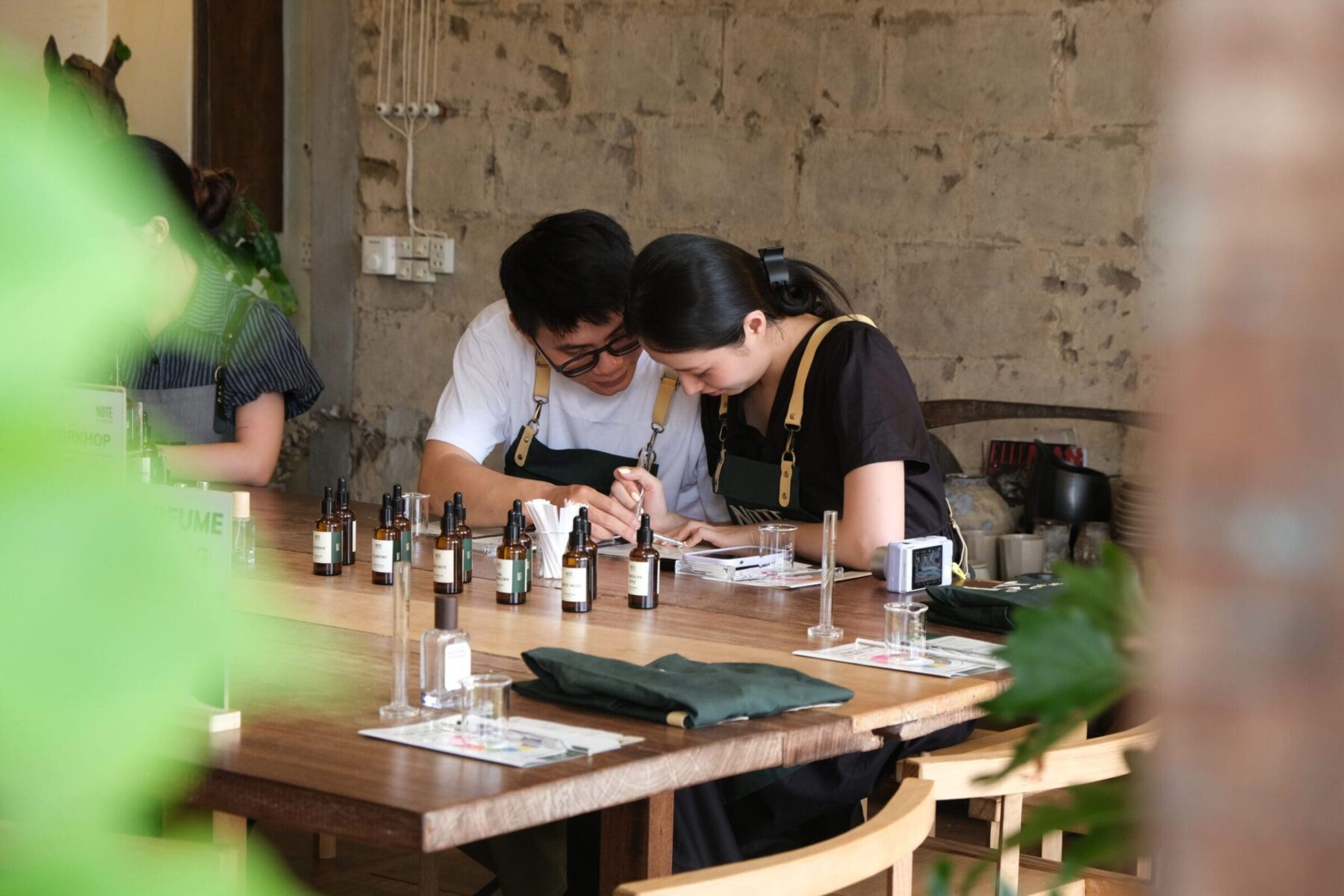
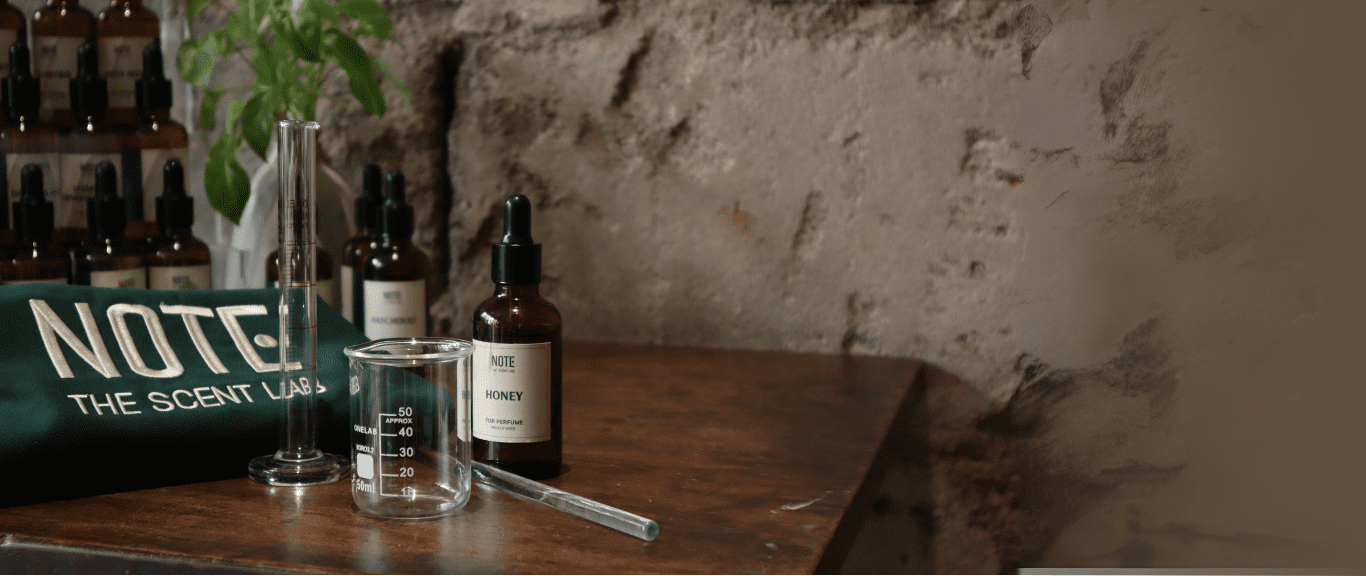
At our bench in Thảo Điền, a guest can sample 30+ fragrance notes. Some that lend a Vietnamese sensibility are jasmine, peppermint, cinnamon, sandalwood, bergamot, fig, white musk, osmanthus, neroli, damask rose, honeysuckle, tuberose, and patchouli. All IFRA-compliant. None of them are unique to Vietnam, but the way our instructors blend them follows a Vietnamese sensibility. Cooler, herbier, more layered, less candy-fruit.
The smell of the workshop itself is part of the answer. Pipettes warm with citrus oil. Sandalwood drifting from the back shelf. A faint jasmine note rising from the diffuser. Coffee from the lobby. The room sits a few floors above District 1’s traffic, on Floor 3 of the Cafe Apartment building (Vietnamese “Lầu 2” — 2 levels up from the ground floor). For a deeper walk-through of that building, see our Cafe Apartment guide.
“Beautiful space, amazing hospitality and great information from knowledgeable host.”
— Tina C, TripAdvisor ★5
Vietnam vs Thailand — the real differences, instructor verdict
Here is the honest verdict from someone who has taught here for two years and travelled there three times. Vietnam vs Thailand is not “better or worse.” It is two different scent identities, designed for two different kinds of traveller. Picking the wrong one for your personality is the actual mistake to avoid.
Thailand smells bolder, hotter, and more sweet-fruit-forward. The country is louder in every register. Public altars. Street food on every corner. Markets that overflow into the road. Scent that meets you halfway. The Thai olfactory signature is comfortable being smelled, the way Thai cuisine is comfortable being tasted in big primary colours.
Vietnam smells cooler, herbier, more layered, more Northern-Asian-influenced, and less sugar-fermented. The country is quieter on the surface and more complicated underneath. The scent identity rewards a slower traveller, the kind who likes a long lunch over four small dishes rather than one giant pad thai.
Vietnam vs Thailand by traveller persona
| Traveller type | Likely better fit | Why |
|---|---|---|
| Beach paradise / island hopper | Thailand | Phuket, Krabi, Koh Samui — coconut-and-frangipani postcard scent identity |
| Slow craft / instructor-led experiences | Vietnam | Tailoring in Hội An, perfume making in Saigon, lantern in Hội An, lacquer in Hanoi |
| Foodie chasing layered cuisine | Toss-up | Thailand wins on bold; Vietnam wins on herbal layering and regional variety |
| Party / nightlife traveller | Thailand | Bangkok and Phuket nightlife scaled for tourists; Vietnam quieter after midnight |
| Quiet morning, cool weather lover | Vietnam (North) | Hanoi cool dry mornings have no Thai equivalent |
| Couple wanting a creative date | Vietnam | Workshop tourism more developed in scent, lantern, and tailoring categories |
| First-time SEA traveller | Either | Both work — choose by the smell preference above, not by Wikipedia checklist |
Where Thailand still wins, fairly
Thailand owns frangipani as a national fragrance signature. It owns coconut-on-warm-sand. The Muay Thai gym smell is uniquely Thai. So is the kaffir lime kitchen. And the loud, public, daily incense at every wat is Thailand’s, period. If those are the smells you want from your trip, Thailand is the right answer to Vietnam vs Thailand. Pick Bangkok or Chiang Mai with my full blessing.
Where Vietnam quietly wins
Vietnam wins on regional variety, on cool-weather florals (Hanoi jasmine, lotus tea), on layered spice in cuisine, on slow craft tourism, and on the kind of morning that smells like petrichor and white musk after rain. It also wins, in my biased view, on take-home experience: a Vietnamese workshop tour leaves you with a bottle of smell, not just photos. For a deeper map of those regional smells, our scent of Vietnam regional guide walks through North, Center, and South in detail.
From smelling to taking home — workshop tourism Vietnam vs Thailand
The Vietnam vs Thailand question changes shape once “take home” enters the picture. A photo holds up for one screen-swipe. Souvenir t-shirts hold up for one wash. Scent on your skin holds up for years. The country that lets you build the best wearable memory wins, for travellers who care about that.
Thailand has Muay Thai class, Thai cooking class, Thai massage course. All excellent, all turn-key. The cooking class has been Bangkok’s most-booked workshop tourism category for over a decade. Phuket has the cooking-class-with-curry-paste-pounding format down to a science.
Vietnam’s workshop tourism has a different shape. Tailoring in Hội An is a multi-day, fitted, made-to-measure experience that produces a wearable garment. Lantern making in Hội An is a half-day craft session. Lacquer painting in Hanoi takes a few hours. Perfume making in Saigon and Hanoi at our bench takes 120 minutes and produces a bottle of custom EDP plus a formula card to recreate the scent later.
A traveller story: choosing Vietnam vs Thailand for the perfume
Last December, two guests at our 34 Nguyễn Duy Hiệu studio had just come from a week in Chiang Mai. I’ll call them Javier and Toni. They’d done a Thai cooking class, a Muay Thai trial session, and a temple food tour. They booked our workshop on the second day of their Saigon stop, ahead of the airport.
Javier said something I keep with me. “Thailand was the holiday. Vietnam is the souvenir.” He didn’t mean Thailand was lesser. He meant Thai memories had stayed in Thailand: the food on his plate, the gym he sweated in, the temples he photographed. The Vietnamese workshop sent him home with something he could spray on his wrist a year later. Vietnam’s slow-craft category is built to ship memory home in physical form.
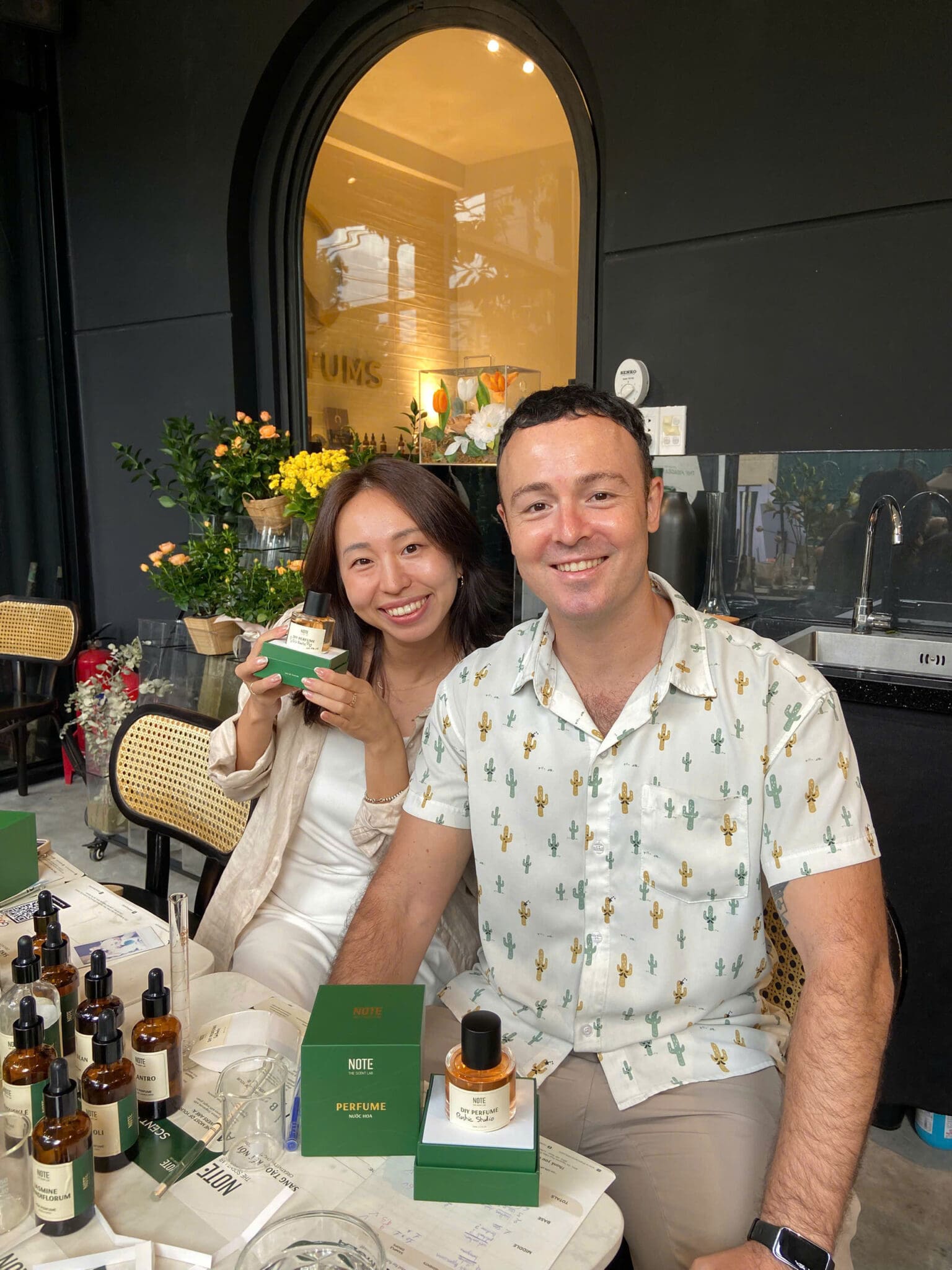
Javier built a 30ml bottle. Toni built a 20ml. They named the formulas, paid, and walked out with bottles, formula cards, and the airline-friendly sealed gift box. Workshop tiers start from $24 (10ml), with 20ml at $44, 30ml at $54, 50ml at $64. The smell on Javier’s wrist (bergamot, fig, sandalwood, white musk) is now the smell of his Vietnam.
“My daughter took a similar class in Singapore but this is at a different level. We learnt about sensory moods and smells. We will definitely come back!”
— Michael, TripAdvisor ★5
A traveller story: the international visitor who chose Vietnam first
Earlier this year, another guest came in alone. I’ll call her Lee. She had three weeks in Southeast Asia, and Vietnam vs Thailand had been the planning question for months. She picked Vietnam first, on a friend’s recommendation, planning to do Thailand on the second leg. By the third hour of our workshop, she had her answer about which country fit her. She wanted layered, not loud. Cool-floral, not sugar-fruit. Slow, not turn-key.
She built a formula she named Saigon Kisses: a clean lifted top with bergamot and lemon, a heart of jasmine and honeysuckle, a base of white musk and a thread of oakmoss. She emailed me a month later from Bangkok, where she had finally arrived. “I love it here,” she wrote, “but my bottle still smells like the right country.” Vietnam stays.
“Suzee explained scent theory in ways I wouldn’t have known. Super patient.”
— Cris P, TripAdvisor ★5
Souvenir economics — Vietnam vs Thailand
If you want a meaningful, wearable Vietnamese souvenir without doing the workshop, NOTE’s ready-made fragrance collection is at thescentnote.biz. Most of our travellers do the workshop and pick up a smaller bottle of an existing scent for a friend on the way out. The two work together — one is the made-by-you formula, the other is the brand’s own composition.
If you’ve come this far in the article, you have already done what most Vietnam vs Thailand searchers don’t. You’ve thought about a country through your nose. The booking link is right above. The studio is open daily.
Frequently asked questions
Is Vietnam better than Thailand for first-time Southeast Asia travellers?
Neither is universally better. The Vietnam vs Thailand answer for first-time Southeast Asia travellers depends on what you want to take home. Thailand offers a louder, more turn-key, postcard-tropical experience with strong beach and party scenes. Vietnam offers a quieter, more layered, three-region scent identity and a stronger slow-craft workshop economy. Beach-and-party travellers often prefer Thailand on a first trip; slow-craft and food-layering travellers often prefer Vietnam.
Which is cheaper for budget travellers, Vietnam or Thailand?
Both countries are budget-friendly compared with most global destinations. Vietnam tends to come out slightly cheaper for daily food, mid-range hotels, and intercity train travel; Thailand tends to come out slightly cheaper for domestic flights and beach island hops. Day-to-day spending in either country can be kept under $50 per person on a comfortable mid-range trip in 2026, though prices change. Always verify current rates before budgeting.
Which has better food scents, Vietnam or Thailand?
Both have outstanding kitchen aromas, with different signatures. Thai cuisine is bolder on the front of the nose: kaffir lime, galangal, palm sugar, fish sauce, fried shallots, palm sugar caramelising. Vietnamese cuisine is herbier and more layered: Yên Bái cinnamon, star anise, cardamom, fresh mint, perilla, Vietnamese coriander, lemongrass. Travellers who like loud sweet-savoury heat tend to prefer Thai; travellers who like green-herb layering tend to prefer Vietnamese.
Should I visit both Vietnam and Thailand on one trip?
Most travellers with three weeks or more do exactly that. Two weeks is workable for one of each, with one main city plus one side trip. Bangkok-Chiang Mai paired with Saigon-Hội An is a classic Vietnam vs Thailand combo route. Bangkok-Phuket paired with Hanoi-Hạ Long is another. Visa rules change, so verify current entry rules before booking flights.
What workshop should I do in Vietnam vs Thailand?
Thailand’s signature workshops are Thai cooking class (best in Chiang Mai or Bangkok), Muay Thai trial session, and Thai massage training. Vietnam’s signature workshops are tailoring (Hội An), perfume making (Saigon and Hanoi), lantern making (Hội An), and lacquer painting (Hanoi). The perfume workshop is the only Vietnamese signature category that produces a wearable scent souvenir, and Thailand has no equivalent at our scale.
Where can I capture the smell of both countries to take home?
For Vietnam, NOTE – The Scent Lab runs perfume workshops at two studios in Ho Chi Minh City: 42 Nguyễn Huệ (District 1 HCMC), 34 Nguyễn Duy Hiệu (Thảo Điền). Sessions are 120 minutes, instructor-led, with 30+ IFRA-compliant notes blended with a Vietnamese sensibility. Tiers start from $24 (10ml) up to $64 (50ml). For Thailand, no equivalent custom-perfume workshop has reached our scale, though Thai aromatherapy oil shops in Chiang Mai sell pre-blended bottles. Workshops are conducted in English. (Vietnamese also available for local guests.)
Is the Vietnam vs Thailand decision really about smell at all?
For most travellers, no — it is about cost, beaches, food, and itinerary. For travellers who care about wearable memory, the smell question is the most useful filter. A trip you can spray on your wrist a year later is a different kind of trip from one you only photograph. The Vietnam vs Thailand answer through the nose tilts toward Vietnam for slow-craft, layered-scent personalities, and toward Thailand for loud-tropical, turn-key personalities.
A last word from the bench
I’m not going to pretend the Vietnam vs Thailand question has a single right answer. It does not. Both countries do scent well. Thailand does it loud, sweet, public, postcard-bright. Vietnam does it cool, layered, herbal, slow, with three regional accords stitched along an S-shaped coast.
Smell shapes memory more than any other sense, and the country whose smell stays in your nose a year later is the country you actually visited. The other one was a holiday photograph. So pick the air you want to keep. The one that fits you on a Tuesday morning two years from now, not just on the trip.
The studio is open daily. Our Instagram @note.workshop shows what a session actually looks like. Some places don’t fit in a suitcase. They fit in a bottle.
This article is provided for general informational and reference purposes only. Information was accurate at the time of writing (May 2026) but may change without notice. Opening hours, prices, transit schedules, and availability for venues outside NOTE – The Scent Lab — including Thai cooking classes, Muay Thai gyms, temples, and other Thailand and Vietnam attractions referenced — can change without notice. Please verify with official websites, TripAdvisor, or Google Maps before your visit. We do not guarantee accuracy and are not responsible for outcomes based on outdated information.
For more on individual Vietnamese destinations, see our Jade Emperor Pagoda guide.
Find NOTE – The Scent Lab
- 42 Nguyễn Huệ (Floor 3, Cafe Apartment, District 1, HCMC) — Get directions → · TripAdvisor
- 34 Nguyễn Duy Hiệu (Thảo Điền, HCMC) — Get directions → · TripAdvisor
How to find us:
- 📍 42 Nguyễn Huệ — Watch direction video on TikTok →
- 📍 34 Nguyễn Duy Hiệu — Watch direction video on YouTube →
- 📍 — Watch direction video on YouTube →
Book your workshop → · Instagram @note.workshop
Ещё в этой серии
- Pad Thai Class vs Perfume Class — Which Asia Workshop Do Tourists Remember Longer?
- The Scent of Vietnam: A Workshop Instructor’s Regional Guide
- Jade Emperor Pagoda Saigon — What a Perfume Instructor Smells When Tourists Just See a Temple
- 7 уникальных впечатлений во Вьетнаме, которых нет больше нигде (2026)
- 15 необычных развлечений в Хошимине вдали от туристических маршрутов
Related Reading