NOTE – The Scent Lab is a perfume workshop in Saigon, Vietnam, where a traveler can build a scent and, in the same afternoon, invent a name for it that did not exist in any language before. This is the kind of foreigner custom perfume Saigon moment that almost never makes it into a guidebook — because it happens quietly, at a workbench, in the 180 seconds between “I like it” and “I want to call it something.” On 3 June 2025, a guest named Toni sat down at our Saigon workshop and left with a 10ml bottle called Việt Gnome — a name his girlfriend coined from a mispronunciation, a garden figurine, and an old Vietnamese script most locals no longer read.
Names in this story have been changed to protect our guests privacy. Details of the workshop experience — the perfumes made, the studio, the conversations — are authentic.
This is how a scent acquires a name you will not find anywhere else in the world.
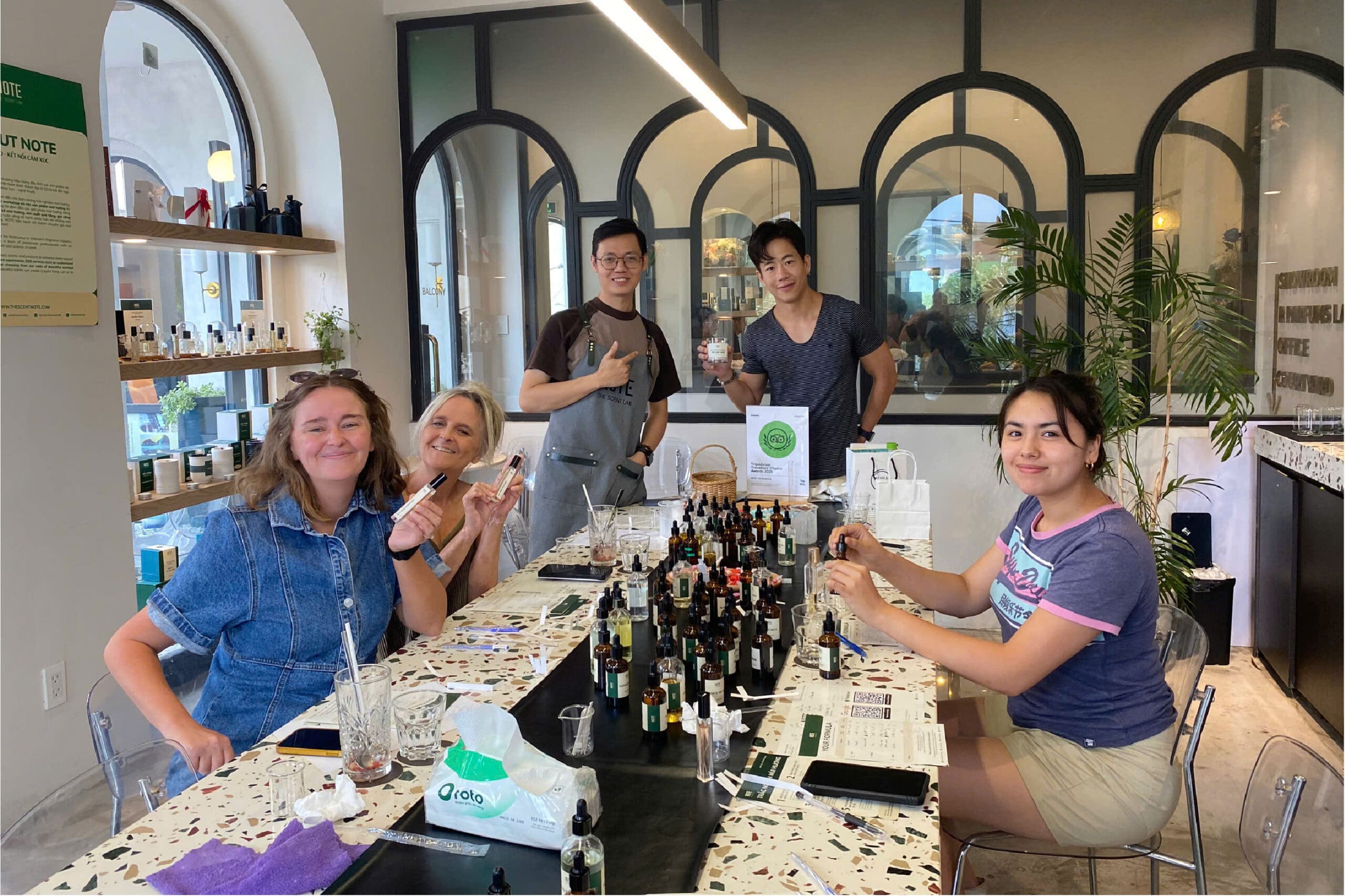
A perfume workshop Saigon morning that began with wood, leather, and one white flower
Toni arrived with a clear instinct, which is rare. Most of our foreign guests walk in a little uncertain about what they want, and the first twenty minutes of the workshop are spent helping them find vocabulary. Toni came in already knowing. He wanted something woody. He wanted a thread of leather running underneath it. And he wanted a single white flower somewhere in the middle — soft enough that the bottle would still be wearable on an ordinary Tuesday in Saigon, with the scooters and the humidity and the 2 PM sun.
That kind of brief, on paper, sounds straightforward. In practice it is one of the harder composition problems in amateur perfumery. Wood and leather are both deep, grounding base-note territories. Put them together without care and the bottle can turn heavy very quickly — the kind of scent that feels like a leather armchair in a closed room. To keep it from sinking, you need a white flower that has some air in it. Not tuberose, which is creamy and carnal. Not jasmine, which can go sweet. Something smaller, cleaner, with a trace of green.
On the workbench in front of him, Toni lined up a honeysuckle, a fig tree, an apricot, a pink peppercorn, a cedarwood, a tonka bean, a leather, a white musk. He sniffed them in sequence, then in pairs, then in threes. The cedarwood grounded everything. The tonka gave the base a gentle sweetness that stopped the leather from reading too smoky. The honeysuckle and the fig tree, stacked carefully, built the green-floral center he had described out loud. The whole thing hung together almost on the first pass.
The single drop of bergamot that changed everything
Here is where it got interesting. Toni smelled his first composition — the one without bergamot — and said, genuinely, that he liked it. He was ready to bottle it. It was a complete, pleasant, wearable scent. Woody, a thread of leather, one soft white flower. Exactly what he had asked for.
Our instructor paused and suggested, almost casually, one drop of bergamot at the top. Just one. Not two. A single drop to see what it would do. Toni shrugged, agreed, and we added it. He smelled the new version against the old.
And then — this is his word, not ours — boom.
One drop of bergamot had lifted the whole bottle. The woods were still there. The leather was still there. The white flower was still there. But now, above all of them, there was a small bright Mediterranean citrus that opened the first ten seconds of the scent before stepping politely out of the way. The bottle had gone from “complete” to “finished.” Toni said yes instantly. He did not need to test a second variation. He wrote the formula down and sealed it.
We tell this story to guests often, because it is a very good small lesson in how perfume actually works. The difference between a good bottle and a bottle you will still be wearing six months later is rarely a dramatic change. It is, almost always, one drop of something you did not think you needed.
Naming a foreigner custom perfume Saigon bottle — the linguistic part
With the formula locked, Toni turned to the harder question: what to call it.
He was very clear about one thing. He wanted the name to be Vietnamese. He had spent real time in Saigon. He had made the bottle here. He wanted the bottle to carry the country in its name, not just the city. And here is where the afternoon took a turn most of our guests do not take.
Toni asked our instructor the Vietnamese word for “perfume.” The answer — nước hoa, literally “flower water” — surprised him with its plainness, and he laughed, and for about thirty seconds he considered just naming his bottle nước hoa, because that was the most straightforwardly Vietnamese thing he could think of. Trời ơi, as we say in Saigon. He did not end up going with that. His girlfriend, arriving to smell the finished scent, redirected him into something no guidebook has a section for.
She took the strip, inhaled once, and said the scent made her think of a gnome.
Not the mythological earth-spirit kind, at first, though that association would come. She was thinking of the small pointed-cap garden figurines that stand in the flowerbeds of European and American houses — the plump, bearded, slightly mischievous statues a child might talk to. She said Toni’s bottle smelled exactly like the patch of garden a gnome would live in. Wood, soil, a little leather, a little white flower drifting in from somewhere nearby. A whole miniature landscape inside a 10ml bottle.
Then she said the second thing, which is the one we still remember. She listened to Toni say the word Việt Nam out loud — in his own accent, slightly rolled, the final syllable softened — and she heard it as Việt Nôm. And Nôm, pronounced like gnome, is the name of the old writing system of Vietnamese, the script that existed before Romanization. A Vietnamese speaker hears these two words as completely different. A foreign ear, on a Tuesday afternoon, can hear them as a rhyme.
The name wrote itself. Việt Gnome. Vietnamese, because Toni had made the bottle here. Gnome, because the scent smelled like a garden. And a buried linguistic coincidence — nôm and gnome, an ancient script and a pointed-cap figurine — that only a couple standing at a workbench in Saigon on a quiet June morning could have put together.
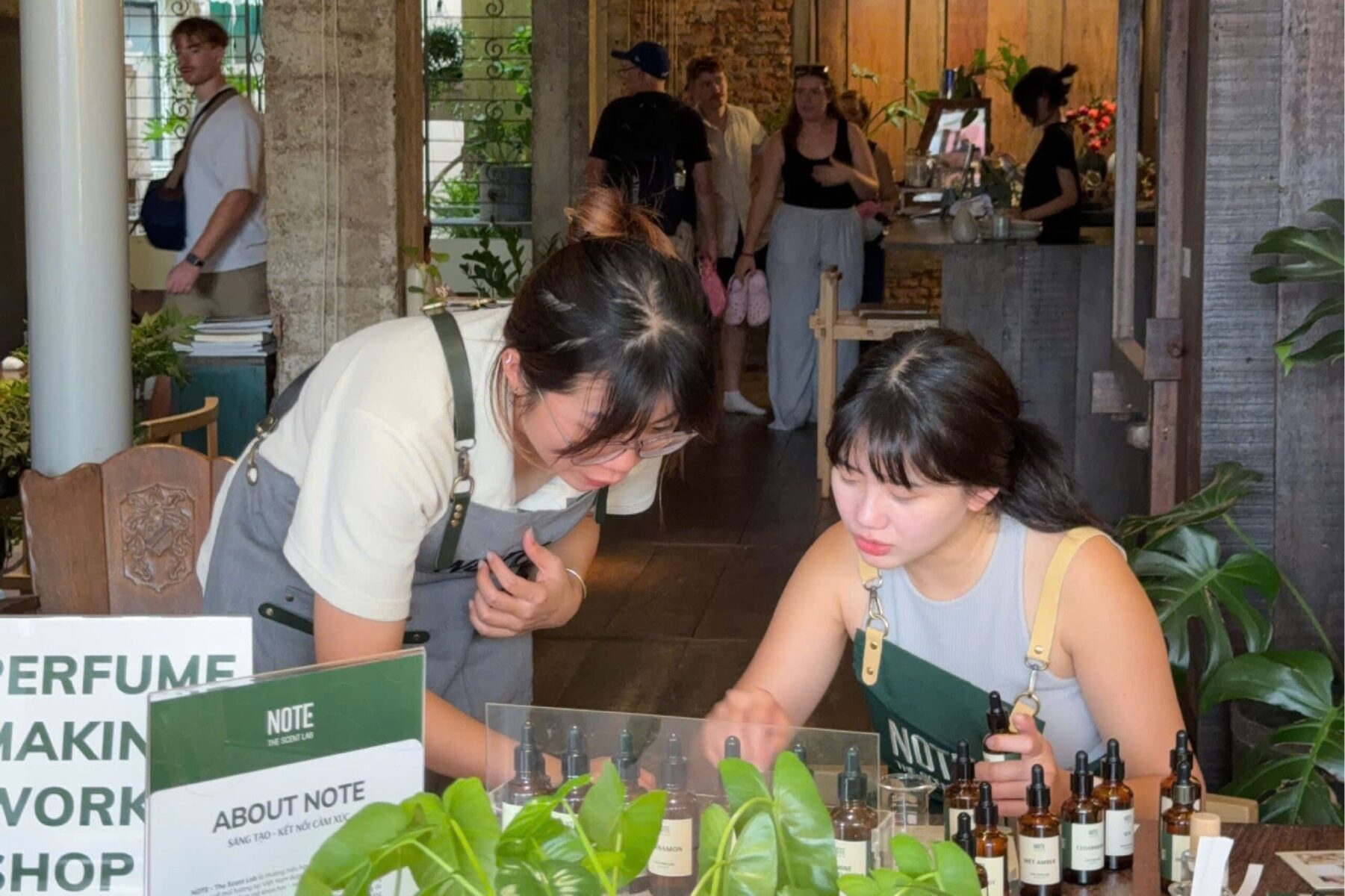
Why couples end up naming scents together, even when only one of them is making the bottle
We see this pattern at our Saigon workbench more often than you would think. One partner books the workshop. The other partner comes along to watch, sometimes to smell a few strips, sometimes just to read a book at the back of the room. By the last fifteen minutes of the session, the non-making partner is always — and we mean always — involved in the naming. They smell the final bottle from across the table. They say what it reminds them of. They propose the name the maker would never have thought of alone.
There is a quiet reason this happens. A custom perfume is ultimately a self-portrait. But you cannot smell yourself very well. The people around you smell you more accurately than you smell you. So when the maker asks their partner “what does this smell like?”, what they are actually asking is “what do I smell like to you?” — and the answer, filtered through affection and six years of a shared life, comes out strange and exact. A gnome in a garden. A kitchen at dusk. A specific brand of soap from a specific city. Names arrive this way. They do not arrive alone.
Max Nguyen, a past guest at our Saigon workshop, captured the couple dynamic in a TripAdvisor review with unusual precision: “Our scent artist instructor Nhi was amazing. I made my gf’s and she made mine.” That trade — I build yours, you build mine, each of us writing the other person’s self-portrait in oil drops — is one of the most common ways a long-term couple ends up in our studio. Sometimes it is both bottles at once. Sometimes, as with Toni, it is one bottle and one person naming it.
Celine, visiting Saigon with her partner on a rainy afternoon, wrote the other half of this sentiment on the same platform: “Making perfume in a space with fresh flowers on a rainy afternoon is romantic.” The room matters. Toni’s session was a clear Tuesday in June, not a rainy one, but the principle is the same — a small space, two people, a table full of raw materials, and a couple of hours in which no one is checking their phone. The afternoon does the work.
A short detour through chữ Nôm — the script that gave Việt Gnome half its name
It is worth stopping here for a minute, because most foreign guests at our Saigon perfume workshop have never heard of chữ Nôm, and Toni’s bottle carries the word in its name whether he fully realized it or not.
Before the 20th century, Vietnamese was written in two scripts. The formal, administrative language used Chinese characters — chữ Hán. But the everyday spoken language, the language of poetry and folk song and the things people said to each other in the courtyard, was written in chữ Nôm, a locally-invented script that adapted Chinese characters to represent Vietnamese sounds. It was the writing system of the Truyện Kiều, the great 19th-century verse novel that is still the most-quoted text in Vietnamese literary culture. Then Romanization arrived with French colonization, and within a generation, chữ Nôm largely fell out of daily use.
Today, almost no Vietnamese person under 80 can read chữ Nôm fluently. It survives in temples, in scholarly journals, in the calligraphy hanging in certain houses in the Old Quarter of Hanoi and on a few quiet altars in District 5 in Saigon. It is one of those scripts that exists the way Latin exists — a ghost language most of the country acknowledges, respects, and does not actually read.
And its name — Nôm — happens to rhyme, in the ear of a foreigner pronouncing Việt Nam with an outsider’s accent, with the English word gnome. Toni’s girlfriend heard this. She almost certainly did not know what chữ Nôm was. But she heard the sound, heard the garden gnome, heard the woody-leathery scent, and put them together into a name that is, by accident, a small quiet tribute to a script most of Vietnam itself has forgotten how to read.
This is what we mean when we say that a perfume workshop Saigon afternoon is not only a scent exercise. It is, sometimes, a linguistic one too.
Book Your Saigon Perfume Workshop →
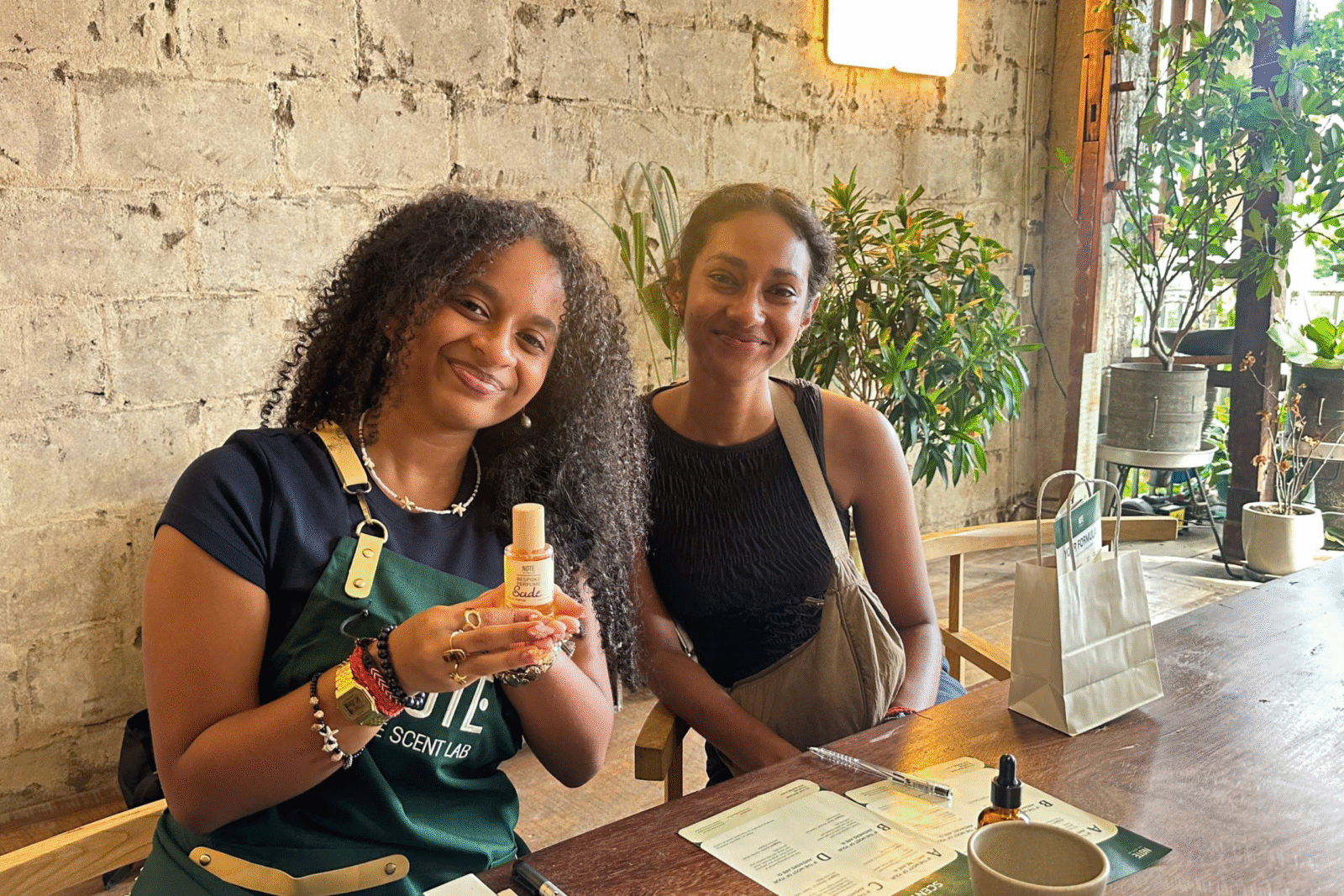
The formula behind Việt Gnome — a wearable woody-floral for Saigon weather
For the curious, here is roughly what Toni’s bottle contains, in the proportions that made it out of our studio. Honeysuckle and fig tree in the heart, giving a soft green-sweet floral core. A pink peppercorn and an apricot at the top, for a small bright opening even before the bergamot drop. Cedarwood, leather, tonka bean, and white musk layered into the base — the grounded, skin-warm part that would still be there six hours later, slowly softening against his arm. And then the single drop of bergamot at the top, which is the part he talks about when he tells other people the story.
As a composition, it sits almost exactly in the middle of what we consider the ideal “wearable in Saigon” zone. The climate here rewards perfumes that can survive heat without turning cloying. A heavy gourmand bottle does not do well at 34°C. A sharp aquatic bottle disappears in twenty minutes. What works — and what Toni arrived at more or less by instinct — is a woody-floral with enough brightness at the top to read fresh in the first hour, and enough grounded base to still be noticeable when you step back into air conditioning from a sweaty walk down Lê Lợi.
It is also, as his girlfriend noticed, a bottle that smells like a small inhabited landscape. Wood and leather suggest somewhere built. Honeysuckle and fig tree suggest somewhere green. A trace of apricot and peppercorn suggests somewhere a little mischievous. A gnome’s garden, more or less. A quiet corner of somewhere you would not mind living in.
A word on our Saigon studios, for foreigners planning the afternoon
Toni’s June 2025 session was at our Saigon workshop, one of two studios we run in the city. The first, at 42 Nguyễn Huệ in District 1, sits on the 2nd floor of the Cafe Apartment — a tall weathered building of independent cafes and small shops that has become one of the most-walked-into addresses in central Saigon. The second, at 34 Nguyễn Duy Hiệu in Thảo Điền, District 2, is a quieter enclosed room with the feel of a small neighborhood workshop, about fifteen to twenty minutes from downtown by taxi.
Foreigners spending a few days in the city usually pick between the two based on mood. If the afternoon already includes the Nguyễn Huệ walking street, the Saigon Opera House, a lunch at one of the District 1 rooftop cafes, the Cafe Apartment workshop fits naturally into that rhythm. If the afternoon is deliberately slow — a Thảo Điền breakfast, a walk along the Saigon River, a half-day spent away from the busy core — the 34 Nguyễn Duy Hiệu studio is the gentler choice. Both studios run the same 90-minute session with the same 30-plus raw materials and the same Vietnamese specialty ingredients, including lotus, cinnamon from Yên Bái, and locally-sourced oud.
Misha C, who sat through one of our Saigon afternoons with a different instructor, wrote afterwards on TripAdvisor: “Great experience! Our tutor Long is the greatest story teller”. We believe her. Storytelling is embedded in how our instructors teach — partly because perfume is, at its most basic, a way of telling a small story to the air around you, and partly because the people we hire at NOTE like to talk. Toni’s instructor the morning he made Việt Gnome was similarly conversational. It is how the bergamot suggestion happened at all — an instructor noticed something was one drop short of finished, and said so.
Phuong Thao N, reviewing a separate solo session at NOTE, left a short sentence that describes exactly what we try to do for guests who arrive with no strong plan: “I felt great. Because I went alone, Zang helped me choose the right item”. Foreign guests arriving from long flights often land in that same slightly-overwhelmed state — unsure what they want, unsure where to start, a little jet-lagged, a little unwilling to commit. The whole first half of the workshop is designed to fix that without the guest noticing. By the time the formula sheet appears, the choices have already been made in small steps, by nose, without pressure.
For longtime visitors who have been through the workshop once before, Jill left a review we quote often internally: “Did this workshop before in 2022, came back 3 years later and improved”. The studio has changed. The ingredient range has doubled. The teaching has sharpened. Toni’s June 2025 session benefited from three years of accumulated small improvements that Jill was one of the first to notice on her second visit.
What a 10ml Việt Gnome looks like, six months later
Toni chose the 10ml size on purpose. It is the size that, in our experience, foreign guests who have made their first custom perfume almost always regret slightly — not because it is too small, but because they use it up faster than they expected and then realize, on a cold morning in their home country in March, that the bottle is nearly empty and the story of that Saigon Tuesday is about to become something they can only describe.
This is, in fact, why some of our guests return — months or years later — to make a second bottle of the exact same formula. We keep formula cards on file. If you walked into our Saigon studio two years from today with a note that said “I am Toni, I made Việt Gnome on 3 June 2025, can I re-order?” — we could do it. Not many guests do this, but a few each year do, and it is always a quiet conversation when they do.
More often, a returning guest comes back with someone new. A new partner. A visiting sibling. A best friend on their first trip to Vietnam. The returning guest sits near the workbench of the new guest and watches the whole thing happen again from the outside. The second bottle is always different from the first. Sometimes the returning guest makes a matching companion bottle. Sometimes they do not. The studio is open to both possibilities.
If Toni returns to Saigon — with his girlfriend, with friends, with a cousin on a layover — Việt Gnome is in our records, the formula is intact, and a second 10ml bottle is 90 minutes away. If he does not return, the bottle he already has will continue to age in its current form. The cedarwood and leather will keep settling into each other. The bergamot will fade, the way bergamot always fades. The honeysuckle and fig will quiet down. And what will be left, at month twelve or month eighteen, is a slightly darker, slightly softer, slightly more private version of the bottle a Tuesday morning in Saigon gave him. A gnome’s garden, a little more shadowed, a little more his.
Frequently asked questions about foreigner custom perfume Saigon workshops at NOTE
How long is a perfume workshop in Saigon, and what does a custom bottle cost?
A full workshop session at NOTE runs about 90 minutes, though solo guests and couples often stay a little longer — no one is rushed. You’ll choose from 30+ raw materials including Vietnamese specialty notes, blend your own formula with an instructor, test on skin, adjust, and leave with a finished bottle. Prices start at 550,000 VND (around $24 USD) for a 10ml bottle — the size Toni chose for Việt Gnome — and go up to 1,550,000 VND ($64 USD) for a 50ml bottle. The 30ml Best Deal at 1,350,000 VND ($54 USD) is our most-booked size. All prices are before 8% VAT.
Can foreigners really name their custom perfume anything — even invented words like “Việt Gnome”?
Yes, and we strongly encourage it. The name is printed on the formula card you take home, not on a commercial label, so there are no restrictions. Some of our favorite foreigner custom perfume Saigon bottles over the years have had names that are untranslatable, bilingual, half-invented, or carry a private joke between the maker and their companion. Toni and his girlfriend’s “Việt Gnome” — a mispronunciation plus a garden figurine plus an old Vietnamese script — is one of several linguistic inventions we have on record. Bring the strangest name you can think of. It will probably not be the strangest we have seen.
Where are NOTE’s Saigon studios, and how do I choose between them?
We run two studios in Saigon. The first is on the 2nd floor of 42 Nguyễn Huệ in District 1, inside the Cafe Apartment — closer to the walking street and most central hotels. The second is at 34 Nguyễn Duy Hiệu in Thảo Điền, District 2, about a 15–20 minute taxi from downtown, in a quieter enclosed room with the feel of a neighborhood workshop. A third NOTE workshop operates inside Lotte Mall Tây Hồ in Hanoi. Foreign guests tend to pick the District 1 studio if they are already exploring central Saigon on foot, and the Thảo Điền studio if they want a slower, more residential afternoon.
Do foreigners need any perfume experience to make a wearable custom bottle?
No. The majority of our foreign guests arrive with no perfumery background at all. Toni came in knowing what he wanted — woody, a thread of leather, one white flower — but that kind of verbal clarity is rare and is not required. Our instructors walk you through top notes, heart notes and base notes before you touch a single ingredient, and a short blind mini-game trains your nose on common materials like cedarwood, bergamot and fig tree. Most guests discover, within the first twenty minutes, that they are much more opinionated about scent than they had assumed.
Is the workshop good for couples where only one partner wants to make a bottle?
Yes — some of our best afternoons follow exactly this pattern. One partner books the workshop. The other partner sits nearby, smells a few test strips, and almost always becomes involved in the naming of the final bottle, the way Toni’s girlfriend did on 3 June 2025. You can also book two stations side by side and make two bottles together, which is how many couples end up — as one past guest, Max Nguyen, put it on TripAdvisor: “I made my gf’s and she made mine”. Book a single station or a pair and decide on the day.
Can I order the exact same formula again later if I run out of my 10ml bottle?
Yes. NOTE keeps your formula card on file. If you come back to our Saigon studio — or to our Hanoi studio — months or years later, you can re-order the same blend in the same or a different bottle size. A few guests do this each year. Many more return to make a second, different bottle with a partner, sibling or friend on a later trip. The first bottle is yours. The second is usually for someone you love enough to bring to a perfume workshop in Saigon.
Find NOTE – The Scent Lab in Saigon
- 42 Nguyễn Huệ (2nd floor, Cafe Apartment, District 1) — Get directions on Google Maps → · TripAdvisor reviews
- 34 Nguyễn Duy Hiệu (Thảo Điền, District 2) — Get directions on Google Maps → · TripAdvisor reviews
How to find us:
- 📍 42 Nguyễn Huệ — Watch direction video on TikTok →
- 📍 34 Nguyễn Duy Hiệu — Watch direction video on YouTube →
If you would rather take home a ready-made scent — a finished bottle built by our perfumers rather than by your own hand — NOTE’s handcrafted fragrance collection lives at thescentnote.biz. Same raw materials, same craftsmanship, already bottled and waiting. Our sister workshop at r-workshop.space, built around R Parfums, runs out of the same Thảo Điền address for guests who want a slightly more artisanal, story-first afternoon.
Related Reading